Transfers 3.0
Transfers 3.0 comprises four types of operations:
Push transfers: these are transfers of funds that debit the applicant’s account and credit the recipient’s account instantly. They have been in force since April 2011.
Pull transfers: these are requests for funds that allow immediate crediting to the applicant’s account by debiting the account of the recipient of the request (either a demand or payment account), with prior authorization.
Currently, these transfers can only be made when the same customer is the one who sends and receives the request for funds.
Transfer payments: this is the use of immediate transfers to pay in stores through QR codes.
Withdrawals with transfer (not yet implemented): possibility of making cash withdrawals in stores, which in exchange for delivering cash receive instant credit of funds.
Transfer payments
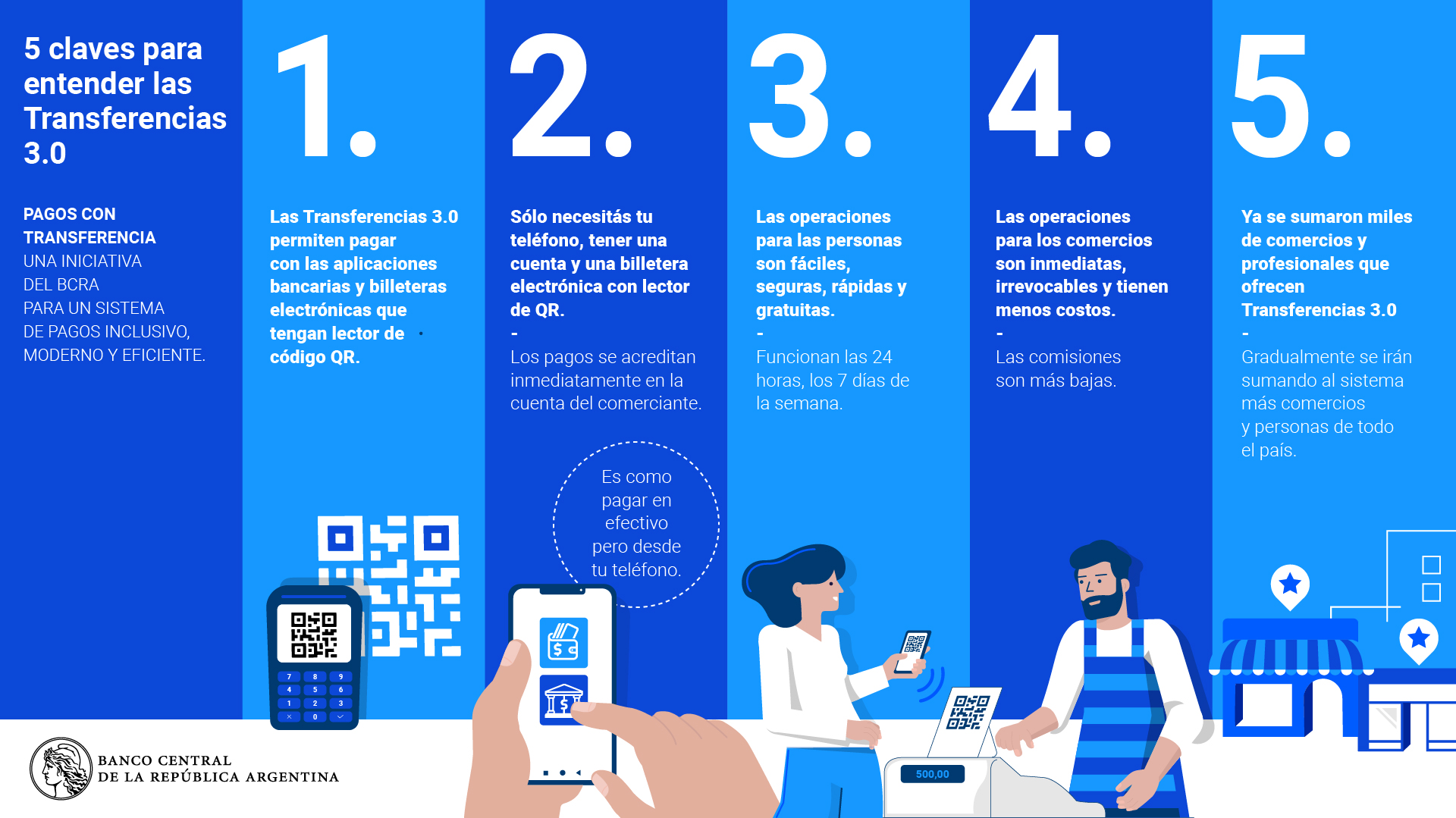
They consist of immediate transfers used to make a payment for the acquisition of a good or service with the participation of an acceptor. The acceptor offers merchants the tools to charge with this means of payment. Transfer payments have different business rules than other instant transfers. This means of payment was presented by the BCRA in 2020 with the aim of promoting open and universal digital payments and achieving greater inclusion of those sectors that do not yet use financial services. Since the full implementation of the measure, people can read any QR code and quickly and easily make transfer payments with just a phone and with any wallet offered by a financial institution or payment service provider that offers that service. Transfer payments are more accessible, efficient, and secure, thus avoiding the use of cash. It is enough to have a single application or electronic wallet installed on the cell phone: transfer payments can be made both from bank accounts with CBU and from accounts of payment service providers that have a CVU associated with them.
You also don’t need to have a debit card. The new open and universal ecosystem stimulates greater competition between the different actors in the system, which results in better conditions for users and businesses.
Characteristics of Transfer Payments
Interoperable: no matter the brand of the QR code, you can pay with any wallet.
Immediate: Merchants receive the credit automatically, either in bank or payment accounts. Full immediacy of payments is guaranteed 24 hours a day, 7 days a week. The payments are irrevocable, that is, once the merchant receives the funds there is no possibility of any type of reversal of the operation.
Economic: the person who buys never pays a commission. As for businesses, they have lower costs, since these payments have a price range between 6 and 8 per thousand (plus VAT), to which is added lower financial costs due to immediacy. In addition, they reduce the use of cash in the premises, resulting in lower expenses and greater security. Finally, it allows them to expand the range of payment options.
Competitive: opens competition for the provision of the service to retail and neighborhood businesses.
Flexible: You don’t need to have an associated debit card to make transfer payments. Financial institutions can open savings accounts virtually without having an associated debit card, although they must issue it if the user requires it.
Technical Documents
Immediate pull transfers
i) Transfers 3.0 Consent: User Experience Guide.
ii) Transfers 3.0: Accession process for new participants.
iii) Transfers 3.0 Consent.
Payment by Transfer (PCT)
i) Transfers 3.0 Interoperability document Administrators.
ii) Transfers 3.0 Operational Regulations: Integration of participants.