Executive summary
• The solvency ratios of the aggregate financial system remained at high levels, showing slight increases over the end of the first half of 2019. In June, capital integration in the financial system accounted for 16.1% of risk-weighted assets (RWA), increasing 0.2 p.p. compared to May and 1.2 p.p. year-on-year (y.o.y.). This capital integration was 185% of the minimum regulatory requirement (+2.7 p.p. compared to last month and +12 p.p. y.o.y.).
• In June, private sector deposits in pesos increased 1.3% in real terms (+4.1% nominal). Deposits in foreign currency in this sector grew 1.1% in the month in foreign currency. The share of private sector deposits in total aggregate funding – liabilities plus net worth – stood at 61.6% in June (+1 p.p. compared to May and +6.4 p.p. y.o.y.).
• The liquidity levels of the financial system continued to exceed the records of recent years. The broad liquidity indicator represented 60.5% of total deposits (61.1% for the segment in pesos), 0.8 p.p. more than in May (+1.4 p.p. in pesos). In a year-on-year comparison, ample liquidity grew 15.1 p.p. of deposits (+19.3 p.p. considering the ratio in pesos).
• In June, the balance of financing in pesos to the private sector fell by 1.6% in real terms compared to May (+1.1% in nominal) and by 31.7% in real y.o.y. On the other hand, credit in foreign currency to this sector increased 0.2% in the month in foreign currency (-3.1% y.o.y.). The gross exposure of the financial system to the private sector remained at historically low levels: bank financing to the private sector represented 39.2% of total bank assets, 8.5 p.p. less than the level of a year ago.
• Given banks’ low exposure to credit risk, the irregularity of financing to the private sector remained unchanged compared to May, standing at 4.5% of the total portfolio (+2.4 p.p. y.o.y.). The NPL ratio for loans to companies stood at 4.3% (+3.1 p.p. YoY), and that of loans to households remained at 4.9% (+1.6 p.p. YoY). Non-performing loans on mortgage loans to households continued at low values (0.4% of the portfolio in UVA and 0.7% for the rest). In June, the forecast for the loan portfolio remained relatively high: it reached 98% of the irregular portfolio to the private sector and 75% considering only the forecasts attributable to loans in an irregular situation. Taking into account this last level of forecasting and solvency indicators, it is estimated that the non-performing portfolio not covered by forecasts is equivalent to only 4.7% of the balance of regulatory capital integration (10% of excess regulatory capital), levels that are moderate even without considering the guarantees and, in general, the recovery rates on this portfolio.
• In June, nominal gains in the financial system were equivalent to 4.4% annualized (a) of assets (ROA) and 39.5% of net worth (ROE). In the cumulative 12 months to June, banks recorded a nominal ROA of 4.4% and a nominal ROE of 40.8%.
• With regard to the operations of the Payment System, the average daily amount of immediate transfers of funds increased in June: 1% in real terms compared to May and 2.9% in real y.o.y. For its part, the ratio between checks rejected due to lack of funds and the total compensated fell in June (0.06 p.p. for the amounts) to reach 0.87%. This ratio was at levels similar to those of the beginning of last year, below the peaks recorded between May and December 2018.
I. Financial intermediation activity
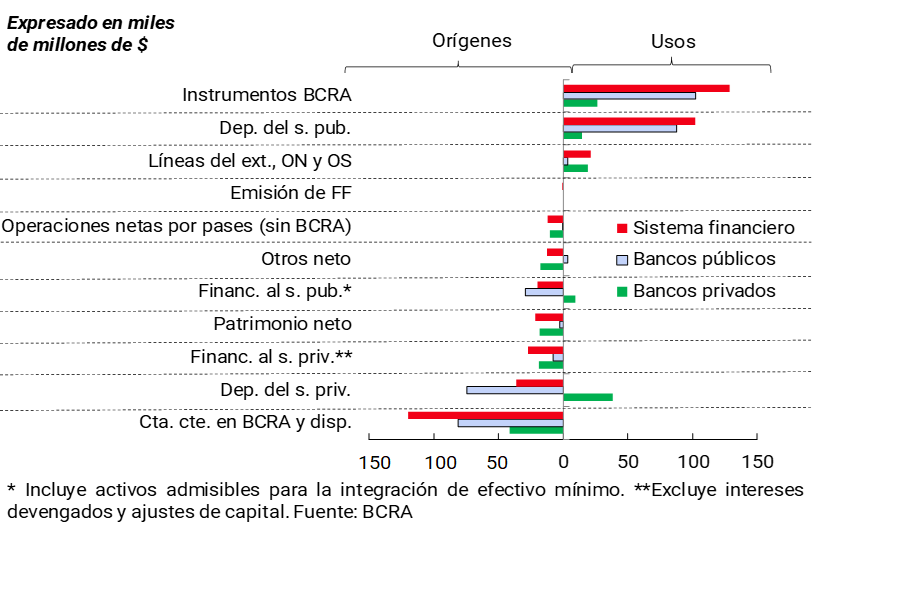
Based on the estimated flow of funds for the financial system,1 in June the reduction in the balance in current accounts at the BCRA (both in domestic and foreign currency) and the increase in private sector deposits were the most important sources of resources (see Chart 1). These funds were mainly used to increase the holdings of BCRA instruments and to provide for the reduction of the balance of public sector deposits (both in pesos and in foreign currency).
Graph 1 | Jun-19 Cash Flow Estimate
In this context, the assets of the financial system decreased 3.3% in real terms in the month, with a similar performance by group of banks. In year-on-year terms, total assets fell 10.3% in real terms.
In June, the financial system’s assets and liabilities denominated in foreign currency decreased in relative importance, an effect mainly verified by the decrease in public sector deposits with counterpart in current accounts at the BCRA. Thus, assets in foreign currency stood at 29.3% of total assets (-2.1 p.p. compared to May) and liabilities in foreign currency reached 28.5% of total funding (-2.3 p.p. in the month). The spread between total assets and liabilities in foreign currency – also considering forward operations in foreign currency – represented 4.4% of regulatory capital, 1.7 p.p. and 6.9 p.p. below last month and June 2018, respectively.
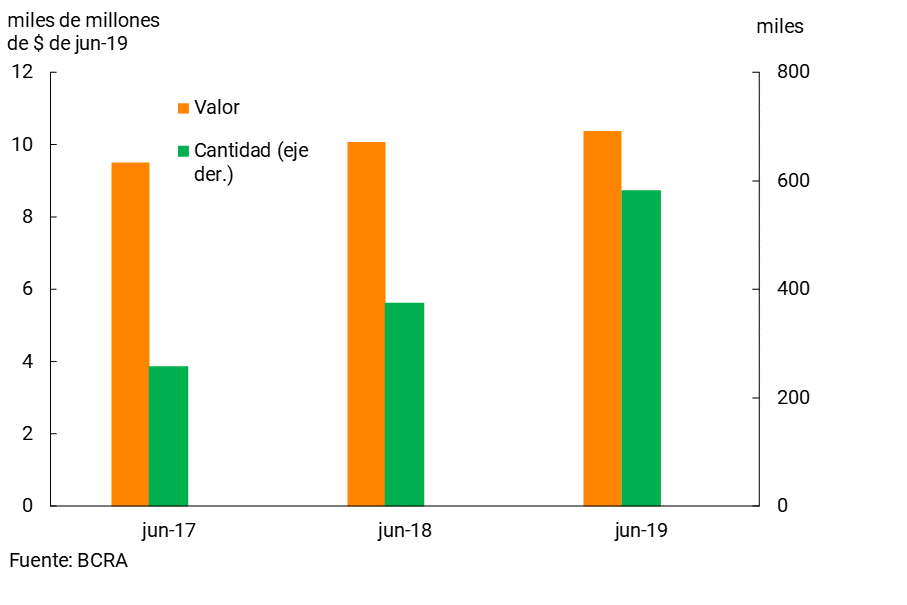
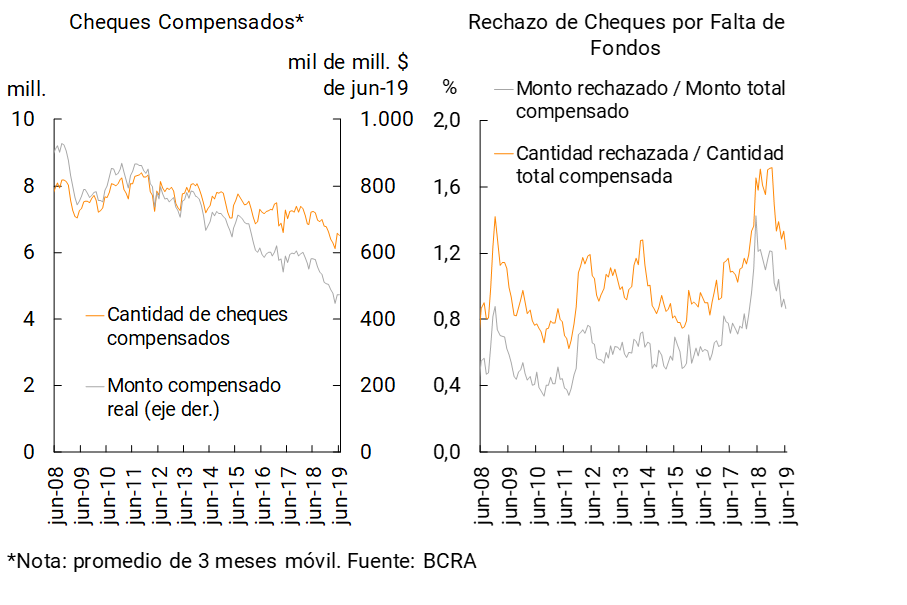
In relation to the operations of the Payment System, the daily average of immediate transfers of funds increased in June compared to May (1% real for securities and 7.1% for the number of operations) and compared to June 2018 (2.9% real for securities and 55.2% for the amount, see Graph 2). On the other hand, the clearing of checks continued to decrease in the month (see Graph 3), both in values (-17.5% real y.o.y.) and in quantities (-10.5% y.o.y.). In this context, the ratio between checks rejected due to lack of funds and the total cleared fell in June (0.06 p.p. for the amounts and 0.11 p.p. for the number of transactions) to reach 0.87% for securities and 1.22% for the number of operations. These ratios are at levels similar to those of the beginning of last year, below the peaks recorded between May and December 2018.
Graph 2 | Immediate Funds Transfers
Daily average
Graph 3 | Check Clearing and Rejection
II. Deposits and liquidity
In June, the balance of deposits in pesos of the private sector increased 1.3% in real terms (4.1% nominal, see Graph 4). Within this segment and in a context characterized by the payment of the complementary annual half salary, private sector demand accounts increased 2.7% in real terms in the month (+5.5% nominal), while time deposits did not show significant changes in real terms (+2.7% nominal). Private sector deposits arranged in foreign currency grew 1.1% in June (in origin currency). Given that public sector deposits fell in the month – both in domestic and foreign currency – the balance of total deposits in the financial system fell by 4.1% in real terms (-1.5% nominal).
Figure 4 | Private Sector Deposits – Financial System
Monthly Change in Balance Sheet Balances*
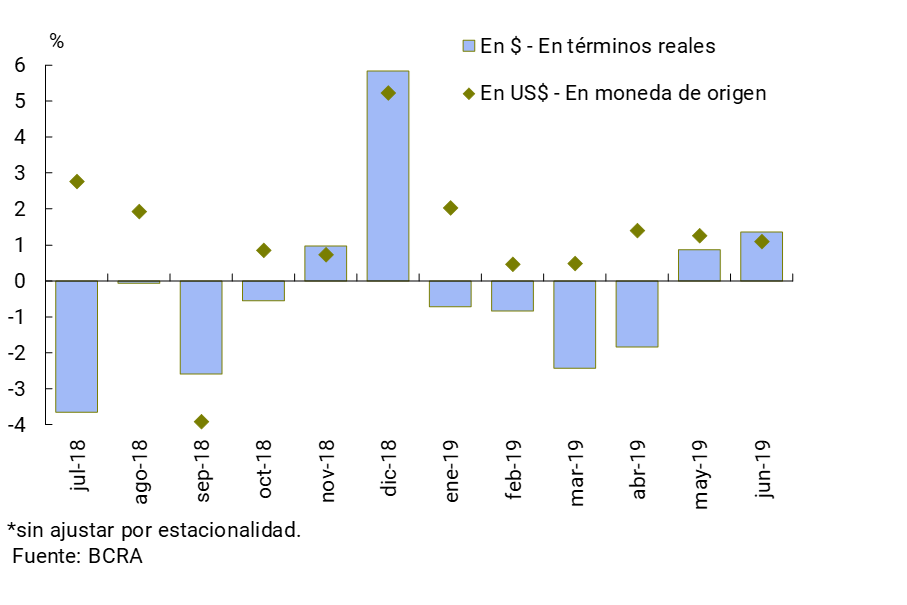
In the last 12 months to June, private sector deposits in local currency decreased 3.9% in real terms, with an increase in those in time deposits (+11.1% y.o.y. in real terms) and a reduction in demand balances (-15.5% y.o.y. in real terms). Private sector deposits in foreign currency increased by 15% YoY (in source currency). The balance of deposits in pesos in the public sector fell in real terms by 46% YoY and the balances in foreign currency of this sector fell by 23% YoY (in currency of origin). In this context, the balance of total deposits in the financial system decreased by 9.5% YoY in real terms.
The relative importance of private sector deposits in the total funding of the financial system stood at 61.6% in June (+1 p.p. and +6.4 p.p. compared to last month and June 2018, respectively), with greater relevance of foreign currency and time deposits in pesos to the detriment of demand accounts in pesos. Public sector deposits accounted for 11% of total funding in mid-2019 (-1.6 p.p. compared to May and -6.3 p.p. y.o.y.).
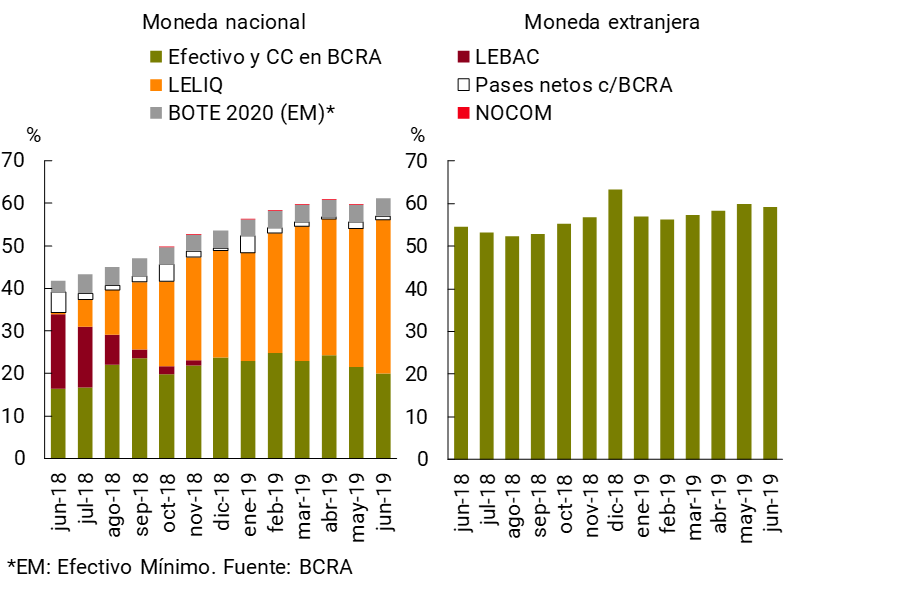
The liquidity of the financial system remained at high levels. In June, the broad liquidity ratio2 stood at 60.5% of total deposits (61.1% for the segment in local currency), 0.8 p.p. above the level recorded in May (+1.4 p.p. for items in pesos). This monthly increase was mainly explained by the increase in the balance of LELIQ (see Graph 5). In the last 12 months, the broad liquidity indicator grew 15.1 p.p. in deposits (+19.3 p.p. for the ratio in pesos). Liquid assets in foreign currency totaled 59.2% of deposits in the same denomination in the period, 0.6 p.p. below the May figure and 4.6 p.p. compared to the same period in 2018.
Graph 5 | Liquidity of the Financial System
III. Credit and Portfolio Quality
In June, the balance of loans in pesos to the private sector fell 1.6% compared to the previous month (+1.1% nominal). The monthly performance was generalized among groups of financial institutions and among credit lines (with the exception of advances)3. For its part, the credit balance in foreign currency increased 0.2% in the period (in currency of origin, see Chart 6).
Graph 6 | Private Sector Credit Balance by Currency*
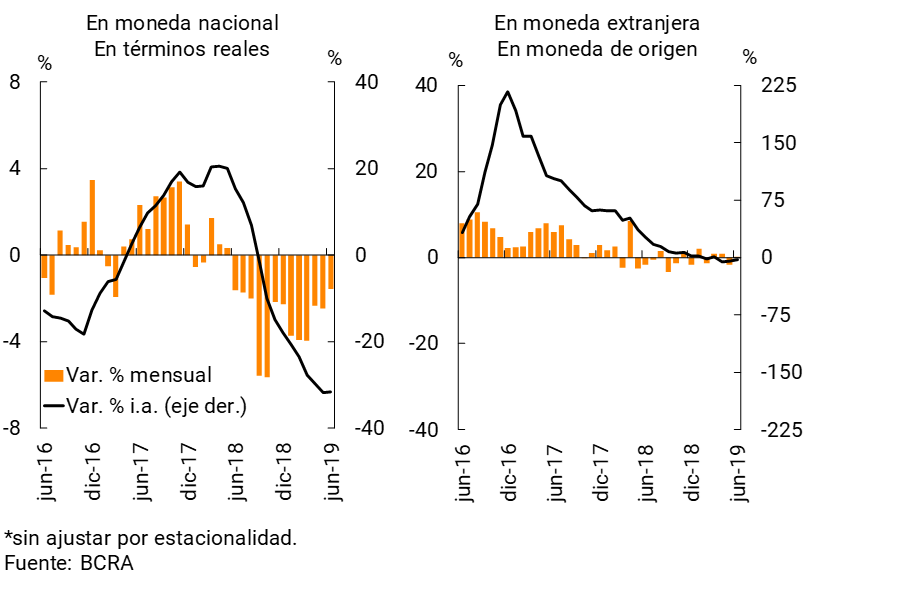
In year-on-year terms, the balance of loans in pesos to the private sector fell 31.7% in real terms, mainly explained by commercial lines. Financing in foreign currency decreased 3.1% YoY in source currency.
In June, the total credit balance to companies (in domestic and foreign currency) fell by 3.6% in real terms compared to the previous month (-1% nominal) and by 27.6% in real terms compared to the same month in 20184. Loans to the trade and construction sectors showed the largest relative year-on-year reductions in the period. The balance of financing to families (in national and foreign currency) decreased 2.7% in real terms in the month (without changes in magnitude in nominal terms) and 23.6% real y.a., with a greater relative fall in pledge and personal lines.
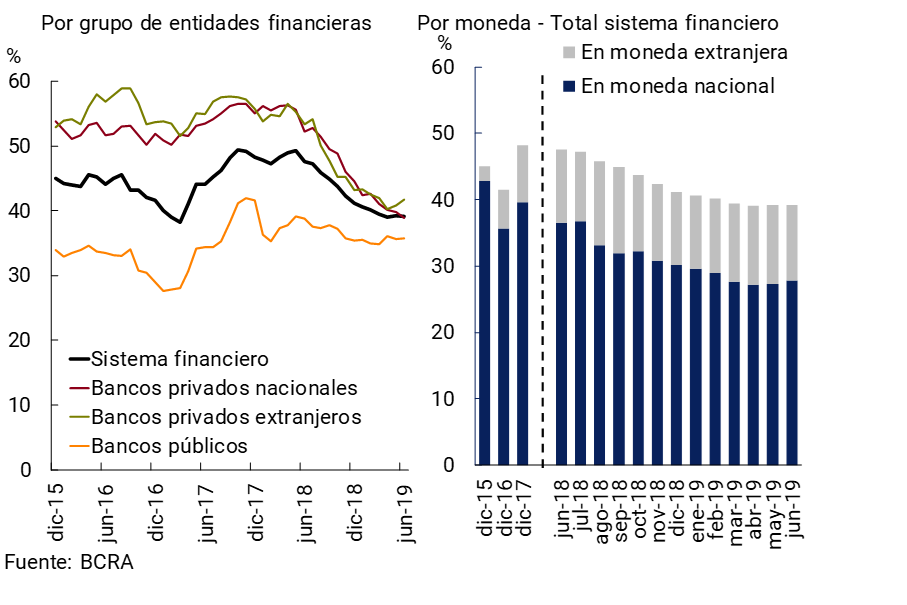
At the end of the first half of the year, bank financing to the private sector represented 39.2% of total bank assets, 2 p.p. below the value at the end of 2018 and 8.5 p.p. less than the level of a year ago (see Chart 7). The fall in this indicator was mainly explained by private banks and by the segment in national currency.
Figure 7 | Private Sector Credit Balance / Total Assets
In June, the ratio of irregularity of financing to the private sector remained unchanged compared to last month, standing at 4.5% (+2.4 p.p. y.o.y., see Chart 8). Non-performing loans to companies remained at 4.3% of the portfolio in the month (+3.1 p.p. y.o.y.), while the NPL ratio for loans to households stood at 4.9% (+1.6 p.p. y.o.y.). The default rate on mortgage loans to households continued to be very low: 0.4% of the portfolio for those denominated in UVA and 0.7% for the rest5.
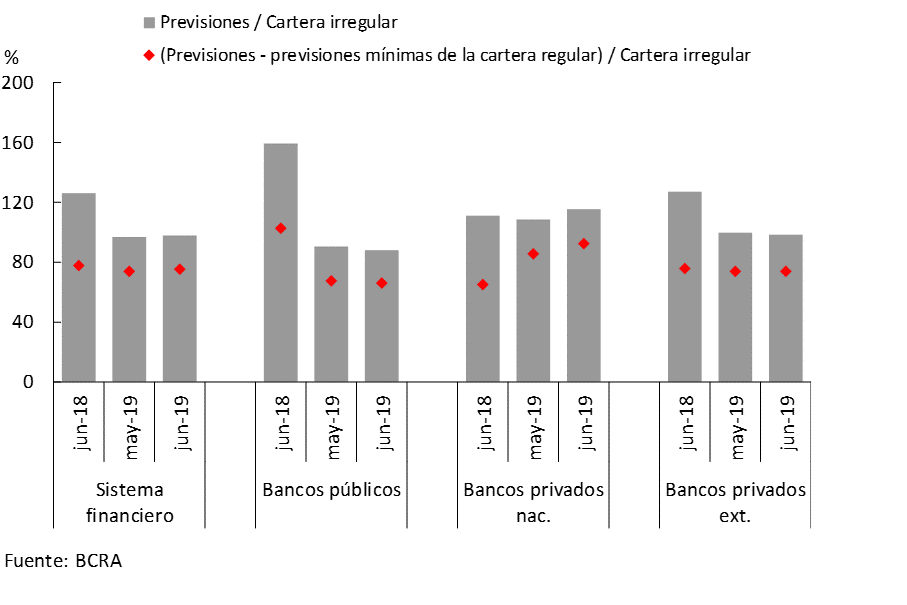
The balance of total accounting forecasts (both for the regular and irregular portfolios) stood at 98% of the irregular portfolio to the private sector in the period. It is estimated that the balance of forecasts attributable to loans in an irregular situation represented 75% of this portfolio in June (see Graph 9), remaining without significant changes so far this year. Taking into account this last level of forecasting and the solvency indicators (see next section), it is estimated that the irregular portfolio not covered by forecasts is equivalent to only 4.7% of the balance of regulatory capital integration or 10% of that corresponding to the excess regulatory capital. These levels are moderate even without considering the guarantees and, in general, the recovery rates on this portfolio.
Figure 8 | Irregularity of Credit to the Private Sector
Irregular financing / Total financing (%)
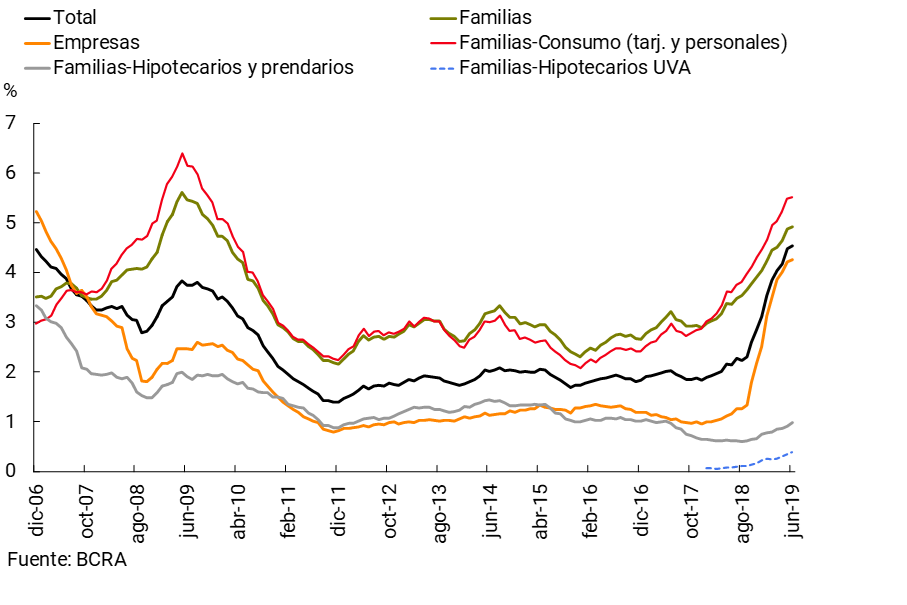
Figure 9 | Forecasting of the Financial System
IV. Solvency
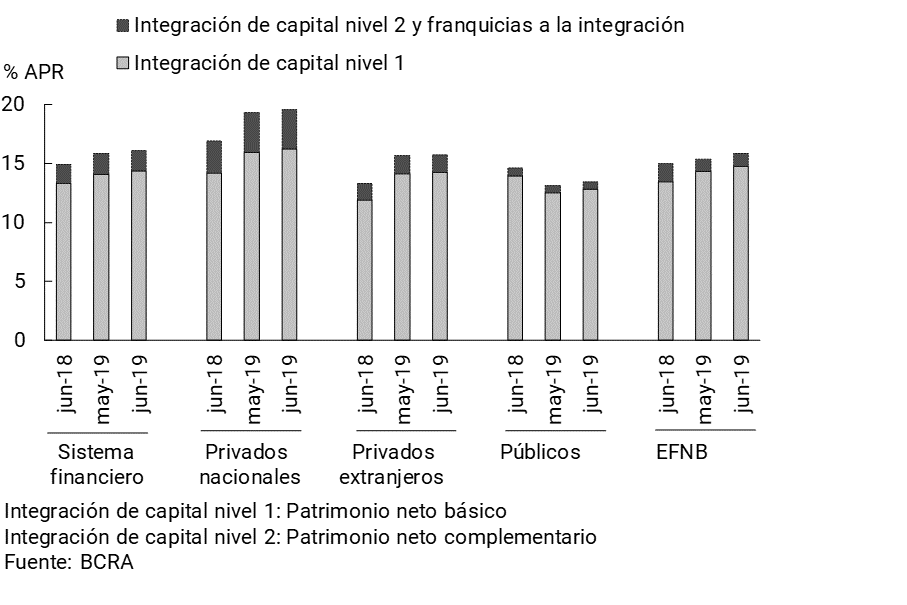
The solvency ratios of the financial system remained at high levels in June (see Chart 10). Capital integration for all financial institutions stood at 16.1% of risk-weighted assets (RWA), 0.2 p.p. more than in May. Tier 1 capital continued to account for most of the total regulatory capital (89%)6. In the month, capital integration totaled 185% of what is required by law. In a year-on-year comparison, the capital integration of the institutions as a whole grew by 1.2 p.p. in RWAs and 12 p.p. in the minimum capital requirement.
Figure 10 | Integration of Regulatory Capital
In June, nominal gains in the financial system were equivalent to 4.4%y/annualized (ROA) and 39.5%y/y/equity (ROE). In the cumulative 12 months to June, banks accumulated a nominal ROA of 4.4% and a nominal ROE of 40.8%.
The financial margin of the banks represented 12.3% of the assets in the month, 1.4 p.p. less than last month (see Graph 11). This performance was mainly explained by the lower results of securities (-0.8 p.p. of assets to 13.8%y) and by a reduction in the CER adjustment (-0.6 p.p. of assets to 2.1%y). In the accumulated 12 months to June, the financial margin stood at 11.7% of assets, 1.4 p.p. more than in a year-on-year comparison.
Figure 11 | Profitability of the Financial System
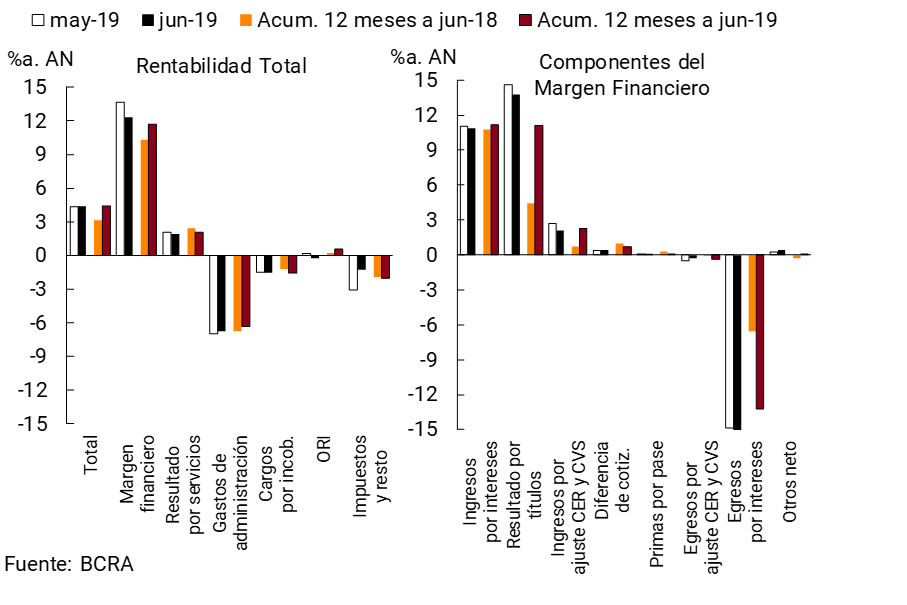
Net income from services in the financial system decreased slightly in the month (-0.1 p.p. of assets to 1.9%y). These results totaled 2.1% of assets in the accumulated 12 months, 0.4 p.p. less in a year-on-year comparison.
Administrative expenses of the banks as a whole totaled 6.7% y/y of assets in June, 0.2 p.p. below the level evidenced in May. In 12 months (accumulated to June) these expenditures were around 6.3% of assets, 0.5 p.p. lower than the record of the 12 months to June 2018. On the other hand, in the month, charges for uncollectibility of the financial system remained stable, in the order of 1.5% of assets. The level accrued by charges for uncollectibility between July 2018 and June 2019 stood at 1.6% y/y. of assets, being 0.4 p.p. higher in a year-on-year comparison.
References
1 Considering differences in balance sheet balance.
2 Availability, integration of minimum cash and BCRA instruments, in national and foreign currency.
3 Includes principal adjustments and accrued interest.
4 Information extracted from the Debtors’ Central (national and foreign currency). Loans to residents abroad are not included. Adjustments in principal and accrued interest are considered. Business financing is defined here as that granted to legal entities and commercial financing granted to individuals. On the other hand, loans to families are considered to be those granted to individuals, unless they are for commercial purposes.
5 As of June, out of a total of 101,840 mortgage financing in UVA granted to individuals in the financial system (73% generated by public banks, 16% by national private banks and 11% by foreign private banks), 548 were in an irregular situation.
6 Tier 1 capital is the one with the greatest capacity to face unexpected losses, composed mainly of common shares and earnings.
Share on


