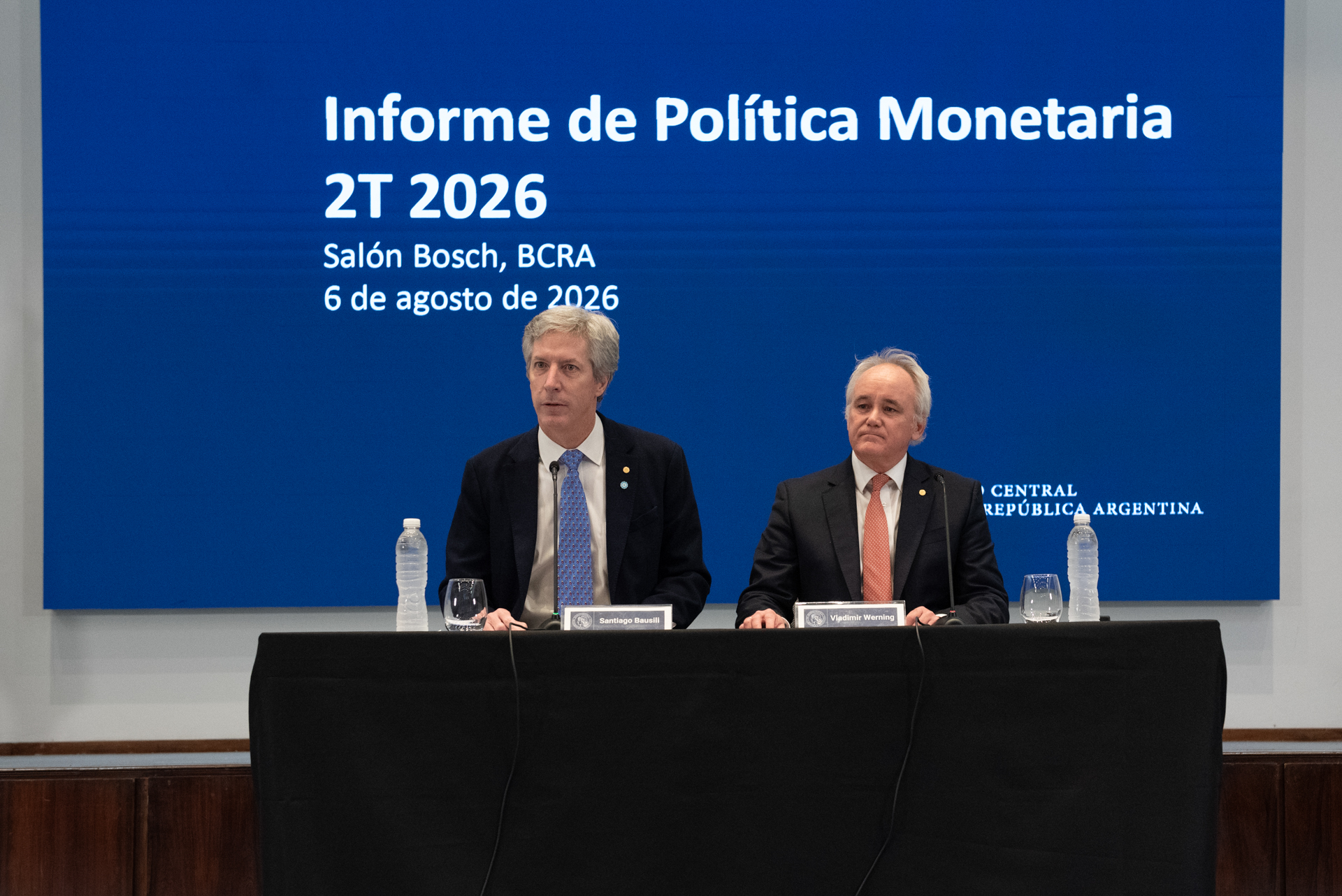
During the event, the main results and assessments of the Monetary Policy Report (IPOM) for the second quarter of 2026 were presented.
The press conference was held in the BCRA’s Dr. Ernesto Bosch Room. Find below the full video of the press conference, the presentation displayed, and the opening remarks delivered by the Governor of the BCRA.
Download Monetary Policy Report, second quarter of 2026 (PDF)
Download presentation displayed at the press conference (PDF)
Opening remarks from the Governor
Good afternoon. We are presenting the Monetary Policy Report for the second quarter of 2026. I will first go over the main topics covered in the report. Vladimir will add his comments on the thematic sections in this edition, and then we will move on to your questions.
I. International context
The conflict in the Middle East continued to be the most significant factor affecting international inflation and global financial market volatility. The initial inflationary impulse stemming from the rise in oil prices subsided during the second quarter, when the conflict seemed to be heading toward a faster resolution than expected. Even so, the IMF’s global inflation projections were revised upward: from 4.1% in 2025 to 4.7% in 2026, compared to a pre-conflict scenario that anticipated 3.8%.
After peaking at USD118 per barrel at the height of the conflict, the price of Brent oil fell back to USD84 on average in June and July, with futures contracts for end-2026 at around USD82. There was also a reversal in grains, although with still-positive gaps versus 2025 averages, with an upward reaction in July amid the intensification of the conflict. The BCRA compiles an index of commodity prices, which in April exceeded last year’s average by 24%, and by June moderated its increase to 17%. Based on futures market prices, it is 17% above 2025, on average, for this full year.
Despite the decline in crude oil prices, dollar interest rates maintained an upward trend, with yields on 10-year US Treasury bonds approaching 4.7%, and futures markets pricing in an additional 25-basis-point increase in the Federal Reserve’s benchmark rate this year. This dynamic reflects that the energy supply shock coexists with a demand impulse linked to the global technology cycle—particularly investment in artificial intelligence—which supports activity and reduces room for accommodation.
The main risk ahead remains a prolonged conflict in the Middle East. There are also other latent threats, such as the implementation of new trade barriers, the emergence of conflicts in other regions, the risk of abrupt corrections in artificial intelligence markets, and the rise in fiscal and public debt vulnerabilities globally that are exhibiting a worrying dynamic.
II. Local macroeconomic context
Against this adverse external backdrop, Argentina’s behavior once again differed from the past. The floating exchange rate regime has acted as a buffer, facilitating the adjustment of relative prices without disruptions in domestic financial markets. The real effective exchange rate remained relatively stable, country risk reached its lowest level from late 2017, and Fitch, Standard & Poor’s and Moody’s upgraded the sovereign credit rating to B- and B3 (the equivalent at Moody’s).
As we noted in the presentation of the latest Monetary Policy Report, this domestic financial stability response evidences the sound macroeconomic fundamentals built over the past two years.
Economic activity
Economic activity reached an all-time high in the first quarter of 2026, with seasonally adjusted quarter-on-quarter growth of 0.7% and year-on-year growth of 2.3%, accumulating an 8.6% increase against the first quarter of 2024. The quarterly improvement was seen both in agriculture—driven by record wheat and corn harvests—and in the average across the other sectors, with a recovery in industry and construction. The demand-side driver was private consumption.
This growth process differs from other expansionary phases in two aspects that make it more sustainable: (1) exports lead and (2) it takes place within a fiscal and monetary balance regime. Previous periods of transitory growth were based on unsustainable policies to stimulate consumption through fiscal impulse financed by monetary issuance. In contrast, this expansion generates from the outset a significant improvement in exports, without fiscal or external imbalances, resulting in income growth that ultimately translates into higher private consumption.
In the second quarter, GDP was affected by the expected normalization of agricultural activity after record harvests and by the adverse international context. (Just as the record wheat and corn harvest pushed GDP upward in the first quarter, returning to the normal level of activity makes us lose statistical ground compared to that record level; that is why the level of activity was adjusted in the second quarter). Among the most dynamic sectors, energy (oil and gas), agriculture, and financial intermediation continued standing out. In April-May, construction interrupted the negative trend it had been showing. Industry and commerce recorded year-on-year declines.
Employment and poverty
In the first quarter of 2026, the unemployment rate fell slightly year-on-year, remaining at historically low levels. Total employment grew 1.7% year-on-year, concentrated in self-employment and informal employment, while formal private employment recorded a 4.1% year-on-year contraction. The Law on Labor Modernization enacted in March aims to reverse the more than decade-long decline in the share of formal employment.
As for poverty, data for the first quarter of 2026 show a rate of 30.0%—a drop of 1.5 percentage points year-on-year—and indigence of 6.5%—0.5 points lower—accumulating declines of 24.8 and 13.7 percentage points, respectively, from the peaks of the first quarter of 2024. The link between monetary stability and social well-being remains one of the program’s most tangible results.
Looking ahead, we expect growth to continue, driven by primary activities whose production linkages will begin to impact the other sectors and formal employment. The experience of Vaca Muerta in Neuquén illustrates that most of the employment derived from primary sectors is not generated in companies within the sector itself, but in the rest of the economy through construction, intermediate inputs, and spending by the newly-employed workers.
Investment
Since the beginning of 2026, investment has been moderating its pace of decline, with stabilization in domestically produced durable equipment and some recovery in construction. Leading indicators for the second quarter confirm that the decline in investment continues easing.
Macroeconomic conditions and policies aimed at stimulating private initiative support a favorable outlook. The most notable initiatives include the Law on Labor Modernization—which includes the Incentive Regime for Medium-Sized Investments—along with the Incentive Regime for Large Investments (RIGI) with 23 approved projects with investments of USD50 billion accelerating, the Super RIGI, and road building contracts and privatizations. Initiatives related to the capital market aim to encourage channeling Argentines’ savings into investments in the country. The Market Expectations Survey (REM) forecasts GDP will grow 2.7% in 2026, accelerating to 3.0% in 2027 and 2028, in line with IMF and World Bank estimates.
External sector and reserves
In the second quarter of 2026, the trade surplus in goods reached the highest level in the past 30 years, driven by record-high exports and the stabilization of imports. In addition to a rise in international commodity prices—especially oil—a growing trend was observed in export volumes. In parallel, the trade opening process continued through tariff reductions, elimination of internal taxes, and the provisional entry into force of the MERCOSUR–European Union Agreement.
REM analysts have successively revised upward their expectations for the 2026 trade surplus, now at USD23.4 billion, with expected export values growing 15% year-on-year.
Public accounts and Treasury finances
The public accounts surplus continues to be the anchor of the economic program. In the second quarter of 2026, the non-financial national public sector recorded a cash-based primary surplus equivalent to 0.9% of seasonally adjusted and annualized GDP. This surplus level is not directly comparable with that of the same period in 2025 because income tax payments were postponed until July, and therefore that source of revenue was not captured in this measure. For 2026, the national public sector is expected to achieve a primary surplus for the third consecutive year, consistent with the national budget projections of 1.5% of GDP. In the capital market, the Treasury continued extending the maturities of peso-denominated debt placements and reducing its financing cost during the second quarter.
III. Prices
Regarding inflation, the second quarter showed the development we had anticipated. Monthly inflation fell significantly: the CPI averaged 2.2% per month in the quarter, 0.8 percentage points less than in the first quarter, recording 1.9% inflation in June, markedly below March’s 3.4%. The deceleration mainly reflects the reversal of the transitory factors that pushed inflation in the first months of the year.
We had identified those factors in the previous IPOM: unfavorable seasonality in meat, education and clothing; electricity and gas rate updates; and the shock to fuel prices stemming from the conflict in the Middle East. As we expected, all of them moderated their upward pressure during the second quarter.
However, the most important thing is what underlying inflation indicators show. The underlying CPI calculated by the BCRA averaged a monthly increase of 2.1% in the quarter and reached 1.6% in June—a record comparable to values observed in 2017. This development confirms that the reduction in inflation is not only due to transitory factors, but rather reflects a widespread process attributable to the deep determinants of the macroeconomic regime.
The “fiscal and monetary” anchor did not validate second-round effects: the pass-through of relative price shocks did not spread to the rest of the economy.
It is particularly relevant to highlight the low correlation of underlying inflation in goods with fluctuations in the nominal exchange rate. This is characteristic of more flexible exchange rate regimes and it is fundamental to increasing the economy’s ability to absorb external shocks without this translating into inflation.
A further improvement is expected for the third quarter. Conditions are favorable: favorable seasonality in meat will continue; vegetable prices are expected to moderate or fall after the increases in May and June; gasoline prices are projected to remain stable; and lower inflation inertia implies a progressive deceleration of indexed items such as rent, health insurance, and public transport.
Market expectations support this diagnosis. According to the latest REM, analysts project that inflation will remain below 2% per month in the coming months and will end 2026 at 30% year-on-year. For 2027 and 2028 they expect 20% and 14.2%, respectively, reflecting confidence in economic policy. Market instruments—which allow calculating a break-even inflation level—are even pointing to somewhat lower values than those of the REM for next year.
IV. Monetary policy
The BCRA kept the monetary policy stance unchanged during the second quarter. The objective of monetary policy is the convergence of inflation in Argentina to the level of international inflation.
Monetary policy prudence, implemented through control of the money supply, made it possible to absorb the shock from the conflict in the Middle East without changing the bias. This result consolidates macroeconomic stability and enhances the credibility of the regime.
From the beginning of the year through July 31, the BCRA purchased USD13.337 billion in the foreign exchange market, exceeding the reference level of USD10 billion included in the IMF program as a target for the full year. This result is no coincidence: it reflects the reversal of pre-2025 election portfolio dollarization, greater foreign exchange flexibility for companies, and the fact that depositors are saving about 80% of the dollars purchased for hoarding within the domestic financial system. That saving feeds financial intermediation, bank credit in dollars, and financing through the capital market.
It should be noted that the BCRA’s purchases continued at a good pace in June and July. In these months, there was an increase in imports seasonally linked to energy, while dividend distributions authorized for the first time in six years accumulated more than USD3.3 billion in the year.
The liquidity expansion resulting from those purchases was actively managed, and managing it becomes a priority going forward, as total purchases have surpassed USD10 billion. The result was a context of stability in interest rates, with volatility markedly reduced compared to previous periods.
A notable element of the quarter is the dynamics of money demand. After a period of relative stability, transactional monetary aggregates began to show greater momentum starting in May, when the downward trend in monthly inflation expectations consolidated. In July, transactional private M2 accounted for 5.6% of GDP, in line with the scenarios from our models presented in March’s IPOM. This recovery in money demand is a positive sign: it is the natural counterpart of the ongoing disinflation process.
As for the BCRA’s balance sheet, we continue moving forward with its cleanup. Following the distribution of profits for fiscal year 2025, the Treasury used the funds as well as the IMF disbursement of USD1.04 billion to repurchase non-transferable bills held by the BCRA for a total nominal value of USD22.284 billion. Taken together, the factors improving the foreign currency position—including the level of additional liquid reserves, the reduction of illiquid assets, and the recovery of tools such as futures and swaps—represent an improvement of more than USD18 billion so far this year.
Credit to the private sector is accompanying the cycle. In June, total credit in pesos and dollars reached 12.3% of GDP, increasing by 0.4 points against December 2025, driven mainly by foreign-currency credit to companies. We expect lending in pesos to gradually align with the dynamism of lending in dollars as the disinflation process advances and money demand consolidates.
Finally, I want to mention that the bill submitted to Congress to amend the Charter of the BCRA represents an institutional step of the highest magnitude. By prohibiting financing to the Treasury through temporary advances and restricting profit distribution, the new framework will reinforce control of monetary aggregates, strengthen the BCRA’s autonomy, and help consolidate the decline in inflation expectations and the convergence of domestic inflation to international levels.
As I mentioned last time, a cleaned-up BCRA balance sheet supports its liabilities with solidity and credibility. The BCRA’s main liability is our currency, the peso. The more the peso is worth, the lower inflation will be.


