I. Financial intermediation activity
In October, the activity of financial intermediation in pesos with the private sector was slightly reduced. Considering the most relevant variations in the balance sheet of the financial system for items in pesos – in homogeneous currency – the balance of deposits in the private sector and the public sector decreased in the month. These movements were mainly offset by a reduction in liquidity in the broad sense and in financing. On the other hand, when considering the segment of foreign currency items, the balance of credit to the public sector and the private sector increased in the period, and deposits in both sectors also increased.
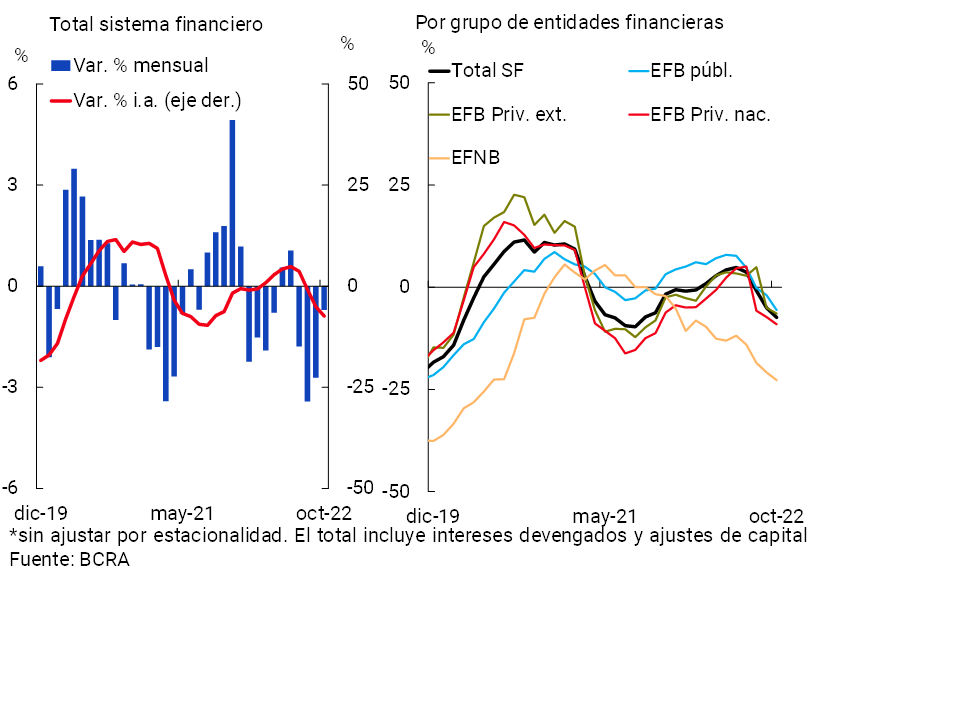
In October, the balance of financing in pesos to the private sector expressed in real terms decreased 0.7% compared to the previous month (+5.5% nominal),1 a performance verified in almost all credit lines (except for advances and assets in financial leases). When distinguishing by group of financial institutions, in the month there were increases in the real credit balance in pesos of private banking financial institutions, and falls for this concept in the rest of the groups of entities. In a year-on-year comparison, the credit balance in national currency fell by 7.4% in real terms (+74.1% nominal, see Chart 1).
Graph 1 | Credit balance to the private sector in pesos
In real terms* – Financial system
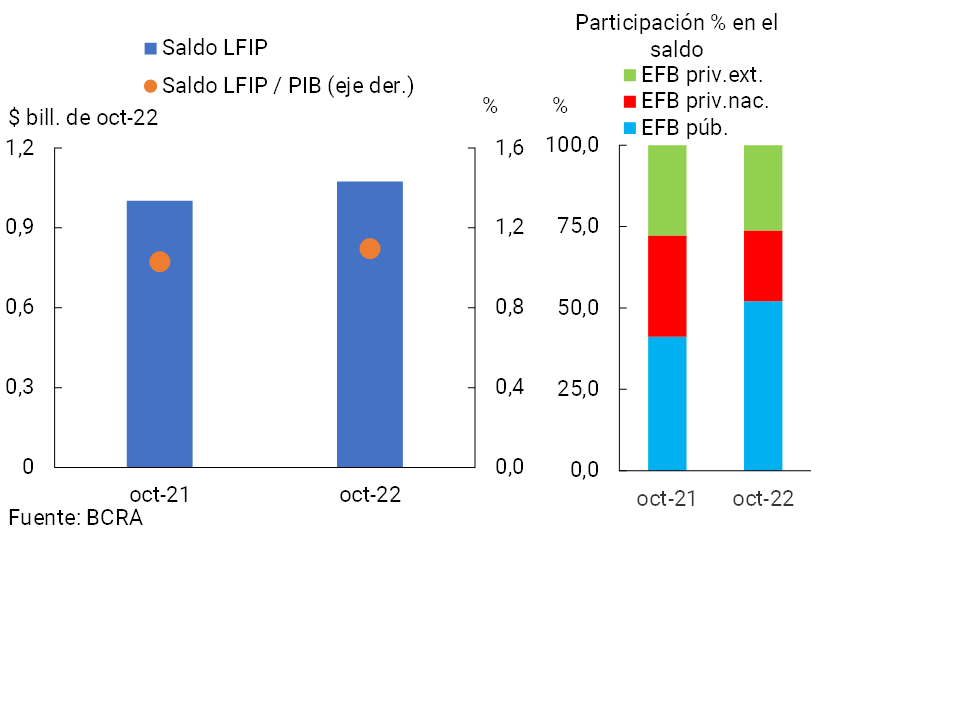
Within the framework of the Financing Line for Productive Investment of MSMEs (LFIP), from its launch until November 2022, $3.6 billion were disbursed, distributed among 350,400 companies. As of October—the latest information available—the estimated financing balance of the LFIP stood at $1.1 trillion, equivalent to 13.6% of the total credit balance to the private sector, increasing 2.2 p.p. y.y. The LFIP balance is estimated to represent 1.1% of GDP, with no significant change in a year-on-year comparison (+0.1 p.p., see Chart 2)2.
Graph 2 | Financing Line for Productive Investment (LFIP) for MSMEs – Estimated Balance
On the side of the segment in foreign currency, in October financing to the private sector in that denomination increased 2.7% (in currency of origin). Thus, the total credit balance (in domestic and foreign currency) to the private sector fell by 0.4% in real terms compared to September (+5.9% nominal), accumulating a year-on-year fall of 10.5% in real terms (+68.1% y.o.y. nominal).
In October, the balance of deposits in pesos in the private sector decreased by 0.9% in real terms compared to the previous month (+5.4% nominal, see Graph 3), a performance mainly explained by demand accounts (-1.9% in real terms in the month or +4.2% nominal). For its part, the balance of time deposits remained without significant changes in the month (+0.2% real or 6.5% nominal, see Chart 4).
Graph 3 | Balance of private sector deposits in pesos
In real terms* – Financial system
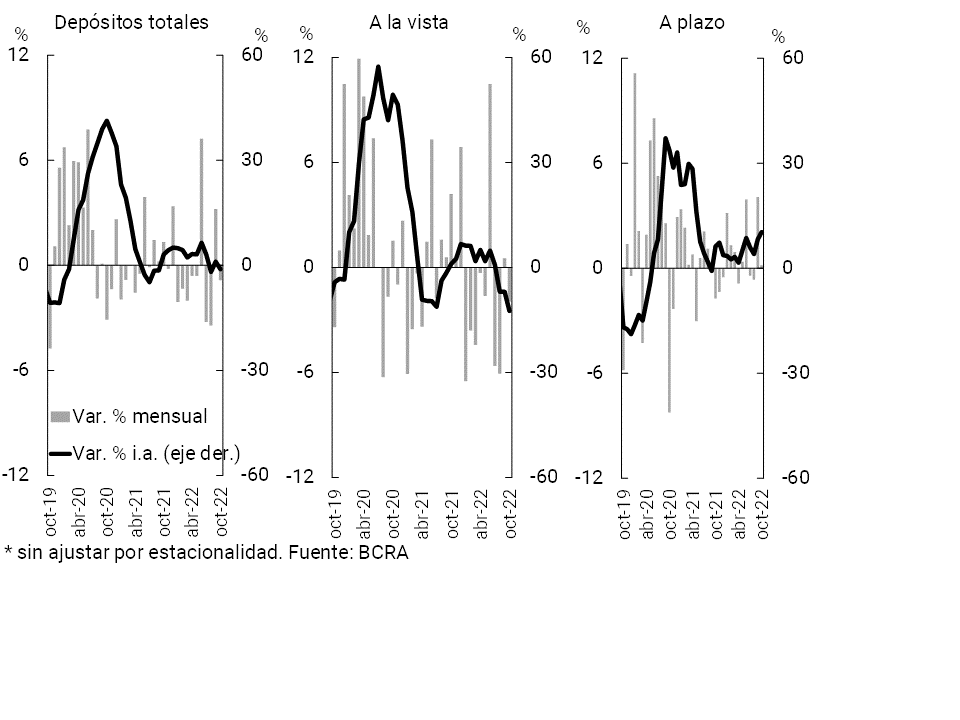
Figure 4 | Balance of fixed-term deposits of the private sector in pesos
In real terms* – Financial system
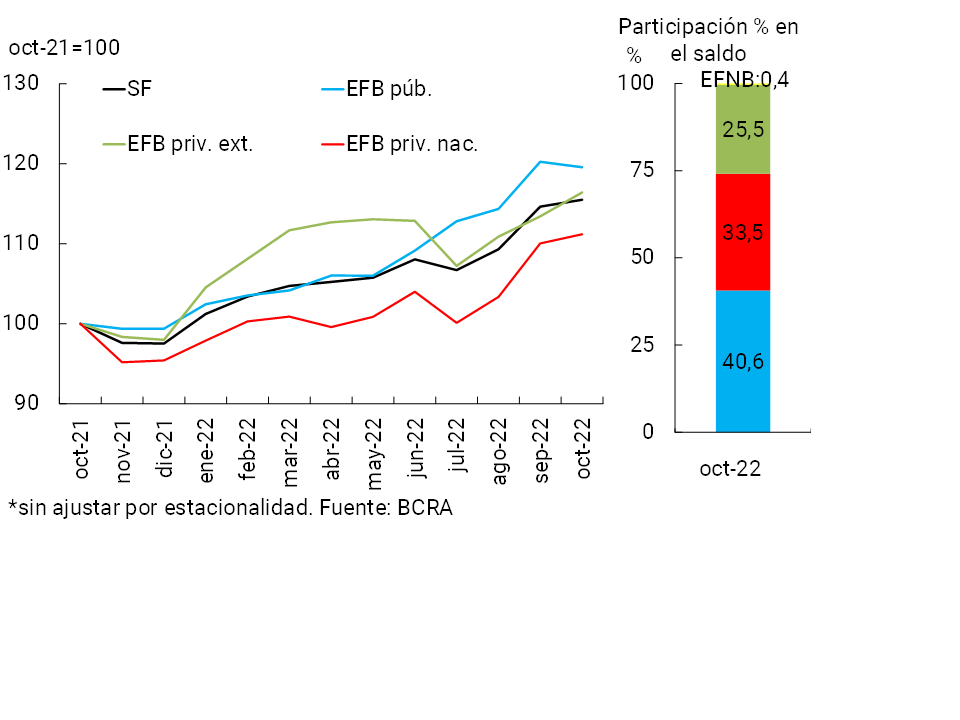
When differentiating by type of private sector time deposits, in the month the traditional ones (at fixed interest rates) increased by 1.7% in real terms (+8.1% nominal), accumulating a year-on-year increase of 14.5% in real terms (+115.2% nominal y.o.y.). Meanwhile, compared to the end of September, the balance of deposits denominated in UVA decreased 11.3% (-5.7% nominal), although it accumulated a growth of 33% real y.o.y. (+150% nominal y.o.y.).
In October, the balance of private sector deposits in foreign currency increased by 0.5% (in source currency). Thus, the balance of total private sector deposits (in domestic and foreign currency) fell by 0.6% in real terms in the month (+5.6% nominal), accumulating a year-on-year fall of 4.9% in real terms (+78.8% nominal YoY).
In a year-on-year comparison, as of October, the real balance of deposits in pesos in the private sector fell slightly (+85.8% nominal YoY), with a fall in demand accounts and an increase in time deposits. Deposits in pesos of the public sector fell by 6.1% y.o.y. in real terms (+76.4% y.o.y. nominal). Taking into account the total sectors, deposits in pesos decreased by 1.4% YoY in real terms (+85.3% YoY in nominal terms). Thus, the balance of total deposits (currencies and sectors) fell by 5% YoY in real terms (+78.6% YoY in nominal terms) in October.
II. Evolution and aggregate composition of the balance sheet
The balance of total assets of the financial system fell by 0.9% in real terms in October (+5.3% nominal), a generalized performance among the different groups of entities. In the last 12 months, the sector’s total assets accumulated a decrease of 3.1% in real terms (+82.1% nominal).
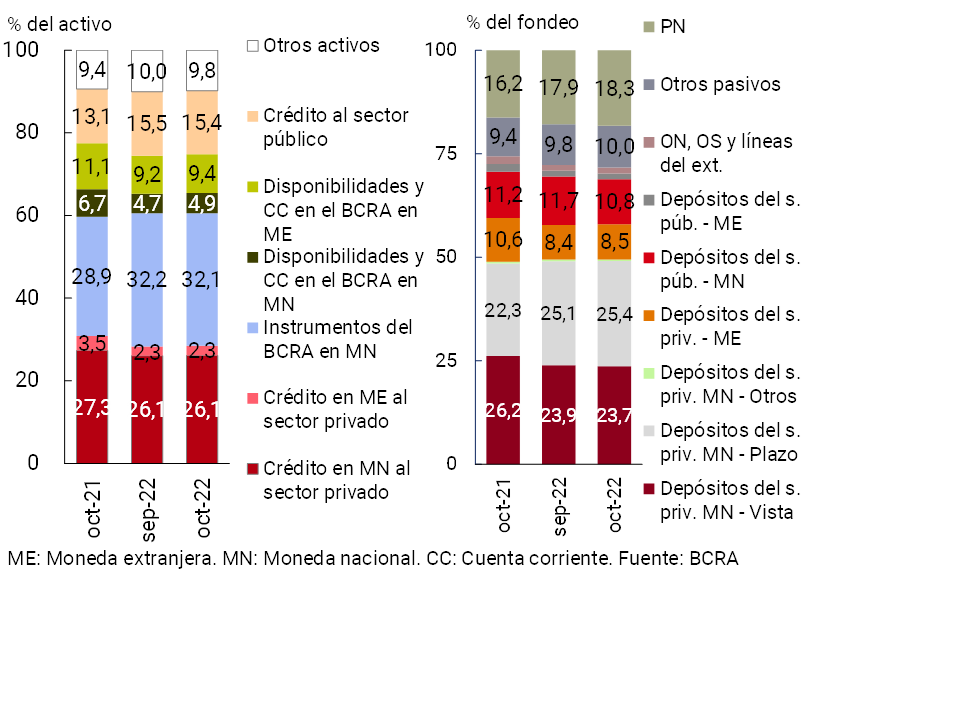
During the month, there were no significant changes in the weighting of the main components that make up the total assets of the financial system: a slight drop in the relevance of the balance of the BCRA’s instruments in pesos and of credit to the public sector, and a slight increase in the relative weight of the balance of the BCRA’s current accounts (both in domestic and foreign currency). With respect to the most relevant items in the total funding of the sector’s aggregate, the weighting of public sector deposits in national currency and private sector demand accounts in the same denomination decreased during the month, while private sector time deposits in pesos and net worth increased in relative importance (see Chart 5).
Graph 5 | Composition of assets and total funding
Financial system – Share %
In October, the estimated spread between assets and liabilities in foreign currency represented 25.5% of regulatory capital at the systemic level (-2.2 p.p. monthly and +12.1 p.p. y.o.y.)3. On the other hand, in the month the estimated positive spread between assets and liabilities with capital adjustment by CER (or in UVA) totaled 55.2% of the PRC at the aggregate level (-2.1 p.p. monthly and -6.6 p.p. y.o.y.).
III. Portfolio quality
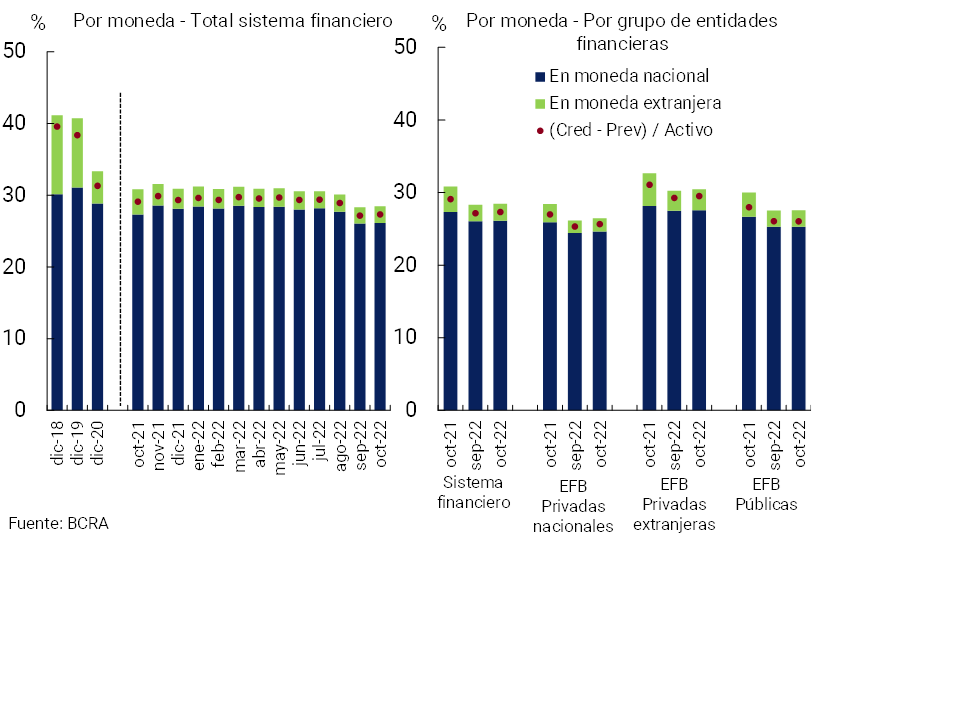
In October, the gross exposure of the financial system to the private sector (including domestic and foreign currency) stood at 28.5% of assets, slightly above the September figure, although 2.4 p.p. less than the same month of the previous year. The monthly and year-on-year dynamics were generalized among the different homogeneous groups of banking financial institutions (see Graph 6). When considering only financing in pesos, this ratio stood at 26.1% in the period (+0.1 p.p. monthly and -1.2 p.p. y.o.y.), while the weighting of credit to the private sector in foreign currency in the total assets of the financial system stood at 2.3% (+0.1 p.p. monthly and -1.2 p.p. y.o.y.). If the balance of forecasts is deducted from the aggregate of entities, credit to the private sector represented 27.3% of assets in the month, 0.2 p.p. above the previous month’s record and 1.8 p.p. below the level of the same period in 2021.
Graph 6 | Private Sector Credit Balance / Assets
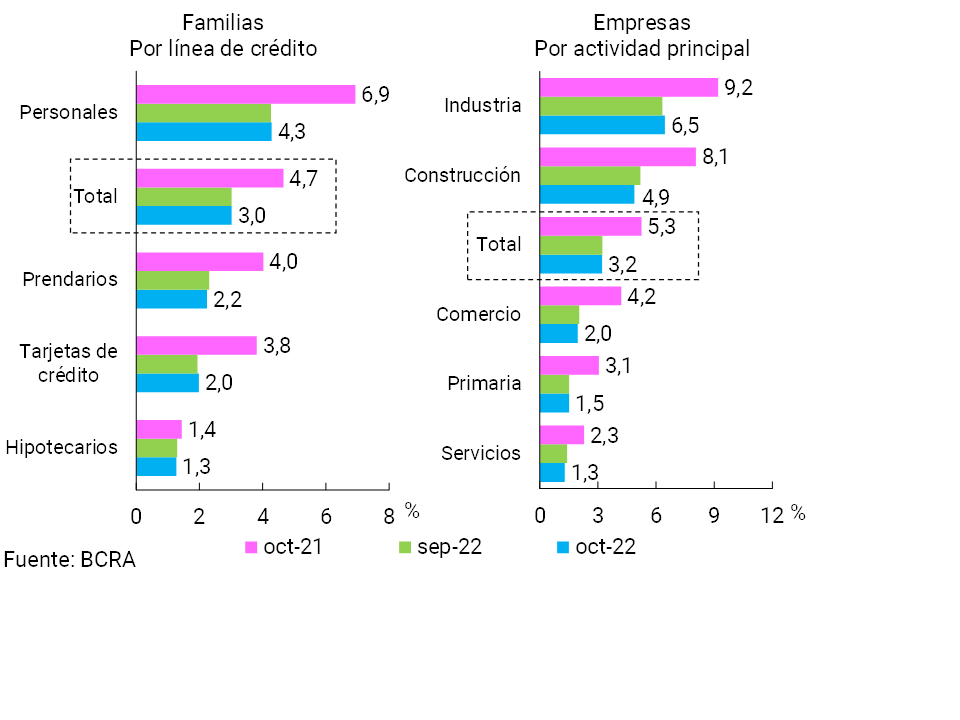
The irregularity ratio of credit to the private sector remained at 3.1% in October, with no significant changes compared to last month (see Chart 7). When distinguishing by credit segment, in the month the indicator of delinquency of loans to households did not verify changes in magnitude (with a similar dynamic between the different lines of credit, see Graph 8), as did the quality of the corporate portfolio (although with heterogeneous performances among economic sectors: increases in industry, reductions in construction, trade and services and no changes in magnitude in the rest of the sectors see Graph 8). In the last 12 months, the private sector NPL indicator fell by 1.8 p.p. at the systemic level (-1.6 p.p. in the family segment and -2 p.p. in the corporate segment)4.
Figure 7 | Private Sector Credit Irregularity Ratio – By Entity Group and by Debtor
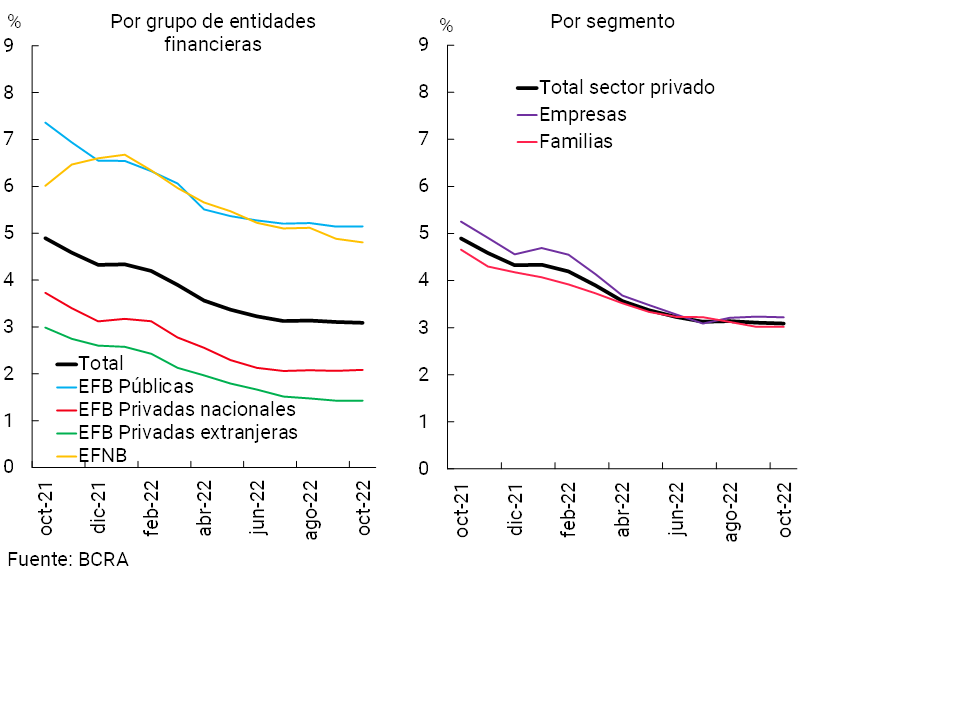
Figure 8 | Irregularity ratio of credit to the private sector – Per debtor
In October, forecasting reached 3.9% of total lending to the private sector for the aggregate of entities (-0.1 p.p. monthly and -1.5 p.p. y.a.) and 126.8% of financing in an irregular situation (-2.1 p.p. monthly and +15.5 p.p. y.a.). In the period, the net forecasts of those that regulatorily correspond to the portfolio in situations 1 and 2 (following the criteria of the minimum regulatory forecasts for uncollectibility risk) were around 93.5% of the irregular portfolio at the systemic level.
IV. Liquidity and solvency
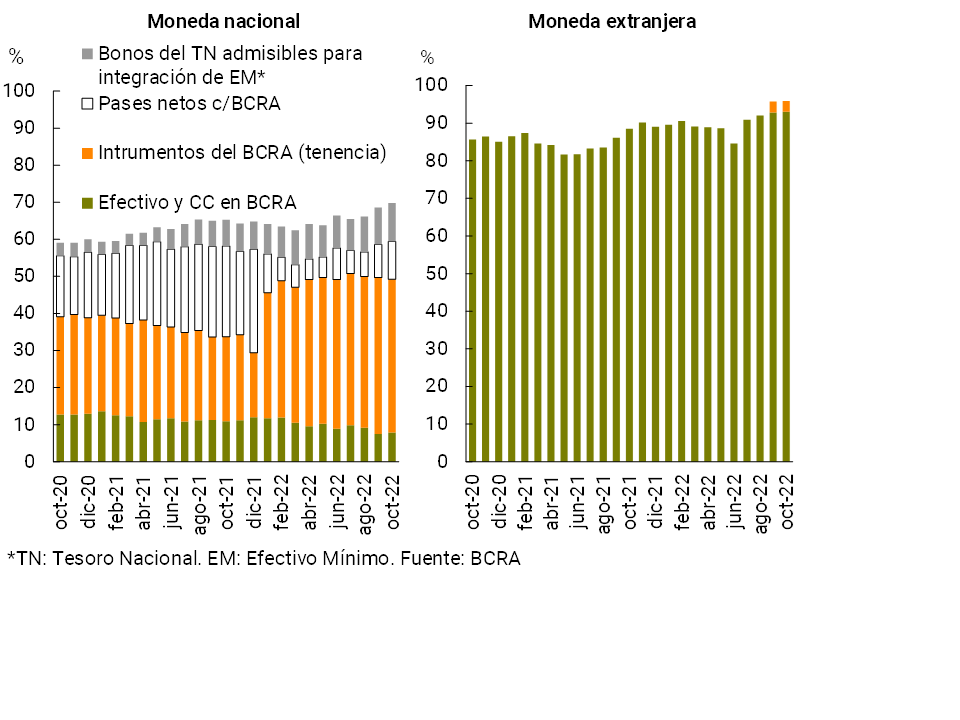
In October, the broad liquid assets of the financial system totaled 73.5% of deposits, 1.2 p.p. above the September figure. Disaggregated by currency, the indicator for items in pesos stood at 69.8%, and at 93% for the corresponding items in foreign currency (+1.2 p.p. and +0.2 p.p. per month, respectively, see Chart 9). In relation to the composition of liquidity in national currency, between the end of the month the share of net passes with the BCRA increased, while the relative importance of the BCRA’s holdings of instruments decreased. In a year-on-year comparison, ample liquidity (in pesos and foreign currency) increased 4.2 p.p. of total deposits.
Graph 9 | Liquidity of the financial system
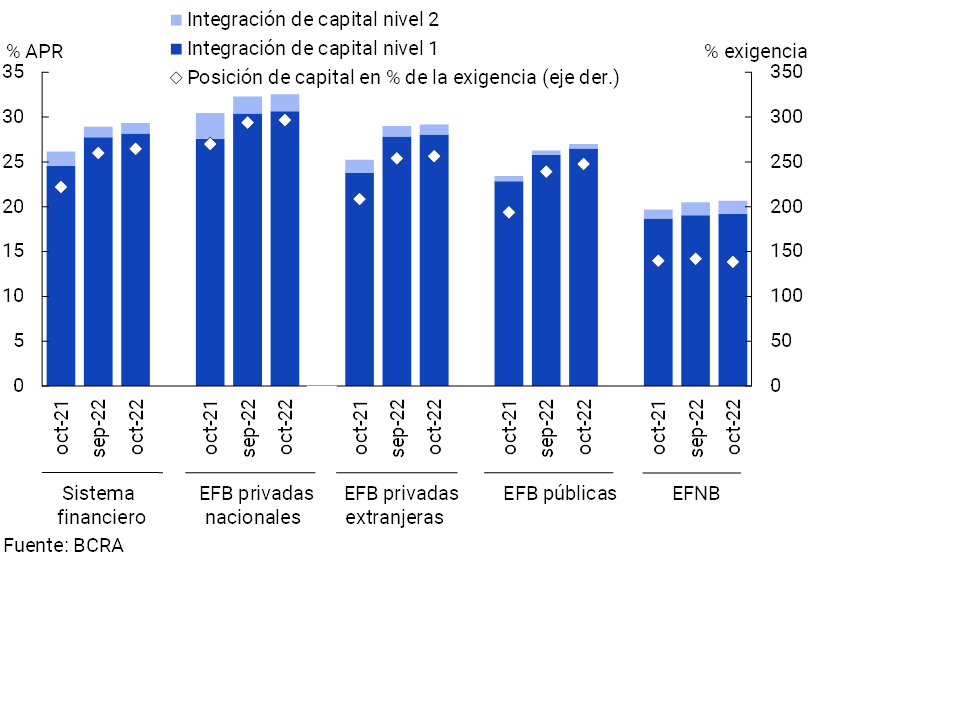
In October, the sector’s solvency indicators increased. The integration of regulatory capital (RPC) of the aggregate of entities stood at 29.3% of risk-weighted assets (RWA), 0.4 p.p. above the previous month’s figure (+3.2 p.p. y.o.y., see Chart 10). More than 96% of the PRC was accounted for by Tier 1 capital, with a greater capacity to absorb potential losses. The capital position – CPR net of the minimum regulatory requirement – totalled 265% of the regulatory requirement at the systemic level, 4.7 p.p. more than in September (+42.6 p.p. y.o.y.). On the other hand, at the systemic level, the excess regulatory capital in October stood at 40.6% of the balance of credit to the private sector net of forecasts, well above the average of the last 10 years (17%).
Figure 10 | Integration of regulatory capital
By financial institution group
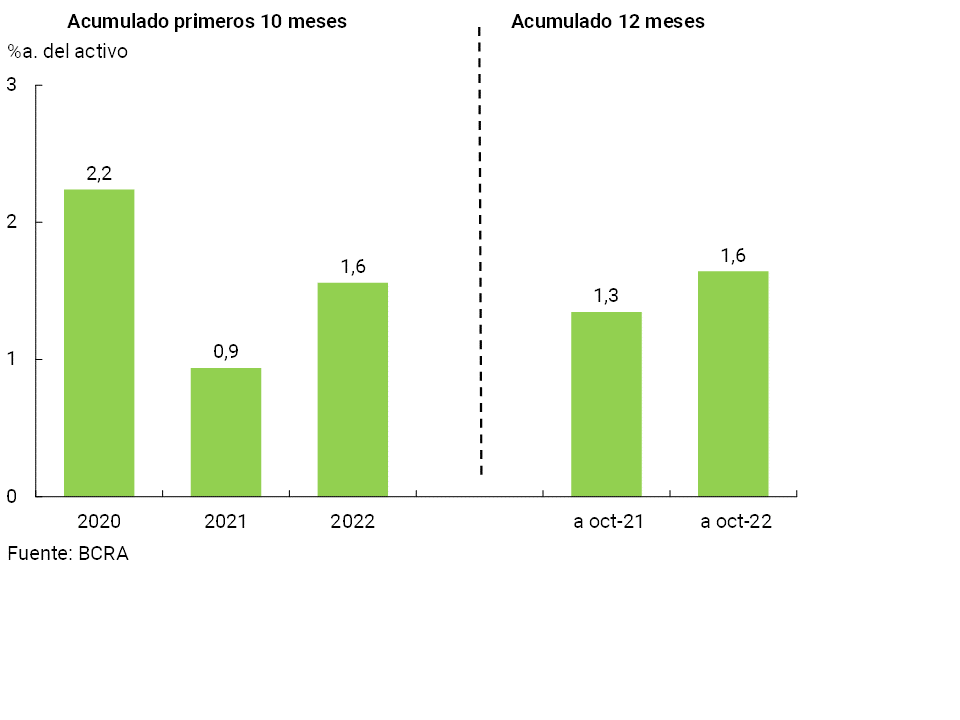
Regarding the sector’s profitability indicators, in the first 10 months of 2022, the financial system accrued a total comprehensive result in homogeneous currency equivalent to 1.6% annualized (a.) of assets (ROA) and 9.1% y. of net worth (ROE), levels higher than the records for the same period of 2021, although lower than those of that part of 2020 (see Chart 11). In the year-on-year comparison of the cumulative return in 10 months, higher results were observed by securities and, to a lesser extent, an increase in interest income from loans. These effects were partially offset by an increase in interest outflows and losses on exposure to currency items.
Figure 11 | Comprehensive total profit in homogeneous currency of the financial system
V. Payment system
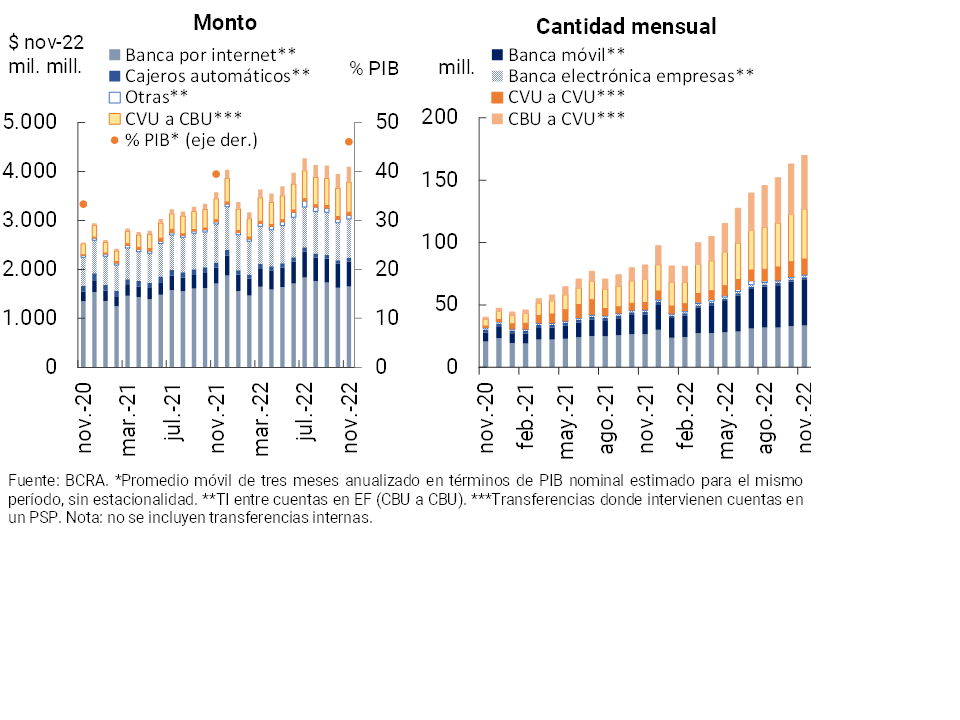
Immediate transfers (TIs) continued to increase significantly. Considering data as of November 2022, the amount of IT grew 4.2% compared to October and 107.8% YoY (3.7% and 13.9% YoY in real amounts). This year-on-year performance was driven by a generalized increase in its components, highlighting IT where accounts in payment service providers (PSPs) are involved to and/or to CVU. Within these latest operations, the year-on-year dynamism of operations from EF to PSP (CBU to CVU) stands out, in quantities (+272.7%) and in real amounts (+131.6%). In this way, operations where a CVU intervenes continue to gain share in the total IT: reaching 56.3% in quantities (+12.6 p.p. y.o.y.) and 24.6% in amounts (+7.6 p.p. y.o.y.). It is estimated that the amount of IT operated in the last three months (annualized) represented 46.1% of GDP (+6.6 p.p. compared to the same month of the previous year, see Chart 12)5.
Figure 12 | Instant Transfers (TI)
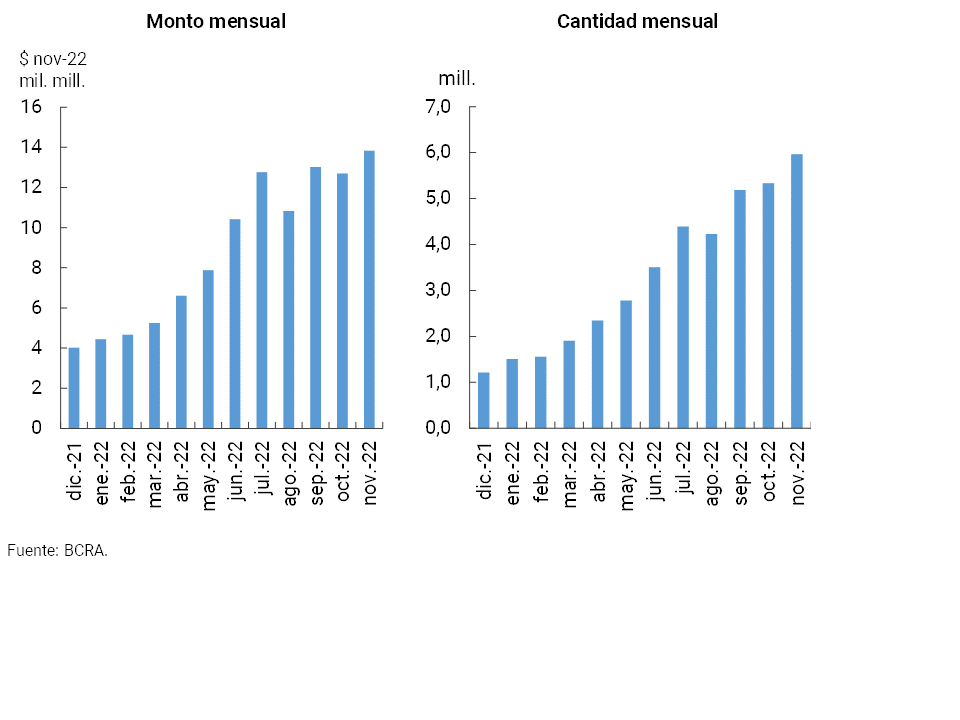
In November, transfer payments (PCT) initiated through interoperable QR codes increased compared to the previous month, both in amounts and in real amounts (+11.9% and +8.9% respectively, see Chart 13)6.
Figure 13 | Payments with transfer (PCT) through interoperable QR codes
In October, partly due to seasonal reasons, debit card transactions increased compared to the previous month: 6.8% in amounts and 5.4% in real amounts. In year-on-year terms, debit card purchases grew in amounts (+11.4%) and decreased in real amounts (-3.7%). It is estimated that the amount of debit card transactions in the last three months (annualized) represented 7.8% of GDP (without significant changes compared to the same month of the previous year)7.
In November, the clearing of checks increased compared to the previous month, both in amounts (3.6%) and in real amounts (2.1%). In year-on-year terms, compensation decreased in amounts (1.1%) and in real amounts (4.4%). This behavior was explained entirely by the decrease in the clearing of physical checks. On the other hand, ECHEQ operations continued to increase their share in the total clearing of documents to represent 33% in November in quantities (+10.6 p.p. y.o.y.) and 58.6% in amounts (+12.2 p.p. y.o.y.). It is estimated that the amount of checks cleared in the last three months (annualized) was equivalent to 25.4% of GDP (+0.2 p.p. y.o.y.). During November, the average value of physical and electronic check clearing operations was $265,000 and $760,000, respectively.
Finally, during November, the ratio of rejection of checks due to lack of funds in terms of the total compensated increased compared to the previous month (+0.08pp, up 0.83% in amounts and +0.02p.p. up to 0.61% in amounts). These levels are slightly higher than the average for 2022 (0.67% in quantities and 0.53% in real amounts).
Back to top
References
1 Includes principal adjustments and accrued interest.
2 See Box 1 of the “Financial Stability Report (FSR) of December 2022”
3 Includes forward purchase and sale transactions of foreign currency classified off-balance sheet. Liabilities include deposits in the agricultural sector that have variable remuneration depending on the evolution of the exchange rate.
4 For more details on the financial system’s equity exposure to credit risk and its hedges, see Section 3.1 of the “Financial Stability Report (FSR) of December 2022”
5 During November, transfers through channels between EFs (CBU to CBU) averaged $41,000, while operations involving a PSP averaged $10,400.
6 During November, the average value of PCTs with interoperable QR was $2,319.
7 During October, the average value of debit card transactions was $3,596.
Share on


