$1000 Bill
Security Measures
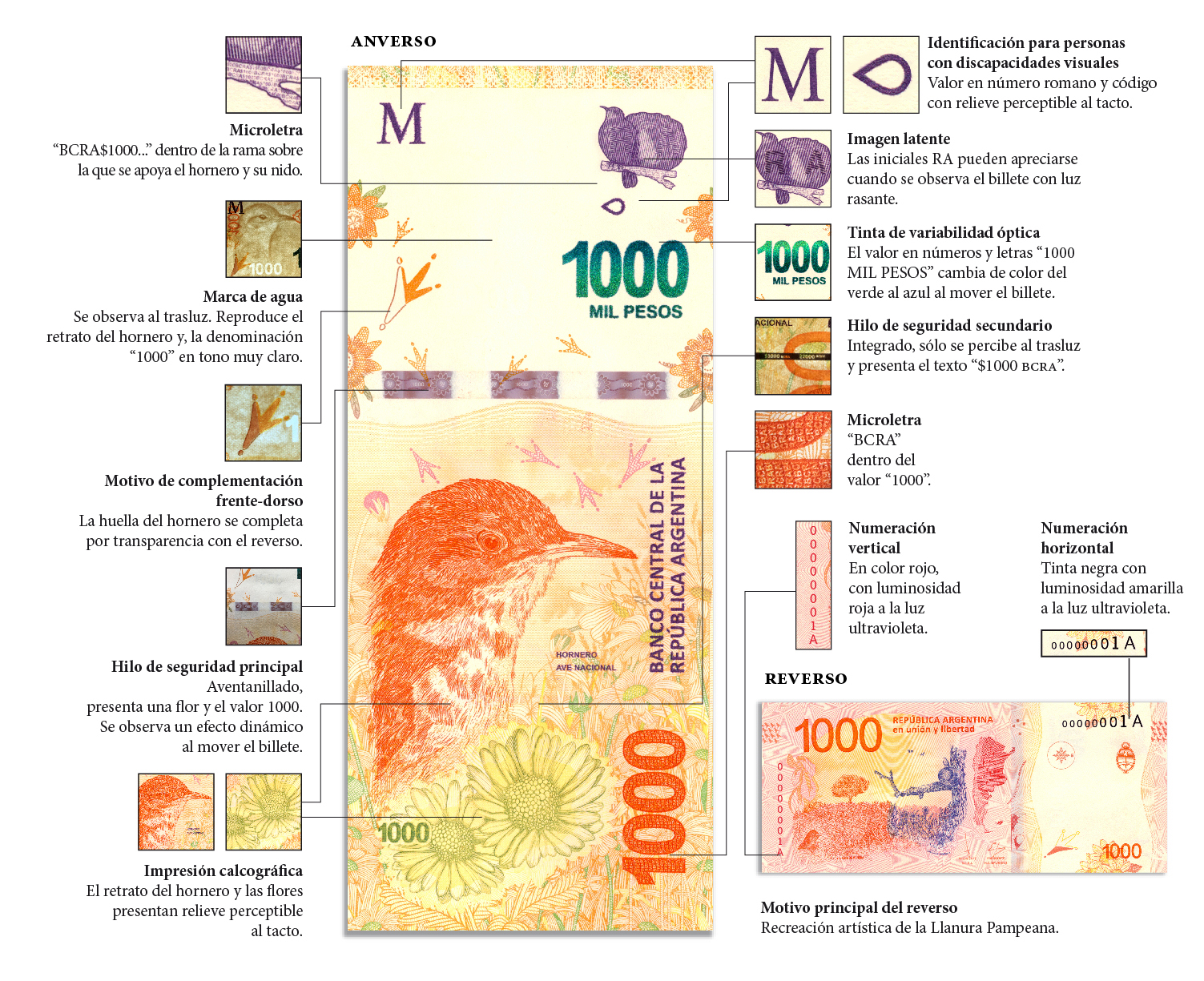
Design
The design of the bill illustrates the Rufous Hornero.
Rufous Hornero
Emblematic bird distinguished by the potent nest it builds, its little adobe house.
This South American bird was named National Bird in 1928 by the Plata Ornithological Association – an organization known as Aves Argentinas-.
The Rufous Hornero measures around 20 centimeters and has earthy-colored feathers. Mentioned in numerous poems and songs, many myths and legends have been built around it, but above all it has been identified with the property of providing good omen. It is insectivorous – it feeds on ants, small spiders or larvae – and has sedentary habits. It usually always flies near the nest, in search of materials for construction or food for its chicks.
It inhabits both the countryside and the cities: it can settle its nest in trees, posts or cornices of buildings. “The Rufous Hornero’s little house has an alcove and a living room” describes a poem that Leopoldo Lugones dedicated to this species. This concept is based on the reality of its nest: inside there is a partition that divides the entrance sector and the incubation chamber, thus preventing the passage of predators and protecting the eggs from the winds. They do not migrate, each autumn begins a new cycle with the construction of another nest.
The nest that they mold between six and fifteen days, depending on the conditions of the environment, weighs four to five kilos and is extremely resistant, can withstand up to 100 kilos and remain firm despite the sun or storms. They mainly use mud, straw and roots, among other materials from the environment.
Another distinctive characteristic of this species is that it maintains a partner throughout its life and develops most of its activities together. Both the male and the female can build the nest and incubate the eggs, and it is very common to hear them sing in duet. In October, the female lays between three and six eggs there that are incubated for 15 days; the chicks remain between two and three months under the care of their parents.
Sources: Aves Argentinas www.avesargentinas.org.ar
Obverse
The main motifs are printed in intaglio and the backgrounds in offset.
The portrait of the Rufous Hornero is reproduced with ornamental flowers, accompanied by the text “HORNERO AVE NACIONAL” (RUFOUS HORNERO NATIONAL BIRD). On the right it reads “BANCO CENTRAL DE LA REPUBLICA ARGENTINA” (CENTRAL BANK OF THE ARGENTINE REPUBLIC).
The security background evokes the vegetation of the Pampean plain, in the lower sector of the obverse. In the upper sector, representations of Rufous Hornero footprints in multiple directions, as a symbol of plurality, and ornamental flowers on both edges.
In the upper left angle, the letter “M” expresses the value of the bill in Roman numerals and on the right, the image of the bird and its nest is represented.
Reverse
The main motifs are printed in intaglio and the backgrounds in offset.
An artistic recreation of the Pampean plain, habitat of the Rufous Hornero, is observed as the main motif. Between the landscape and the bicontinental map of the Argentine Republic, is located the distribution map of the Rufous Hornero that reflects the area where it lives.
On the upper side edges, a set of Rufous Horneros is completed by joining the ends of the bill.
In the lower left corner there is a representation of the Rufous Hornero as an element dedicated to the children’s public.
Date of Issue
30/11/2017