Within the framework of the XXXIV Annual Congress “From Management to Growth”organized by the the Argentine Institute of Finance Executives (Instituto Argentino de Ejecutivos en Finanzas, IAEF), Federico Sturzenegger, Governor of the BCRA, headed the working lunch on June 6.
The full speech is as follows:
Thank you for your invitation. It is always a pleasure to interact with you and share ideas and viewpoints.
I was last here in February. You may remember that then we said we would face three sensitive months in terms of inflation. Three months later, inflation shows a downward trend and we should start focusing on the path inflation will follow by the end of this year and during 2018.
In the first place, I consider it appropriate to analyze the evolution of this year’s price indexes in perspective as illustrated in the first chart. Here we show the path of domestic inflation calculated by the BCRA. Please note that, since April, the y.o.y. variation of our benchmark index for target compliance has been included. It is the price index for the province of Buenos Aires, the index of the widest geographical range published by the INDEC.
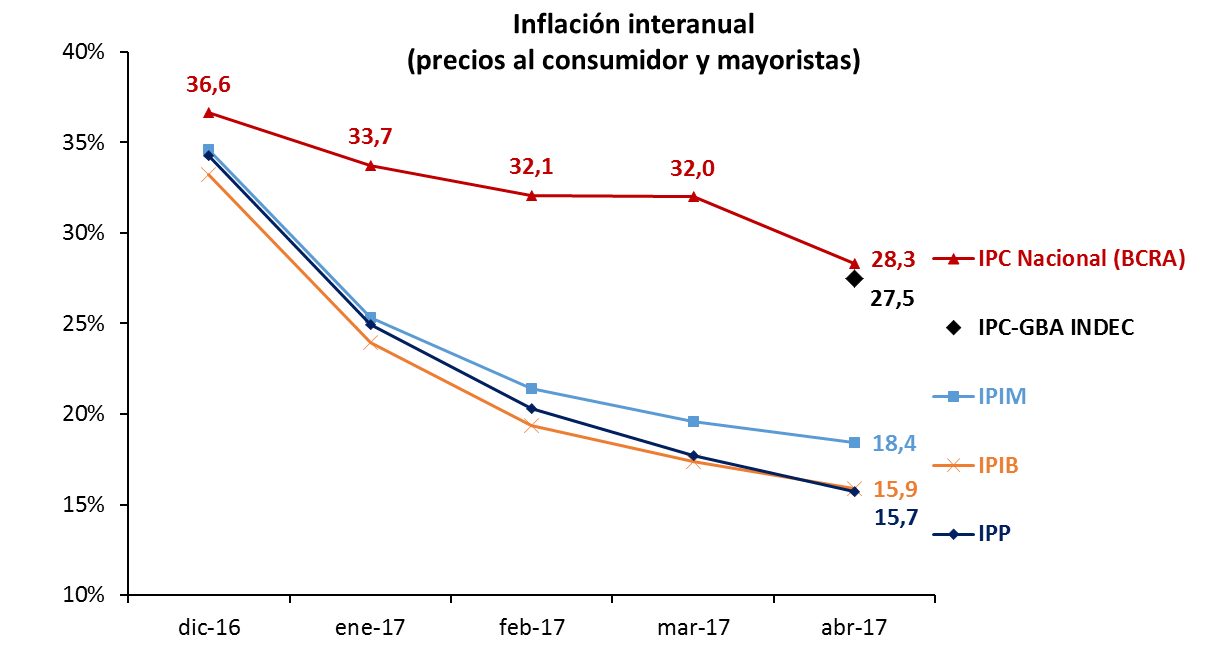
Source: INDEC and BCRA
As you can see, a significant process of deflation has been enhanced during this year. In April, the first figure of y.o.y inflation of the new CPI (Consumer Price Index) published by INDEC was 27.5%. We expect this figure to be below 25% in May, and to range between 21% and 22% in July, thus reaching the lowest inflation rates since 2009 and, in turn, the lowest rate in the last ten years if we disregarded the period affected by the international crisis of 2009.
Also, wholesale prices are aligned with the inflation target for this year. The Wholesale Price Index (Índice de Precios Mayoristas, IPIM) reflected an 18.5% annual inflation in April while the Wholesale Basic Price Index (Índice de Precios Básicos al por Mayor, IPIB), which includes the prices of goods but excludes tax components, rose by 15.9%. On the basis of these percentage points, the BCRA sees no early sign that the wholesale prices may exert pressure for consumer prices to climb.
Beyond the good performance of y.o.y. inflation, it is important to understand why inflation behaved as it did. A good diagnosis is central to administer the right medicine.
Let’s go back in time for a while. Last March’s 38% benchmark interest rate remained unchanged for the necessary time so as to slow down inflation to less than 9% in the second half of the year, which slightly edged up one third of the inflation of the first half of the current year.
Once we witnessed the consolidation of a downturn in prices in the second half of 2016, we backed such disinflation by reducing the rate as well making sure we would keep an “ex ante” positive real interest rate. Inflation figures in November, December and January were really promising by exhibiting a sharp drop. For this reason, and to avoid an excessively contractionary bias in monetary policy, we allowed rates to move in the same direction with a focus on the longest segment of the curve.
However, in February when I last attended this meeting, prices indicated that monetary policy loosening was “ex post” and probably greater than necessary. As a consequence, since March 2, we have withdrawn liquidity surplus so as to adjust market rates from the floor to the center of the repo corridor established by the BCRA. Consequently, in the following two months the BCRA gave a boost to the rates of the shortest LEBAC bills, which rose 450 basis points. As part of this process, on April 11, we strengthened such actions by increasing the benchmark rate by 150 basis points, figure at which it stands today. As a result, current monetary aggregates remain at the levels reached by mid-December. We are determined to continue following our monetary policy rate until monthly inflation shows a strong downward trend, which started last May. This Central Bank will strive for ensuring an ”ex ante” positive real interest rate in order for inflation to fit within the targets it has set.
I think we can draw at least two lessons so far. In the first place, it is obvious that monetary policy works and it is the essential medicine to cure the ravages of inflation. The main and most problematic issue is to appropriately determine the doses to be administered, evaluating them according to the future dynamics of the variables involved.
On the contrary, we see that other factors, occasionally considered to be a source of inflation, cannot seemingly explain the observed price evolution. The exchange rate performance during this period did not match up with the rest of prices at all. Also, the often mentioned inflationary inertia was not evidenced when we witnessed a sharp inflation deceleration in the second half last year. In addition, market structures, that is, commercial chain characteristics, did not change between the first and the second half of 2016. The only change was monetary policy harshness.
Looking ahead, economic analysts’ forecasts summarized in the BCRA Market Expectations Survey (Relevamiento de Expectativas de Mercado, REM) predict that annual inflation will be just above 21% by the end of 2017, 17.4% in the next 12 months and 15% in 2018. As I told you, we will probably reach an annual inflation rate somewhat lower than 22% in July, which means there would then be five months ahead to get closer to the 17% , which—as assumed by REM analysts—will be reached in May or June next year. By the end of this year, it is also essential to reach such monthly inflation levels as they t are compatible with the inflation target for next year.
So far, I have expressed my opinion about inflation, an unavoidable matter of concern in any BCRA talk. However, I would focus on another topic today. Given you are financial managers, I would like to take the opportunity to discuss the appropriate way to manage in a floating exchange rate context, the new exchange rate regime we are implementing in Argentina.
Since the beginning of our administration in December 2015, we have quested for a macro economy with no shortcuts. Particularly, we decided to reduce Argentina’s inflation levels by providing a floating exchange rate regime, which has never been applied in the history of our country. This implies leaving behind the easy path of fixing the value of currency as we were used to. A floating exchange rate regime is an absolutely essential tool for Argentina to stop falling in the macroeconomic traps it fell time after time and to protect our real economy against the inevitable worldwide ups and downs.
The floating exchange rate is central to our viewpoint about the chance of achieving more orderly, less intense and even “healthier” cycles in Argentina. Under a floating exchange rate our economy has a greater ability to adjust to external shocks, which makes our country have a priceless flexibility to face international fluctuations and correct our potential instability, while protecting our productive structure. If we had a fixed exchange rate, we would lose that tool, that escape mechanism, and problems would be much more difficult to solve. Real economy would then be forced to change in the presence of worldwide cyclical changes.
Maybe Argentinians are, unknowingly, already enjoying these benefits. During last year, Argentine economy has gone through two significant worldwideshocks: the Brexit and President Trump’s election. Some weeks ago, there was a political crisis in Brazil. Within the context of these three events, our exchange rate had to adjust to the changes experienced by our commercial partners’ currency with respect to the American currency. For instance, think about what would have happened if the peso had not been adjusted to face a 5, 6 or 7% depreciation of the Brazilian real in real terms. However, Argentine economy could smoothly cushion the effects of these shocks. In fact, the 0.1% growth in the third quarter of 2016 rose to 0.5% in the fourth quarter; it accelerated to about 0.7% in the first quarter of 2017 and once again to nearly 1.4% in the second quarter, according to estimations by the Ministry of Economy. This means that economy could avoid external brunts without affecting its domestic recovery dynamics. So this is the use of the floating exchange rate.
A few days ago, while talking with the Governor of the Central Bank of Colombia about the crisis they faced in 1999, he told me that one of the main problems that worsened their serious situation was that they had a fixed exchange rate. In times of reversal of capital flows and crisis, such inflexibility of the exchange rate forced the monetary authority to adopt even more contractionary measures, having to increase the interest rate in order to keep a pre-established exchange rate parity. This procyclical behavior worsened the macroeconomic situation even more, deepening the newly born recession. Argentina faced a similar problem when the convertibility crisis broke out. The monetary authority, intended to keep a fixed exchange rate, can only adopt contractionary measures at hard times until the situation becomes unsustainable, and the pre-established exchange rate is entirely abandoned.
This type of dynamics generally end up in big crisis, such as the 2001 crisis in our country or the crises suffered by many Latin American economies in the same year and in the past. Fixed exchange rate regimes tend to broaden cycles, and generally lead to strong recoveries and subsequently very strong crises as well in scenarios when the piled up instability becomes unsustainable or when economy must adjust to external shocks, at which time the fixed exchange rate is forced out. This sequence turns into economy’s high volatility with subsequent detrimental effects on our country’s long-term growth. In a paper I published with my colleague Eduardo Levy-Yeyati in the American Economic Review1 some years ago, we discussed the relationship among the different exchange rate regimes and their impact on economic growth, on the basis of 183 sample countries from 1974 through 2000. We found out that fixed exchange rate schemes in developing countries increase the broadness of economic cycles. On the contrary, a floating exchange rate scheme leaves more room to adopt economic policy measures and moderates the product’s fluctuations, thus reducing volatility given it increases the economy’s capacity to absorb potential shocks.
We also discovered that a rigid exchange rate scheme tends to reduce the long-term growth rate by more than 1 p.p. in developing countries. This result is associated with both the strength of the crises gone through by countries which had adopted fixed exchange rates, and with the negative effects derived from international fluctuations, in view of which the capacity of fixed rates was very limited. Fortunately, we have learnt the lesson and most countries in the region have adopted floating exchange rate regimes.
Exchange rate flexibility gives rise to more orderly recoveries while it dispels the possibility of crises to come. This way, it contributes to the achievement of a higher and more sustainable long-term growth. That is our goal in Argentina.
Now, I would like to focus on an important aspect of the exchange rate scheme, to which we are getting used to little by little. For the exchange rate to respond to ups and downs or instability, it is essential to allow it to fluctuate both upwards and downwards. That is, if at times, conditions are given for currency to depreciate, currency appreciation should also be facilitated when appropriate, so that it does not fluctuate in only one direction. This allows the exchange rate dynamics to separate from the rest of the prices in the market, thus limiting the so called “pass-through” (the transfer of exchange rate changes to prices), from which most of the economies in the region have already got free. So, for the exchange rate to go up smoothly without producing disruptions, downward movements should also be likely to occur quietly as set by the economy’s essential variables.
Following this line of thought, today I would like to analyze—from a financial viewpoint—what an ideal management would be like in a floating exchange rate country. I would like to highlight the fact that you, as financial managers, have a great value to offer your companies in this new context. Precisely this is so, because you are in a position to grasp the dynamics that come up, to develop strategies to better draw on the financial resources of your companies, and to manage risks smartly.
I will go over three main issues:
- a) The exchange rate predictability.
- b) The ideal financial strategy to follow in this context.
- c) Credit access and cost.
a) The exchange rate predictability
As you already know, one of the first concepts taught in world finance courses is that the price of any asset freely traded in the market is absolutely unpredictable. This is a well-known trait of financial assets’ prices, empirically proved, which starts with Fama’s germinal paper2 (1965), and supplements with his later contribution together with French3 (1988, 1992, 1993).
In a few words, the results reveal that—if markets work properly—the current prices of assets will convey reasonable information. Thus if, for instance, agents come to know that the price of an asset will go up in the future, the demand of such asset will increase today and, consequently, its price will soar until the spot price matches the expected price and the implied return disappears.
No doubt, this also applies for the floating exchange rate. In the foreign exchange market, Meese and Rogoff were the first ones to test this hypothesis 4 (1983) in a paper for the record books, presented when the developed world started to be acquainted with floating exchange rates regimes. They essentially assessed the reasonability of nominal exchange rate forecasts (from several countries) which were deduced from econometric models based on the potential determinants of foreign exchange parity. They concluded that the best model to predict the evolution of the nominal exchange rate was the random walk, which is just a random sequence of values without any types of additional determinants.
This finding backs up Fama’s theory according to which it is impossible to anticipate the future price of the different assets traded in productive markets. Then, they proved the impossibility of predicting the future evolution of the floating exchange rate.
BCRA professionals have also carried out a similar analysis on the Argentine exchange rate, from the implementation of the floating exchange rate in December 2015 to the present. They concluded that the daily rate of the peso depreciation stood for the so-called idea of “white noise” in statistical terms. So it is practically impossible to predict it. That is, the peso-dollar parity was not an exception, and the development of its spot price cannot be consistently forecast.
It is interesting to consider that since we lifted the clamp, the exchange rate went up over 51% of the subsequent days, while it dropped on the remaining 49%. This situation has shown the most unpredictable currency behavior ever seen since foreign exchange parity became flexible. In the chart that follows, there is a histogram of nominal exchange rate monthly variations since the clamp was removed. The distribution of variables would be quite symmetrical at both sides of the zero number, but for some atypically high values found to the right side of the chart. This evidences how risky it is to forecast an exchange rate future value given its unpredictability in flotation contexts.
Histogram of nominal exchange rate monthly variations (in logarithms)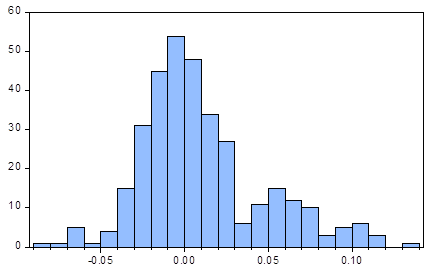
Source: BCRA
Now, what are the consequences for you as finance managers of your companies?
Firstly, getting part of your cash flow into open positions in foreign currency does not generate returns but volatility. The prices of currencies may go up or down, according to theshocks and changes that affect our economy, but they do not generate real returns.
To put it simply, a cash flow with foreign currency income and costs in pesos entails an exchange rate risk, which cannot ensure a positive real return. On the contrary, this makes a cash flow with a really high volatility level, just because fluctuations in foreign currency value are very high. This volatility brings about stress on your companies’ cash flow. So firstly, it is necessary to be aware of such a stress and, secondly, to mitigate it.
So what is it advisable to do or what should companies do as to their daily transactions dependent on the exchange rate? Does unpredictability of the foreign currency rate imply that there is nothing to be done? Should we stand back with our arms folded and leave everything in God’s hands? Certainly not. In fact, we will conclude that there are many and very important things to do.
b) The ideal financial strategy to follow in this context.
Let’s consider an export company with costs in pesos and income in dollars (the same reasoning is valid for companies with costs in dollars and income in pesos). This means that cash flow in pesos depends on the fluctuations of the price of dollars, which sets back a reasonable financial planning. How can the cash flow of an export company be managed under these circumstances?
The ideal strategy consists on hedging the flows of imports and exports. In this way, the exchange rate component is removed from the equation as income in foreign currency remains fixed n pesos. The same applies for companies with income in pesos and costs in foreign currency.
In addition to this achievement, which is valuable per se, there is an extra benefit. As you know, the arbitrage of exchange rate future prices is a trade that profits by exploiting the price differences of domestic rates and international rates:
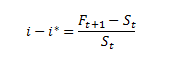
Where i is the domestic interest rate, i* is the international interest rate, Ft+1 is the relevant exchange rate future value, and St is the current spot exchange rate. It has to do with the well-known interest rate covered parity. At present, such parity takes place almost perfectly. For instance, have a look at the following chart, published in the BCRA blog5.
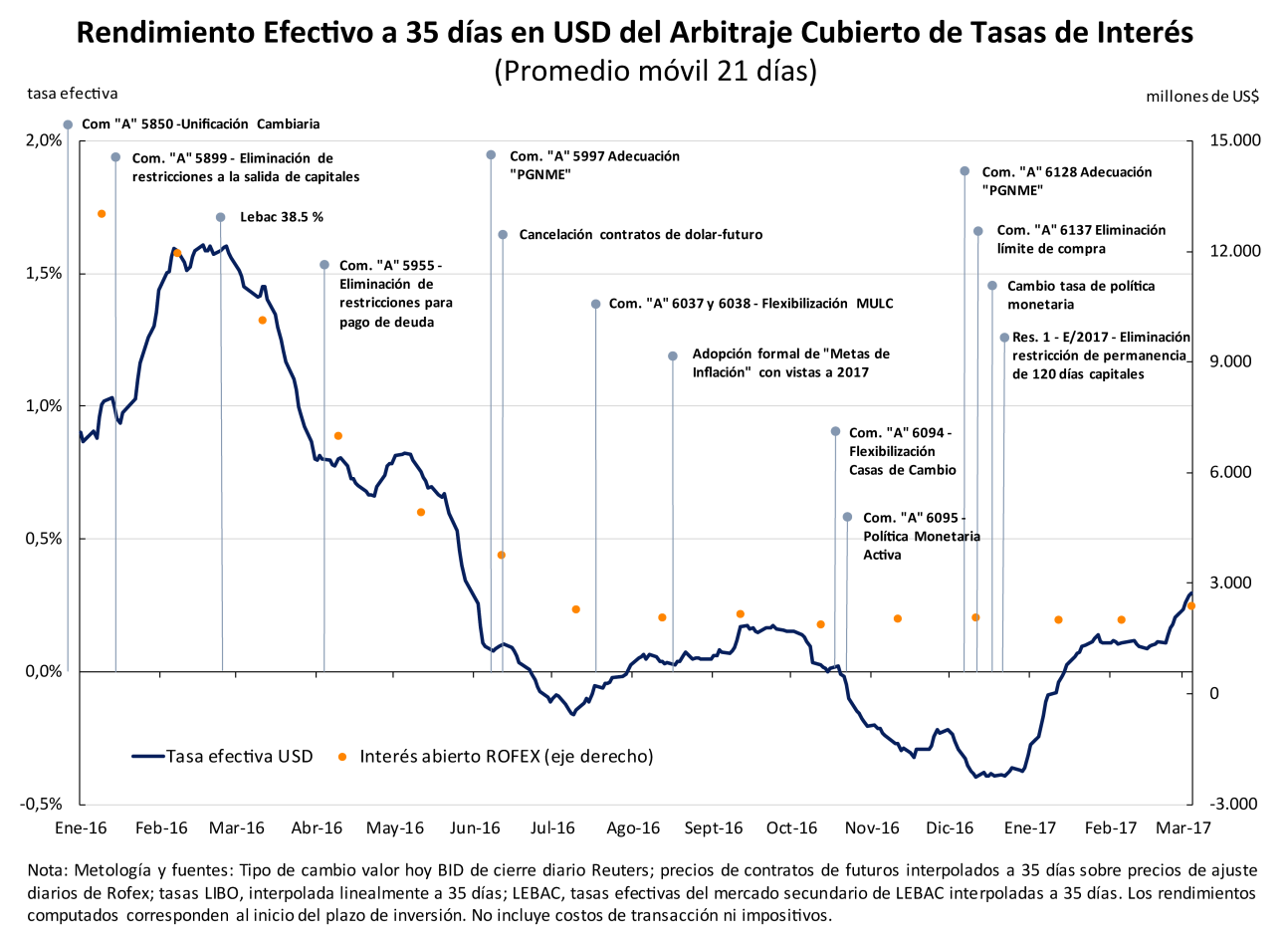
As you see, the blue line indicates that, at present, the expected devaluation implicit in the futures market involves an arbitrage of the interest rate differential between LEBAC bills and LIBOR bills in dollars. This means that future sales will make up for the domestic financial cost. For instance, the current prices would be as follows:
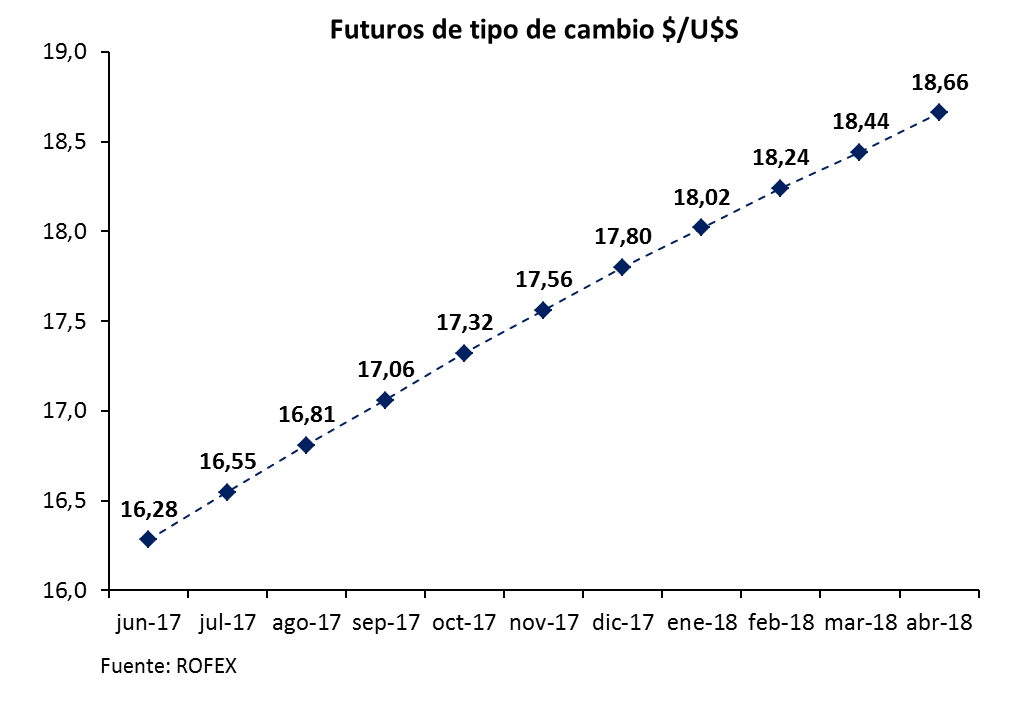
To sum up, the hedging of future transactions not only removes foreign exchange risks in cash flow but also produces returns at the domestic interest rate in pesos deducting the international rate. Remember, and this is of key interest, that the BCRA seeks to ensure that the nominal interest rate exceeds the expected inflation level (as part of its anti-inflationary policy). In this way, companies will actually get an increase in their income levels in real terms. That is, hedging transactions remove volatility and increase income in real terms. It is surprising to find that these mechanisms are not common place among domestic finance managers. Obviously, this may be explained by the fact that the floating exchange rate regime is just getting underway in our country.
No doubt, this financial management strategy is remarkably more effective than keeping a foreign currency open position, which is meant to be speculative and has a lower “real” income. There is certainly much to do!
It is interesting to point out that all the countries in this region, which implemented flexible exchange rate regimes, went through the same situation. For instance, let’s go over Chile’s case.
Chile: Assets and Liabilities in dollars, and Derivatives’ Net Position from the corporate private sector (2001-2016) (left axis % of total assets, right axis CLP/USD)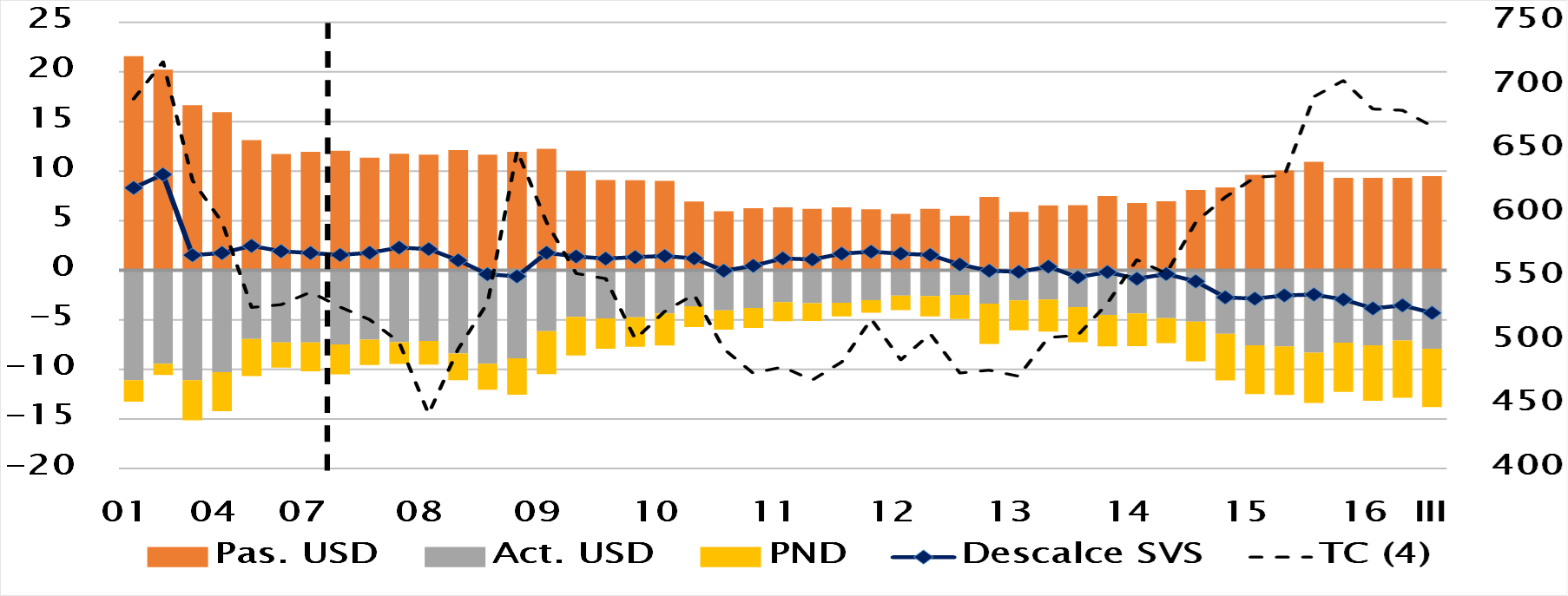
Notes (1) Mismatches are calculated as liabilities in dollars minus assets in dollars, minus net position in derivatives, over total assets (2) Annual data up to 2006, from then on, quarterly data (3) Accounting Information on each individual company, denominated in pesos. State-owned, Mining and Financial companies are not considered (4) Average exchange rate of the last month in the quarter (or year) in the secondary axis
Source: Central Bank of Chile, based on data provided by the Superintendence of Securities and Insurance of Chile (SVS)
As you can see in the chart, financial derivatives position from the Chilean private sector has grown prominently for the last few years in response to ideal financial planning in the context of a floating exchange rate implemented by our neighboring country. Every financial manager should remove the exchange rate risk component from their financial equations as a basic and essential strategy to calculate future cash flows and adopt the general financial planning of their business.
To conclude, let me announce some news on credit access and financing conditions for export and non-export companies.
c) Credit access and cost
Let’s go over the current situation of the different segments of commercial loans by analyzing the financing conditions by which companies are bound for access nowadays.
Firstly, in the following chart you can see the interest rate of promissory notes in pesos. Interest rates of these loans, which average term is generally around 10 and 15 months, are around 22%-23%, below the levels recorded in the last years of the previous administration. Truly enough, inflation’s dynamics and expectations are different. However, this issue cannot be neglected when analyzing the circumstances under which domestic credit can be accessed.
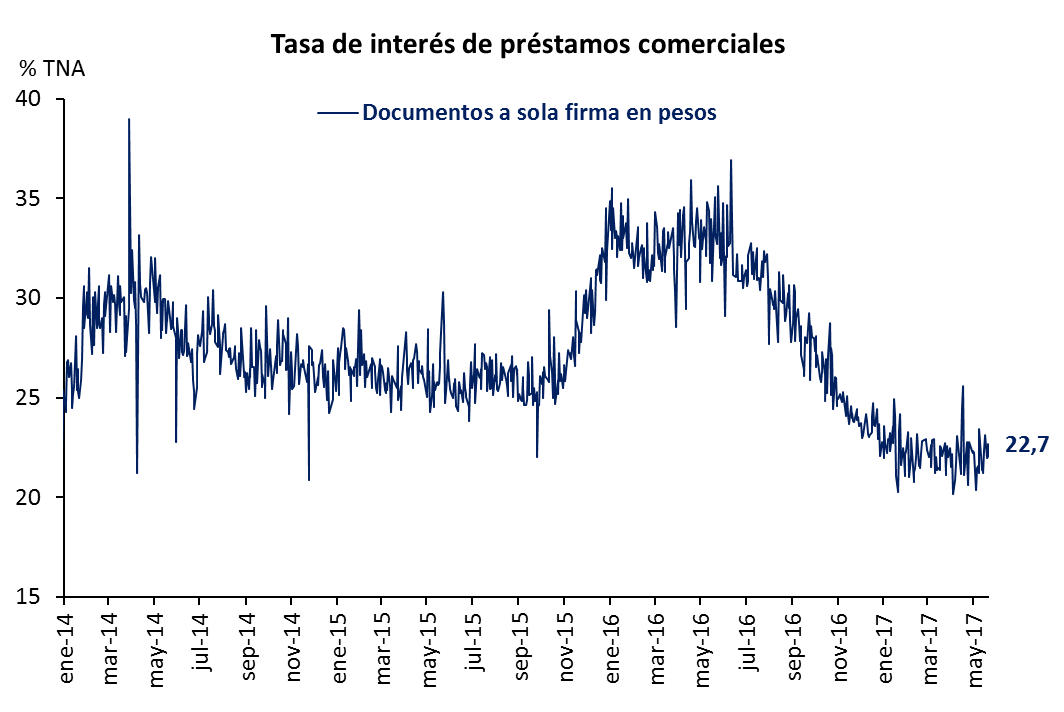
Source: BCRA
Secondly, as you may well know, the foreign currency credit segment has been increasing since the removal of the exchange clamp. This phenomenon took place in a context in which interest rates for these segments fell to unprecedented low values, from 5%-6% by the end of 2015 to 2%-3% nowadays, in answer to our decision to provide incentives in order to channel our financial system’s plenty unused resources in dollars towards productive activities. It is worth remembering that, after the removal of the clamp, the launch of the tax amnesty regime, and the general easing on the restrictions that imposed a severe burden upon our external sector, private sector deposits in foreign currency turned from USD9.3 billion in December 2015 to USD23.5 billion to date.
During the last few months, we broadened the purposes to which the financial institutions’ loan capacity in foreign currency would be channeled.
I think it useful to share this with you. In January, we allocated part of the deposits in dollars to loans for cattle rearing investment projects (Communication A 6162). By the end of April, the BCRA determined that financial institutions will be able to allocate part of those funds to finance importers of Argentine products or services, a mechanism through which Argentine banks will become funding sources for customers of Argentine export companies abroad, thus fulfilling a role comparable to that of development banks in other countries, (such as BNDES in Brazil and EXIM Bank in the USA). To put it simply, at present an Argentine bank can lend dollars to finance their customers abroad. This is the first time in many years that Argentine companies can go out into the world and offer goods and loans. A few days ago, we broadened the scope of loans so that residents in need of financing—for any purpose—against stand-by letters issued by a bank abroad may access credits in dollars. This was conceived as a strategy to use the amount of USD100 billion of Argentinians’ deposits held abroad—disclosed under the amnesty tax regime—as a mismatch coverage, thus increasing the use of dollars domestically. For instance, real estate developers may use their assets held abroad as a guarantee for domestic banks to resort to their deposits in dollars. In this case, the foreign exchange mismatch is covered by a foreign exchange collateral, not by loans. Thus, the latter may be used for any purpose. For instance, for a real estate development.
The following chart shows the development of the rates in dollars both for bank deposits and loans, and for financing in capital markets in our country.
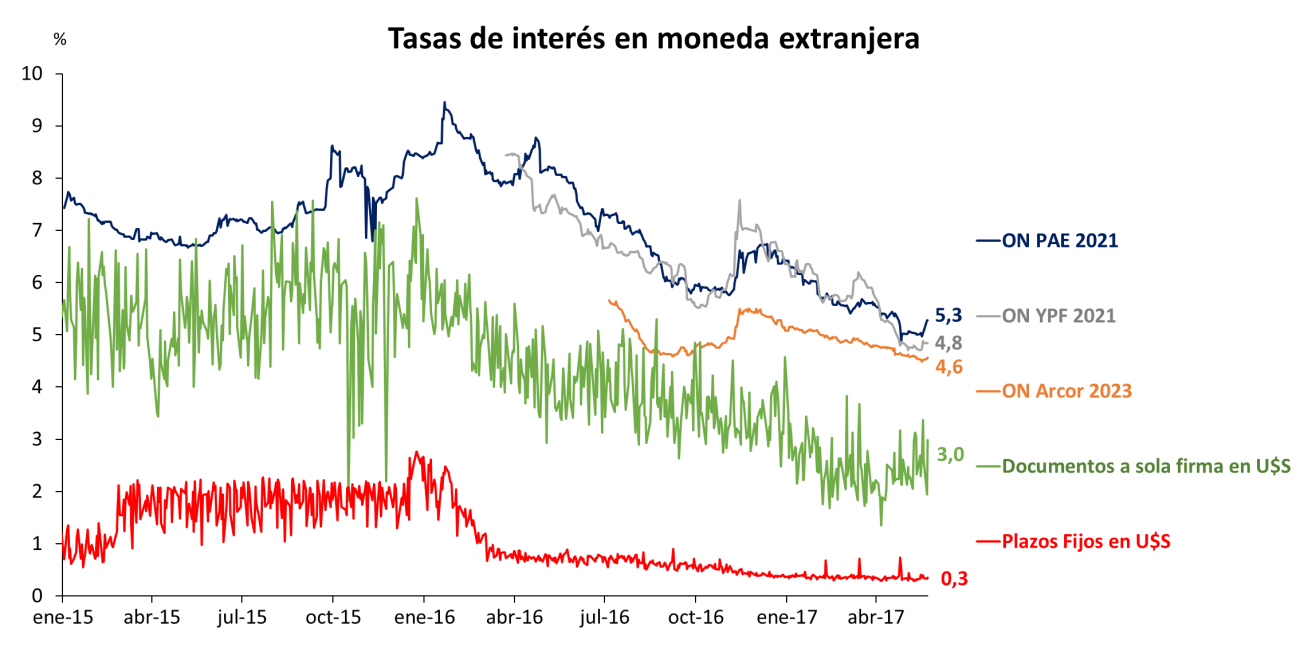
Source: BCRA
This reduction in capital cost means a real improvement in competitiveness for our export companies. Then, it is not surprising that the total amount of loans granted in dollars has quadrupled since December 2015, going up from USD2.9 billion to USD11.8 billion today. However, funds availability remains really high so we still have a great deal of funds to channel through these credit lines. It is worth noting that at the BCRA we are strictly monitoring this process to avoid potential currency mismatches, by implementing macro prudential measures to the letter consistent with the best international standards.
Finally, the other segment we fostered at the BCRA is that of units of purchasing power (Unidades de Valor Adquisitivo, UVAs), a tool which allows us to think, once again, about long-term loans in pesos in our country. You may know that mortgage credit in this denomination is growing every month and that mortgage credit stock has increased once again after a ten-year stagnation. The key lies on the fact that the installments of mortgage credit in UVAs are similar to those of rentals. Finally, we have achieved a goal which seemed to be impossible: nowadays the amount paid for purchasing real estate is the same as that paid for renting in Argentina.
However, for this segment to develop further, an appropriate funding growth in the same denomination is necessary. In this respect, Banco Provincia and Banco Hipotecario have already carried out the new issuance of corporate bonds in UVAs, and Banco Ciudad is ready to move in the same direction. These bonds contribute towards the market growth of UVA-denominated instruments, which will motivate both saving and long-term investment in domestic currency, something longed for and unthinkable in the past. The pending issue is to expand on corporate credit. Many private banks, such as Santander, are already offering this type of credit lines, yet the demand remains low. You may wish to get acquainted with this new credit facility, given UVA loans allow for the decrease of financial obligations in the short-term, making them more stable throughout the investment project and generating a significantly higher lending capacity for each cash flow.
I will call this speech to an end, and I hope these comments and thoughts will help achieve, at last, a stable Argentinian macro economy, capable of growing steadily and getting ahead for decades.
Thank you.
June 6, 2017
1 Levy-Yeyati, E. and Sturzenegger, F. (2003): To Float or to Trail: Evidence on the Impact of Exchange Rate Regimes on Growth, American Economic Review, vol. 93 (4), 1173–1193.
2 Fama, E. (1965): The Behavior of Stock Market Prices, Journal of Business, vol. 38(1), pp. 34-105.
3 Fama, E. and French, K. (1988): Dividend yields and expected stock returns, Journal of Financial Economics, vol. 22 (1), pp. 3-25. Fama, E. and French, K. (1992): The Cross-Section of Expected Stock Returns, Journal of Finance, vol. 47(2), pp. 427-465. Fama, E. and French, K. (1993): Common risk factors in the returns on stocks and bonds, Journal of Financial Economics, vol. 33(1), pp. 3-56.
4 Meese, R. and Rogoff, K. (1983): Empirical exchange rate models of the seventies: Do they fit out of sample?, Journal of International Economics, vol. 14(1-2), pp. 3-24.
5 ¿Existe bicicleta financiera en Argentina? (Is There Carry Trade in Argentina?), published on May 8, 2017, in the BCRA’s blog called “Ideas de Peso.”


