Monetary policy
Monetary Policy Report (IPOM)
Fourth Quarter 2022
This quarterly publication aims to analyze the national and international economic situation, assess the dynamics of inflation and its prospects, and explain in a transparent manner the fundamentals of monetary policy decisions.
Table of Contents
Chapters
1. Monetary policy: assessment and outlook
2. International context
3. Economic Activity and Employment
4. External Sector
5. Public Finance
6. Pricing
7. Monetary Policy
Sections
1. Financial vulnerabilities of the global economy
2. Initiatives to promote strategic sectors
3. Kiel Institute Trading Indicator
4. Primary Result of the National Non-Financial Public Sector adjusted by the cycle
5. ¿Es el IPIM un buen predictor del IPC?
6. Evolution of interest-bearing liabilities
Summary
1. Monetary policy: assessment and outlook
Global economic activity continued to slow in recent months and global growth forecasts for next year continued to shrink. This scenario occurred in a scenario in which the persistence of high inflation led central banks in advanced economies to implement the largest cycle of contractionary monetary policy since the global financial crisis of 2008/09. While financial conditions for developing countries improved at the margin, a mostly adverse environment of high interest rates and net capital outflows still prevails.
In Argentina, economic activity continued to expand during the third quarter, at a higher rate than in previous quarters. From the point of view of demand, a great dynamism of private consumption was observed, while investment remained around the maximum levels of 2017. For the fourth quarter, however, leading indicators of activity anticipate a slowdown in growth. This dynamic will partly reflect the effect of the drought, which affected the fine harvest in the latter part of the year and poses initial conditionalities for the outcome of next year’s coarse harvest. Even so, the economy would grow in 2022 by more than 5% per year, far exceeding the forecasts at the beginning of the year. For 2023, lower growth is expected, close to 2%.
The monthly inflation rate has been gradually reduced since September and stood at 4.9% in November, the lowest level since February this year. The moderation of the inflation rate was partly the result of a series of measures adopted by the National Government and the BCRA to contain the acceleration of prices verified in the first part of the third quarter. In particular, the monetary authority repeatedly raised the monetary policy interest rate to positive territory in real terms, helping to boost demand for peso-denominated assets, thus favoring exchange rate stability. For its part, the Ministry of Economy implemented policies aimed at consolidating the process of reducing the primary fiscal deficit and monetary financing needs, encouraged the liquidation of exports to strengthen international reserves, and reached agreements on reference prices on certain sets of goods and services. Among the latter, the Fair Prices Program launched in mid-November stands out. For the coming months, the gradual downward trend in core inflation is expected to continue, in an environment that, although it still registers high inflation expectations, is favored by a lower dynamism of the international price of commodities and a wage recovery that, at least for the moment, is presented as gradual. which contributes to reducing inflationary inertia.
In the context of the significant slowdown in the inflation rate in November, the BCRA decided to keep the monetary policy rate unchanged, tending to consolidate an environment of positive real interest rates that favors financial and exchange rate stability, and to reinforce the trend of gradual deceleration of inflation in the medium term. Thus, the interest rate of the 28-day LELIQ remained at 75% n.a. (107% e.a.), as well as the minimum regulated rates on term placements for individuals for up to $10 million. The rest of the term placements maintained a minimum guaranteed rate of 66.5% n.a. (91% e.a.). It is worth remembering that, in an economy like Argentina’s, with a relatively small credit channel, the rise in interest rates acts mainly by encouraging savings in pesos. Its anti-inflationary action therefore largely involves contributing to exchange rate and financial stability, and must be complemented with other economic policy instruments to reduce inflationary inertia.
Other policies of the BCRA also contributed to preserving financial and exchange rate stability. On the one hand, the monetary authority continued to use its capacity to intervene through open market operations, in order to promote greater liquidity, depth and transparency of the sovereign debt markets. On the other hand, in the area of foreign exchange, the Central Bank continued to calibrate the rate of change in the nominal exchange rate, placing it at a level in line with the inflation rate, in order to preserve external competitiveness and enhance the accumulation of reserves, complementing the exchange rate policy with the continuous improvement of the current regulatory framework of the exchange market. It is worth highlighting the creation of the “Export Increase Program”, which allowed the soybean complex to liquidate foreign currency at an exceptional and transitory exchange rate and had a positive impact on International Reserves of US$5,000 million during September and, in a second stage, an additional US$1,200 million from the end of November to the closing of this edition.
The agreement at the technical level between the IMF and the Argentine authorities on the third review of the Extended Facilities Program, and its subsequent approval by the executive board of the multilateral credit organization, consolidates the monetary policy framework that the BCRA has been implementing, with a focus on a policy of interest rates that allow the preservation of the savings of families and companies and a path of the official exchange rate that sustains the levels of external competitiveness of the economy. Within the framework of the agreement, the fiscal deficit targets, financing to the Treasury and the reserve accumulation targets for the 2022-2023 biennium were maintained. Likewise, progress will continue with a structural agenda that includes actions to strengthen the BCRA’s balance sheet and design a roadmap for the gradual and conditional relaxation of exchange controls, among other aspects of the National Government’s policy.
The BCRA will continue to calibrate its policies with the aim of consolidating the disinflation process. To this end, it will continue to monitor the macroeconomic situation, paying special attention to the past and prospective evolution of the general price level, the sovereign debt market and the dynamics of the exchange market, particularly in an election year where greater volatility is typically observed in the financial markets. It will also maintain at all times a prudent administration of monetary aggregates, sterilizing any surplus liquidity with its monetary regulation instruments, in order to preserve monetary balance.
In this sense, the evolution of interest-bearing liabilities in recent years was the counterpart of the policies implemented by the BCRA to assist the National Treasury in the face of the COVID-19 pandemic, stabilize the sovereign debt market in the face of episodes of excessive financial volatility, strengthen its international reserves and promote better returns for savers. which contributed to reducing pressures in the foreign exchange market and strengthening the demand for peso-denominated assets. Even with all these changes, the ratio of total monetary liabilities (Monetary Base plus Interest-Bearing Liabilities) to GDP stood at a level of 13.7% in November, 5.3 p.p. below the maximum reached in 2018 and a record similar to that verified between 2004 and 2015.
In the medium term, sustained growth in economic activity and a moderation in the inflation rate will lead to greater demand for real money balances. In this context, it is expected that the monetary sterilization effort will be gradually reduced. This will favor the demand for the monetary base to be provided by the interest associated with the BCRA’s interest-bearing liabilities and, potentially, by a reduction in its stock.
2. International context
The global economy has lost momentum, along with a generalized inflationary acceleration between countries. The most intense contractionary monetary policy cycle in decades is combined with the previous impact of higher energy prices and the economic slowdown in China (due to mobility restrictions in the face of COVID-19); and it has led to lower activity and tighter global financial conditions. These present significant risks given the high levels of public and private debt in many countries, the evolution of the mortgage market in some of them, and the possible contagion of further falls in cryptoassets, among other financial vulnerabilities.
Since the previous IPOM, the US dollar appreciated and commodity prices declined; The former has eased in recent weeks, but the latter are below their pre-war levels, with the exception of gas. As the risks of a global recession become more present, yield curves in advanced countries invert (with shorter-term rates rising and longer-term rates falling), easing financial conditions at the margin. In the same vein, capital flows to emerging markets registered lower net outflows than in the previous quarter.
The unprecedented monetary contraction underway will imply lower activity from Argentina’s main trading partners. It is still unknown whether this will imply a monetary policy cycle with a “soft landing”, accompanied by slowing inflation and an orderly evolution of the markets (which today discount in their prices a slower pace of monetary tightening, and a relatively close end of the contractionary cycle). Or, a more intense or prolonged monetary contraction, materializing financial vulnerabilities in both advanced and developing countries.
2.1. Lower global growth in a more uncertain context
In recent months, the world economy continued to suffer the negative effects of high energy prices, mainly in Europe; the slowdown of China’s economy due to mobility restrictions and problems in the real estate sector; and, with greater weight, the more contractionary monetary policy than expected in advanced countries, with its consequences on economic activity and global financial conditions. Downside risks remain due to potential vulnerabilities of the global economy to monetary contraction, linked to some elements of the financial system, the real estate sector and the levels of public and private debt in some countries (see Section 1 / Financial vulnerabilities of the global economy).
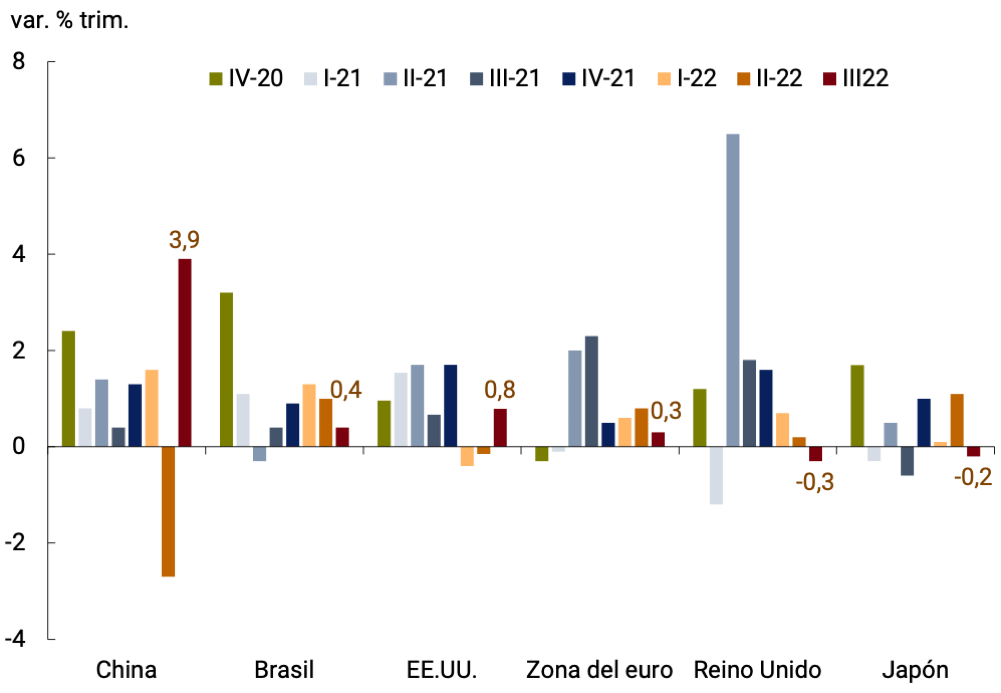
In the third quarter of 2022, China’s economy grew again, after the impact of the lockdown due to its Zero COVID policy in the second quarter, and that of the United States recovered, after two consecutive quarters of contraction. However, economic activity slowed in the euro area, as energy prices and interest rates were impacted, and in Brazil and the economies of Japan and the United Kingdom contracted (see Figure 2.1). This economic dynamic occurred together with unemployment rates still at minimum levels.
Figure 2.1 | Evolution of the GDP of selected countries (real GDP without seasonality

Source: BCRA based on data from national statistics institutes.
The high-frequency indicators for October and November show a worse economic performance in the fourth quarter of 2022. In October, industrial production contracted in the United States, the euro area and Japan and stagnated in the United Kingdom, while in November it fell in China and fell again in the United States. Retail sales declined in China and the euro area in October and in the United States and the United Kingdom in November (see Figure 2.2, top panel). Forward-looking indicators also suggest that the deterioration in activity will deepen by the fourth quarter. According to purchasing managers’ surveys (PMIs), advanced economies, except Singapore, are in the area of greater contraction than a few months ago. For emerging countries, the measurement indicates expansion or stability, except in China, whose value suggests a decrease. The dynamics of the PMIs showed a worsening compared to the values recorded in August in all cases except Germany and the United States. Consumer confidence also declined in the euro area, the United Kingdom, and China, remaining below the long-term average, while it recovered in the United States and Brazil (see Figure 2.2, bottom panel).
Figure 2.2 | Activity indicators (top panel)

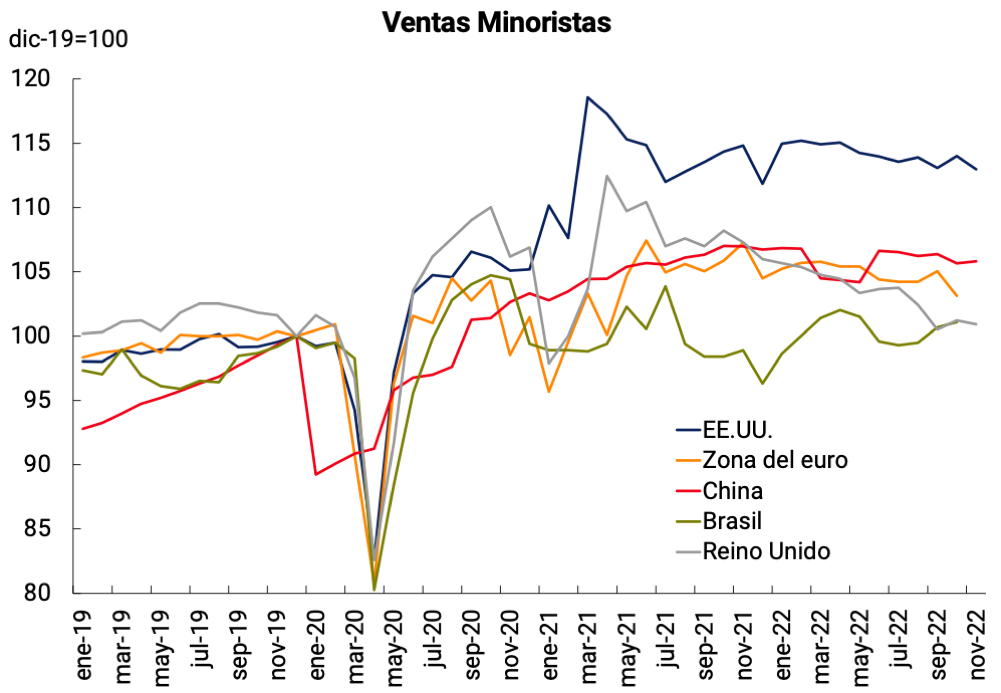
Figure 2.2 | Activity indicators (bottom panel)
Source: BCRA based on data from IHS Markit, OECD and Trading Economics.
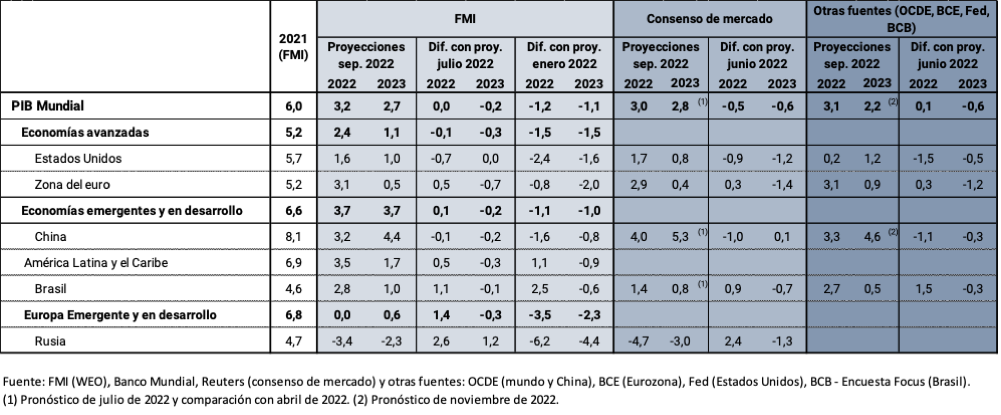
Global growth forecasts for 2023 continued to be reduced. Thus, the IMF, in its October report, maintained the growth forecast for this year at 3.2%, but reduced it to 2.7% in 2023 (-0.2 p.p.), in the face of inflationary pressures and rising interest rates. Despite the rebound of China’s economy in the third quarter, a slowdown in activity is expected for this year and next, with growth of 3.2% and 4.4%, respectively, well below the pre-pandemic average. The OECD’s November forecasts project that the global economy will grow 3.1% this year (+0.1 p.p. compared to the June forecast), decelerate to 2.2% in 2023 (-0.6 p.p.) and recover moderately to 2.7% in 2024. The market consensus also agrees in forecasting lower global activity for next year (see Table 2.1). On the other hand, inflation forecasts increased for this year, only foreseeing a gradual decline next year. The IMF expects global inflation to reach 8.8% in 2022, before slowing to 6.5% in 2023 and 4.1% in 2024, while the OECD sees inflation remaining high in the group’s countries, at more than 9% this year, before gradually moderating to 6.5% in 2023 and 5.1% in 2024.
Table 2.1 | Economic activity projections 2022-2023
Box. Global COVID-19 cases rebound from low levels, and China begins to ease its zero-COVID policy
Since the last IPOM, the curve of global COVID-19 infections continued its decline that began after the July peak of 7.75 million weekly cases, to reach 2.24 million at the beginning of November, the lowest values since October 2020. From that floor, a rebound began to be observed: in mid-December the global figure was 4.04 million, representing 80% growth in less than two months (see Figure 2.3). This has been widespread among geographical regions.
Meanwhile, the global death rate rose from 0.25% in September to 0.35% at the end of November. However, it is at values much lower than those recorded during 2021, when it exceeded 1.5% for almost the entire year, with maximums approaching 3%. This reflects the effectiveness of vaccines and progress in immunization campaigns.
Figure 2.3 | New cases and deaths from COVID-19

Source: BCRA based on WHO data.
More than 68% of the world’s population has received at least one dose and 63% the complete initial schedule as of December 2022. However, wide gaps in coverage remain between high- and upper-middle-income and low-income countries. In the former, between 74% and 79% of its population is fully vaccinated while, in the latter, barely 20%. The differences are even starker when booster doses are compared. High-income countries have applied 62 doses per 100 inhabitants, upper-middle-income countries 48, lower-middle-income countries 18 and low-income countries only 1.5 per 100 inhabitants.
China deserves a separate mention for its economic impact. During September and October, the weekly infected ranged between 6 thousand and 12 thousand, very low figures in relation to its population. However, the government increased restrictions and implemented lockdowns in several major cities. At least 36 cities, home to nearly 200 million people, were under some kind of limitation as of mid-October. President Xi Jinping stated at the opening of the 20th Communist Party Congress that there were no plans to abandon this policy in the near future.
Since the end of October, infections have accelerated, from 7,595 to 255,023 cases in December, exceeding the peak in April by 37%. In this context, public protests increased in cities such as Shanghai, Beijing and Guangzhou against the restrictions. Government authorities began to give signs that there could be changes in the Zero COVID strategy. In the first week of December, the National Health Commission announced new, more flexible provisions, including eventual focused and more time-limited lockdowns, avoiding school closures and eliminating COVID-19 testing requirements in public places. Going forward, this relaxation raises questions about the dynamics of the disease in a country where immunization in older adults is low (only 40% of those over 80 years of age have received the third dose), and the health system presents risks of saturation. Such uncertainty is transferred to the impact it may have on the economy.
2.2. The contractionary monetary policy cycle continues, with inflation declining in some countries
The world is going through an inflationary acceleration unprecedented in more than twenty years, with core inflation at around 11% for a group of representative countries. The persistence of inflation above the average upper limit of inflation (around 4%) led G20 central banks to carry out the largest cycle of contractionary monetary policy since the global financial crisis of 2008-2009 (see Figure 2.4a, b).
Figure 2.4 | Contractionary monetary policy cycle (selected countries)
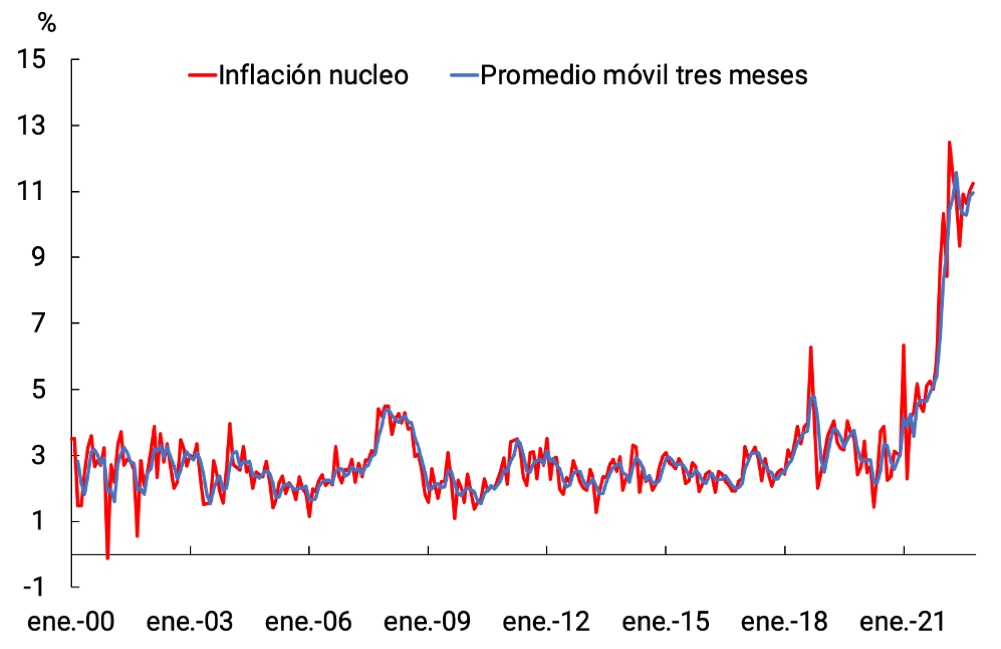 inflation b. Measures of MPR increases and decreases (cumulative)
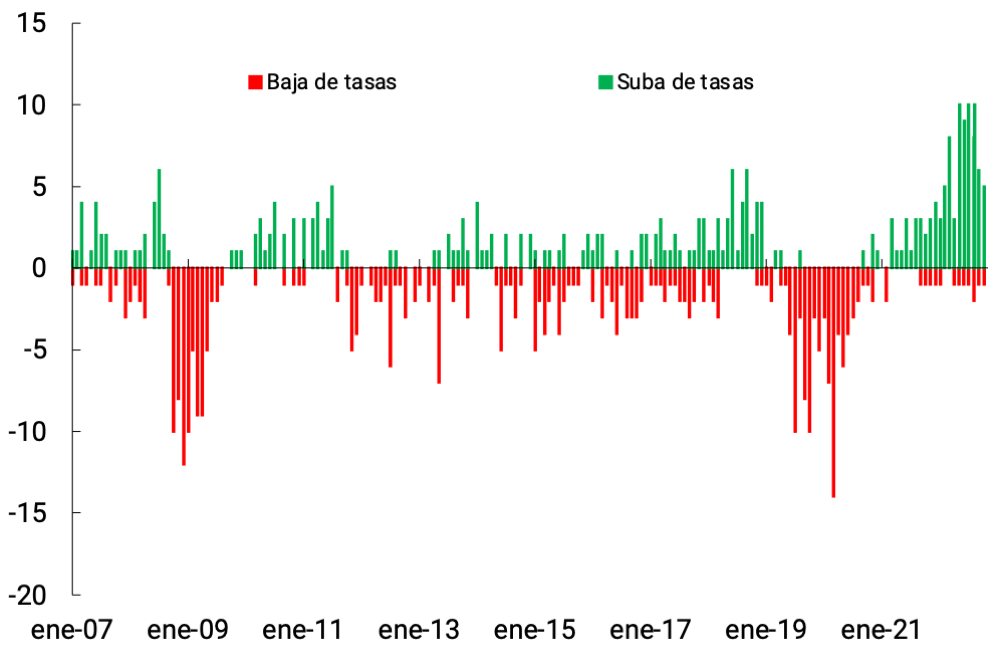
Graphic source to: IMF. Sample countries: Argentina, Brazil, Canada, Switzerland, Chile, Colombia, Czech Republic, Germany, Denmark, Spain, France, England, Hong Kong, Hungary, Indonesia, India, Israel, Italy, Japan, Korea, Mexico, Malaysia, Norway, Peru, Philippines, Poland, Russia, Singapore, Sweden, Thailand, Turkey, Taiwan, USA and South Africa. Graphic source b: BIS, G20 countries.
Central banks in developed countries, with the exception of Japan, continued to raise interest rates at record speed. Since the publication of the latest IPOM, the US Federal Reserve (Fed) increased its monetary policy rate (MPR) by 1.25 p.p. (and 4.25 p.p. since the beginning of the contractionary cycle; see box below), the European Central Bank (ECB) by 1.25 p.p. (2.5 p.p.), the Bank of England by 1.75 p.p. (3.4 p.p.), the Bank of Canada by 1 p.p. (4 p.p.), and the Reserve Bank of Australia by 0.75 p.p. (3 p.p.), (see Figure 2.5a). In addition, all central banks in developed countries have begun – or continue – their contractionary unconventional monetary policy (QT), withdrawing liquidity from the market. The exception is the ECB, which is due to start in January. On the other hand, Japan’s monetary authority maintains an unconventional expansive policy, to which it added the intervention in the foreign exchange market to prevent a further depreciation of its currency. At the close of this report, it indicated that it would continue to buy 10-year government bonds, but at a higher rate of return (0.5%).
In the face of these measures, there is an incipient slowdown in inflation in the US, Canada and the euro area, while the rest of the developed countries in the sample continue to have rising levels of inflation (see Figure 2.5b).
Figure 2.5 | Major advanced economies
to. Monetary Policy Rate
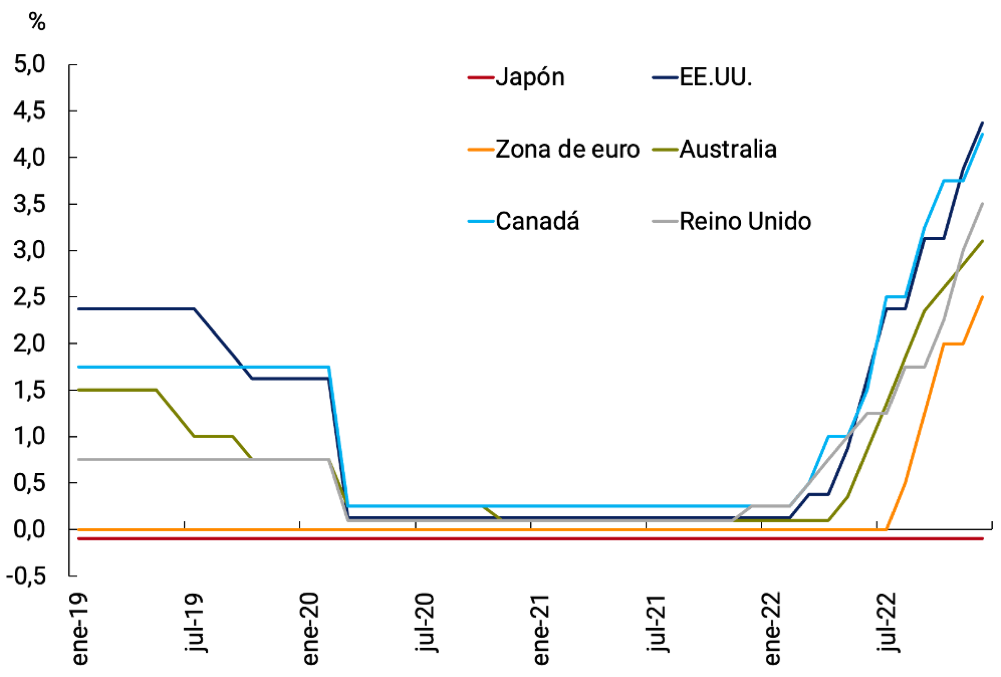
b. Inflation

Source: national statistical offices and central banks.
Central banks in emerging economies continued to take contractionary measures, with the exception of Turkey, which announced that the rate-cutting cycle was coming to an end; Russia, which left its MPR unchanged (after a series of reductions); and China, which took expansionary measures in response to the lower level of activity and the deterioration of the real estate market. Meanwhile, central banks in Latin America, which had begun to take contractionary measures earlier (Brazil, Chile, and Peru), kept their MPRs unchanged (see Figure 2.6a). Inflation in these economies has been decreasing slightly in recent months, except in Chile. Brazil applied a strong tax reduction that contributed 3 p.p. to the fall in annual inflation (see Figure 2.6 b); Other countries have also taken fiscal and trade measures to mitigate price increases.
Gráfico 2.6 | Economías emergentes de América Latina
to. Monetary Policy Rate

b. Inflation
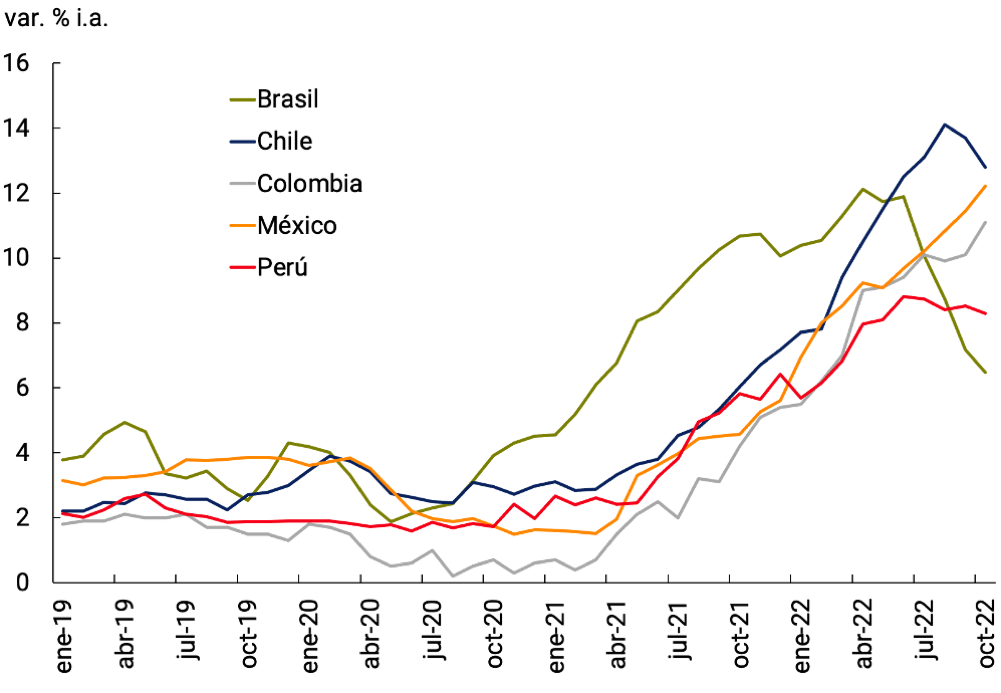
Source: national statistical offices and central banks.
Box. Historical contractionary cycles of monetary policy in the United States
The Fed’s current contractionary cycle is the fastest and most forceful in the last forty years. Although inflation is declining in the United States, it is nearly four times higher than the Fed’s inflation target, and labor market indicators show clear strength in historical terms (see Figure 2.7). In the previous contractionary cycle (which began in 2015) in the same period (ten months) the Fed had raised its MPR by only 0.25 p.p., while it currently has a cumulative increase of 4.25 p.p. If we compare it with the contractionary cycle most similar to the current one (in terms of its speed), the one that began in 1994, in the same ten months the Fed had accumulated a 2.5 p.p. increase in the MPR, 1.75 p.p. less than in the current cycle (see Figure 2.8 a).
Figure 2.7 | | Nonfarm job creation (left), unemployment rate, and jobless claims (right)
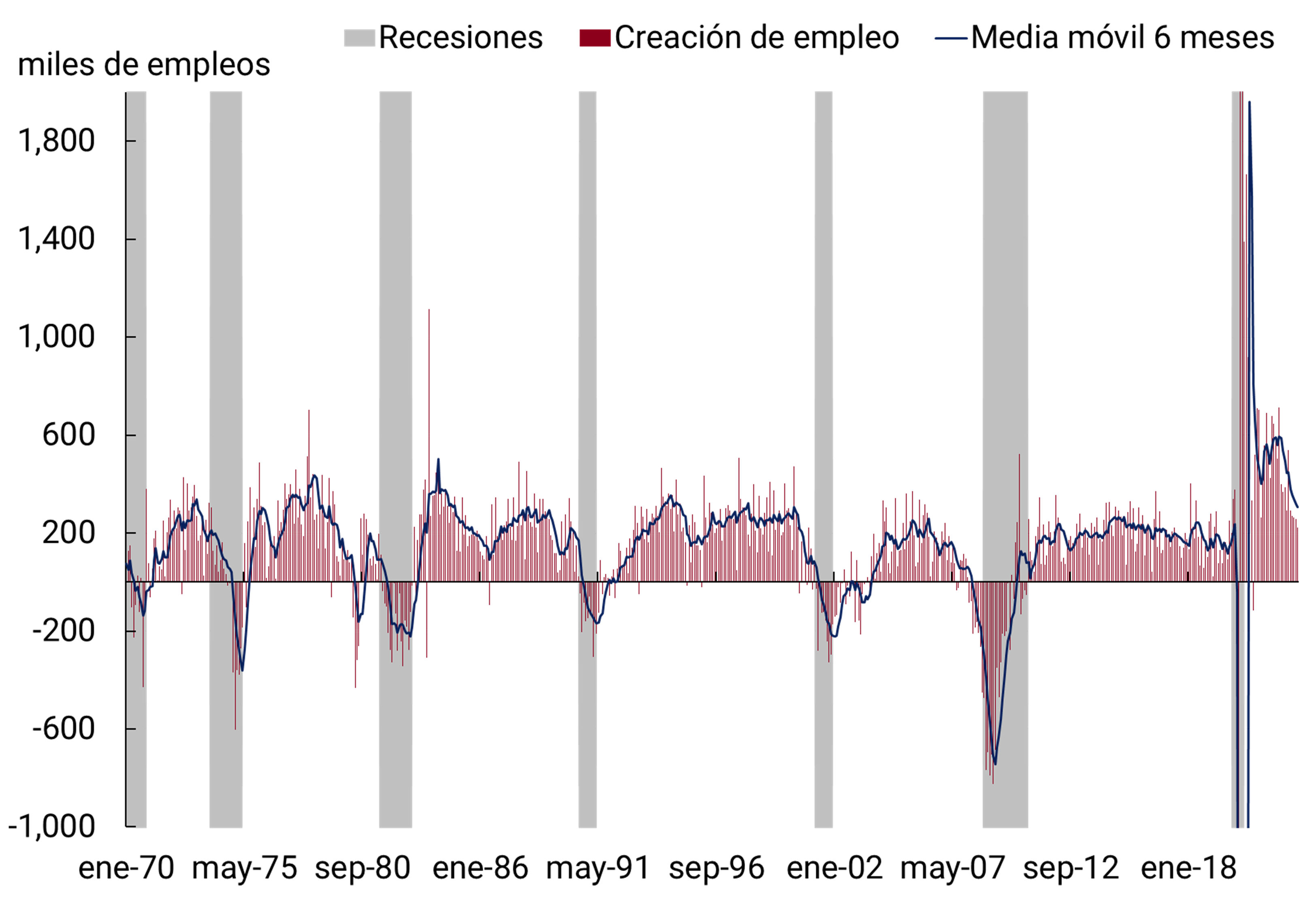

Source: St. Louis Federal Reserve (FRED).
But the Fed’s contraction is not only faster in terms of the MPR, it is also faster in terms of the size of its balance sheet. In the current QT cycle, the Fed’s assets contracted almost three times more than in the previous cycle (2018-2019; see Figure 2.8b). This may bring liquidity problems in the U.S. bond market, as it did in the previous cycle, which could have negative consequences on global financial stability. The same is even more likely, if you add up the contractionary effects of rate hikes and QT.
Figure 2.8 | Emerging Latin American Economies
to. Monetary Policy Rate

b. Change in Asset
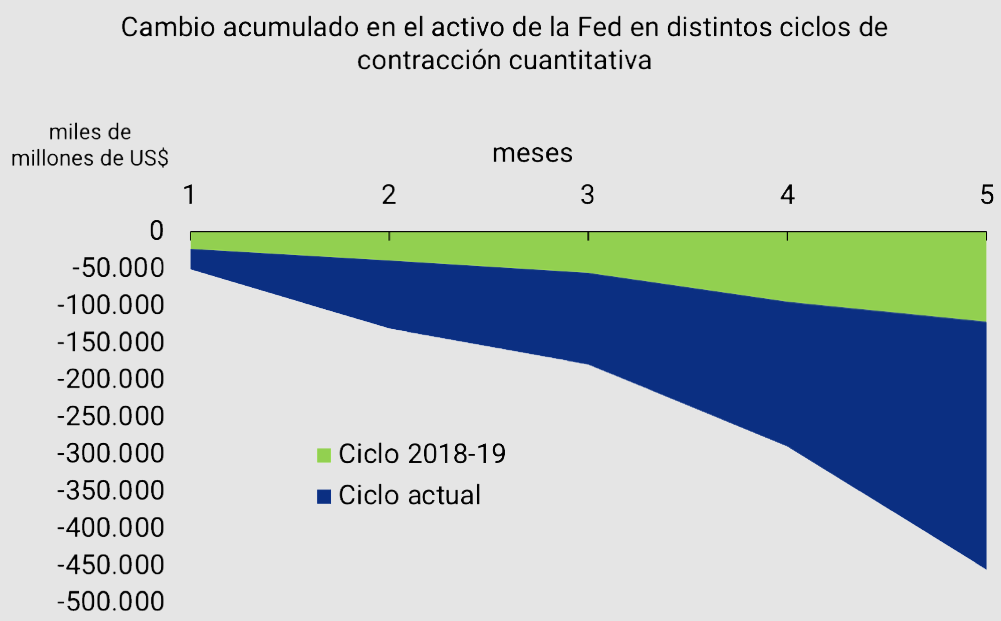
Fuente: Reserva Federal de Estados Unidos.
2.3. Global financial conditions reflect recession risk
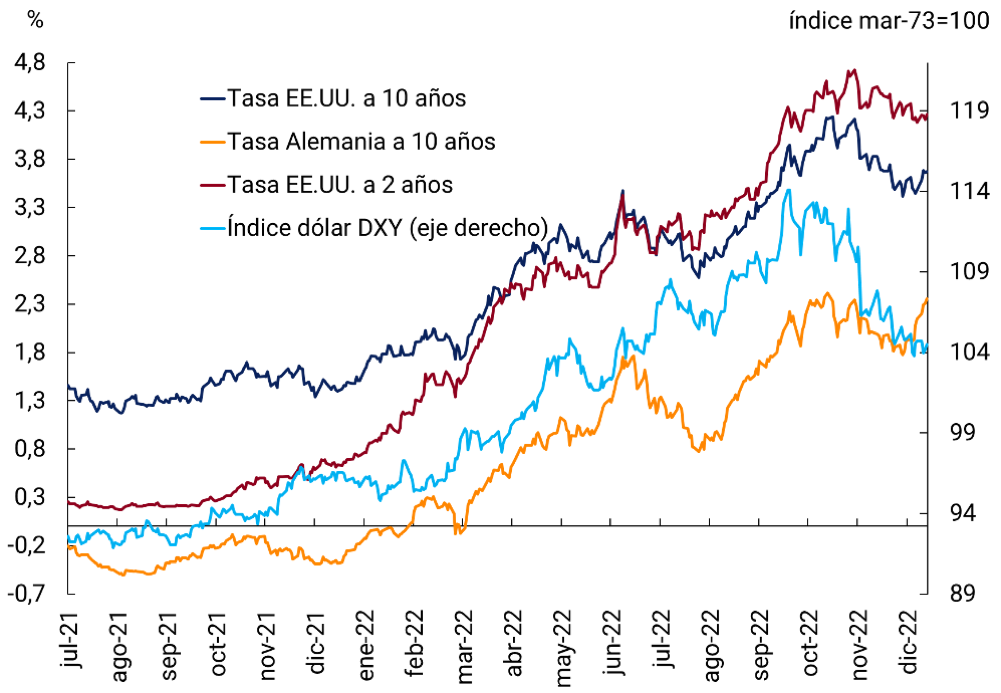
The risk of a global recession began to become more present in the financial markets. Yield curves continued to invert (see Figure 2.9a), reflecting the larger relative decline of longer rates; The global yield curve even inverted for the first time this century. As a result, expectations of policy rate hikes began to moderate in the market, and this was transferred to the other market rates, which fell from the highs of a few months ago. Thus, the 10-year rate in the United States fell, although in recent weeks it rose again and is 4 bps below that observed at the close of the previous IPOM and 57 bps from the high of the end of October. The flip side of this was that the multilateral U.S. dollar, after peaking in late October, has depreciated nearly 10 percent since then (see Figure 2.9b). Real rates, as measured by U.S. inflation-indexed bond rates (10-year TIPS, see Figure 2.9a), have risen sharply in recent months and remain elevated. Mortgage interest rates also rose; All of this is expected to have a contractionary effect on advanced countries. The latter, together with global debt levels and a possible contagion from the falls in cryptoassets, are risks to monitor (see Section 1 / Financial vulnerabilities of the global economy).
Figure 2.9

b. Interest rates and dollar index Source: Bloomberg.
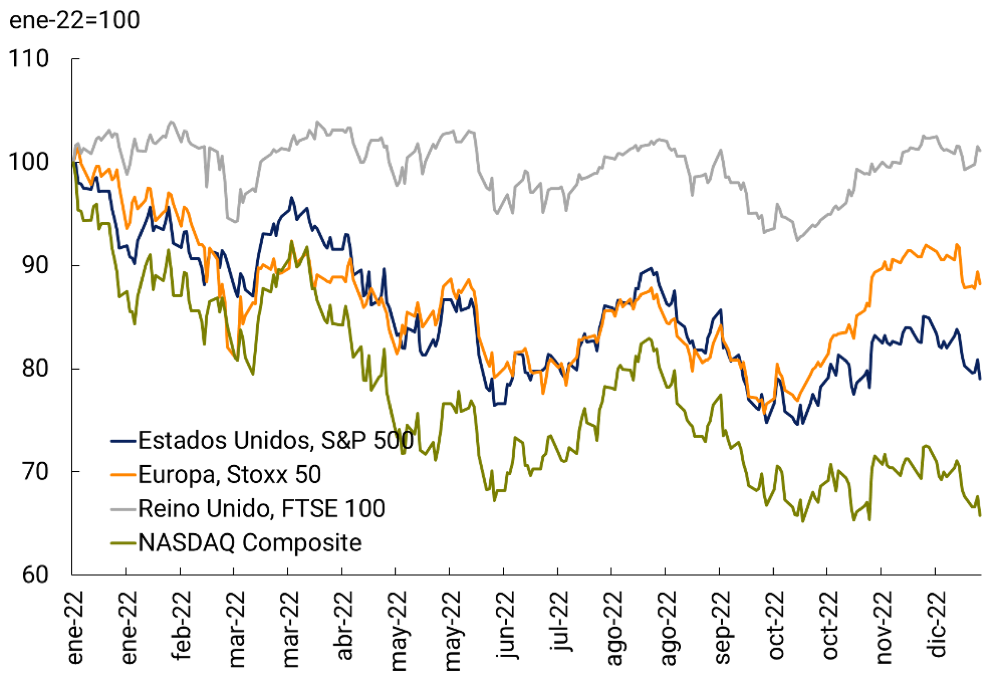
Las condiciones financieras en los Estados Unidos tocaron un mínimo de laxitud a fines de octubre y desde entonces se hicieron algo más benignas. Esto favoreció a los activos de riesgo, tanto a los bonos de emergentes como a los bonos corporativos de alto rendimiento (ver Gráfico 2.10 a). Por otro lado, las bolsas comenzaron a recuperarse y el S&P500 subió 1% desde el IPOM anterior, mientras que el Stoxx 50 de Europa lo hizo un 12% (ver Gráfico 2.10 b). Los flujos de capitales hacia países emergentes se movieron a la par de las condiciones financieras, con picos de salidas entre septiembre y octubre y volviendo a registrarse entradas en noviembre. De todas maneras, los flujos acumulados en el trimestre desde el cierre del IPOM anterior muestran salidas netas, aunque son 22% menores que las salidas del trimestre anterior, y obedecen básicamente a las salidas de fondos desde China.
Figure 2.10
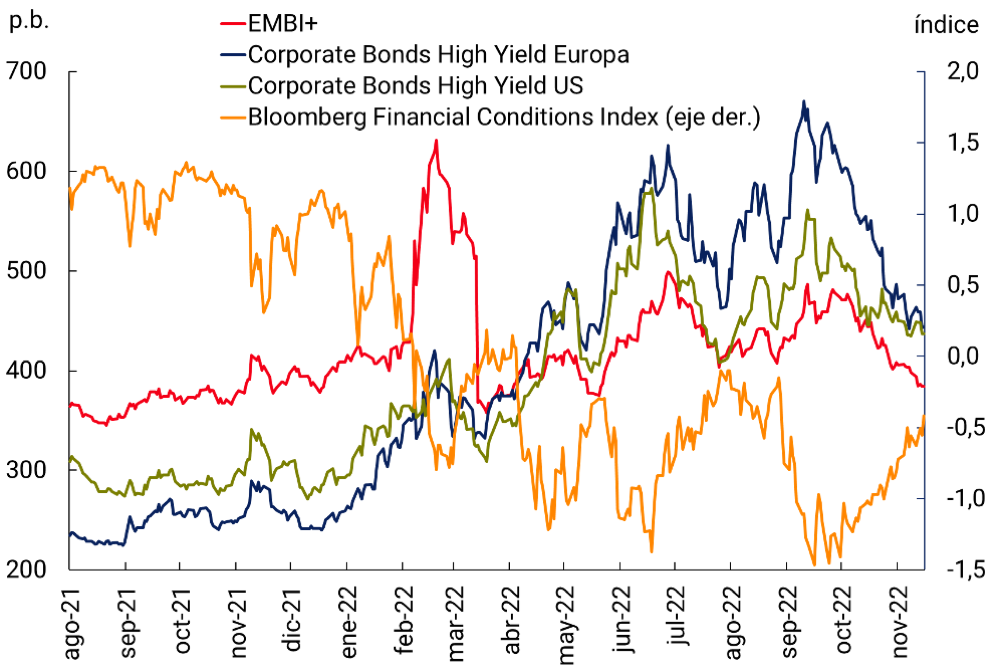
assets b. Stock indices Source: Bloomberg.
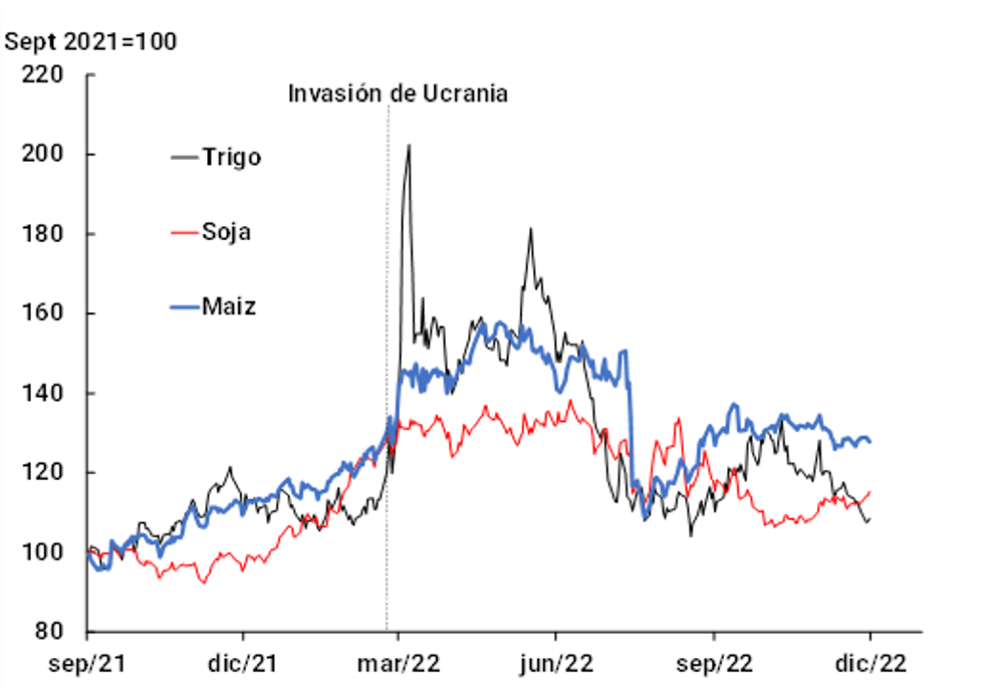
The prices of raw materials (soybeans, wheat, corn, crude oil) reached levels prior to the war, with the exception of gas. The risk of a global recession is the dominant factor impacting the price of the same with a downward trend, while they continue to show strong volatility.
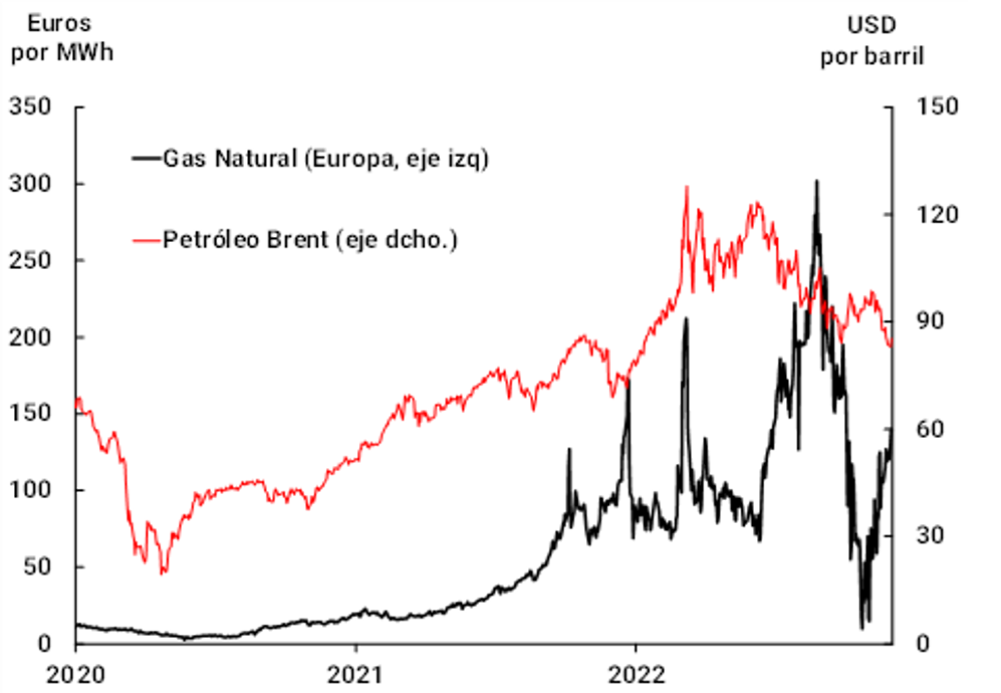
Brent oil continued to decline in price after reaching US$122 per barrel in the middle of the year and is currently trading at US$80 mainly due to two factors: fears of a global economic slowdown that could be generated by the Fed’s rate hike and the restrictive measures taken by China to combat COVID-19. The price of natural gas in Europe continued to fall (albeit with high volatility) from the September peak due to gas deposits in the EU reaching values above 90% before the boreal winter and the presence of less severe weather than usual. In addition, Gazprom continued to ship gas to Europe through Ukraine, albeit at levels considerably lower than before the war in that country (see Figure 2.11a).
Wheat and corn, which reached US$523 and US$321 per ton respectively during May, are currently trading at US$269 and US$250 per ton, bringing the prices of both cereals back to values at the beginning of the year. Shipments from Ukraine through Black Sea ports continued after Russia agreed to extend the UN-brokered deal, which guarantees a trade corridor for ships carrying Ukrainian grain in the Black Sea for another four months. According to Ukrainian authorities, the country was able to export more than 11 million tons of grain by ship since the start of the deal on Aug. 1, significantly easing concerns about shortages. Soybeans, on the other hand, decreased in price in the last quarter after the main producers could have record harvests, such as Russia, or a very good level of production, such as in the United States. In addition, demand does not generate enough pressure on the price due to uncertainty about the world economy. Soybeans are currently trading at US$540, which represents values for January of this year (see Figure 2.11 b).
Figure 2.11 | Selected raw material prices
a. Natural gas and crude oil Brent
b. Corn, wheat and soybeans
Source: Bloomberg.
2.4. In summary
The global economy continues to be characterized by a slowdown in activity and higher inflation. The impact of higher energy prices, the slowdown in China due to mobility restrictions and the problems in its real estate market, and the aggressive cycle of contractionary monetary policy felt their impact on the international economy. These factors could interact with global financial vulnerabilities, presenting risks not only of “trickle-down” from advanced economies to developing countries, but also among the former. Going forward, the evolution will be conditional on whether the monetary contraction culminates gradually, with inflation deepening an incipient slowdown; or if rate hikes continue at the current pace or in a disorderly manner, leading to greater financial volatility and a growing economic slowdown.
Back to top
3. Economic Activity and Employment
During the third quarter of 2022, economic activity grew 1.7% quarter-on-quarter seasonally adjusted (s.e.) and 5.9% year-on-year (y.o.y.), mainly due to the performance of services and primary activities. From the point of view of demand, there was a great dynamism in private consumption, while investment remained around the maximum levels of 2017.
Leading indicators for the fourth quarter indicate a slowdown in growth during the latter part of the year. The drought context, which affected the fine harvest, the incidence of less dynamism in construction and the fall in industrial production contribute to this performance. From the point of view of demand, there is a further drop in investment. However, job creation expectations were sustained at the beginning of the last quarter of the year.
On average, the economy would grow in 2022 by more than 5% per year, well above what market analysts predicted at the beginning of the year. For 2023, a moderation in the pace of expansion is expected, with most sectors having already exceeded their pre-pandemic levels. Other factors that would contribute to moderating the growth of economic activity are the impact of the slowdown in global growth, the potential impact of weather conditions on the coarse harvest, and the bias of fiscal and monetary policies to consolidate the slowdown in inflation. Given that 2023 is a presidential election year, an increase in volatility in domestic financial markets could be observed, influencing the performance of economic activity.
3.1. Growth in 2022 is expected to exceed 5%
GDP registered a growth of 1.7% quarterly s.e. in the third quarter (5.9% y.o.y.), again above the estimates of the BCRA and the market. This deviation from expected growth was mainly explained by the outstanding performance of some services and primary activities, including the Agricultural Sector, which rose in the third quarter after the impact of the drought that affected the coarse harvest in the second quarter.
The available data for the fourth quarter show a slowdown in economic activity. The seasonally adjusted Monthly Estimator of Economic Activity (EMAE) (s.e.) registered a fall of 0.2% monthly s.e. in September and another of 0.3% monthly s.e. in October, leaving a statistical drag of 5.9 percentage points for the average of the year. Compared to the same period in 2021, activity registered an average growth of 6.1% between January and October (see Figure 3.1).
Figure 3.1 | Monthly Estimator of Economic Activity
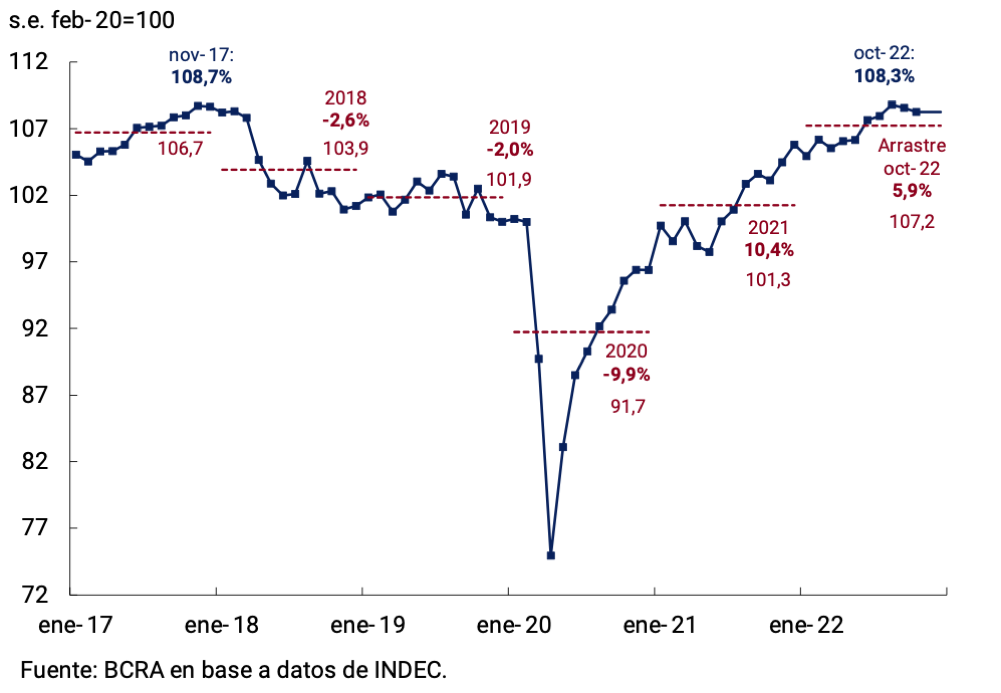
The performance of the EMAE at the beginning of the fourth quarter was in line with what was anticipated by the available leading indicators. The Leading Activity Indicator (ILA-BCRA) continued without recovering until November1. For its part, the activity indicator prepared by the OECD – based on internet searches through Google – remained without significant changes from September to November. On the contrary, partial construction indicators showed some recovery in November.
3.1.1. Domestic demand continued to recover in the third quarter
Desde el punto de vista de la demanda, el incremento del PIB de 1,7% trimestral s.e. durante el tercer trimestre se explicó fundamentalmente por el Consumo privado, que registró una suba de 1,4% trimestral s.e. (10,2% i.a.) y contribuyó con 1 p.p. a la variación trimestral del PIB. La inversión2 cayó 0,8% trimestral s.e. (aunque se incrementó 14% i.a.). Las Importaciones de bienes y servicios, medidas a precios constantes de 2004, aumentaron 2% trimestral s.e. (21% i.a.), en tanto que las Exportaciones de bienes y servicios presentaron caídas tanto trimestrales como interanuales durante el tercer trimestre (3,7% s.e. y 4,6% i.a., respectivamente). De esta manera, el sector externo tuvo una contribución negativa a la variación trimestral del PIB de 1,3 p.p. La variación de stocks y la discrepancia estadística tuvieron un fuerte aporte positivo al crecimiento trimestral desestacionalizado del Producto (2,4 p.p.).
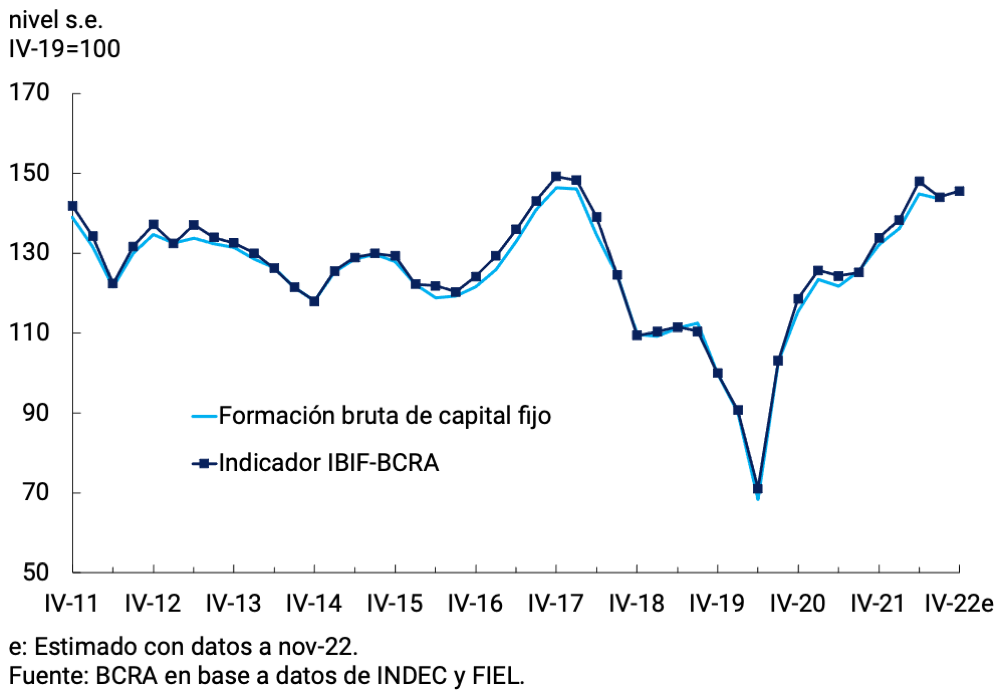
The investment rate measured at constant prices and calculated on seasonally adjusted series remained around historical highs in the third quarter of 2022 (21.5%), similar to that observed in the fourth quarter of 2017 (21.9%) and in the third quarter of 2011 (22%).
La retracción de la inversión en el tercer trimestre (-0,8% trimestral s.e.) se explicó fundamentalmente por el desempeño del Equipamiento durable de producción (EDP), que cayó 4,2% trimestral s.e. tanto el de origen nacional como el importado. En octubre, la producción nacional de Maquinaria y equipo cayó 1,6% i.a. y 11,1% mensual s.e. según el INDEC3. Entre octubre y noviembre, las cantidades importadas de Bienes de capital aumentaron en promedio un 1,3% s.e. en relación con el trimestre anterior. Por su parte, la demanda de insumos para la construcción medida por el ISAC cayó 3,5% mensual s.e. en octubre mientras que la actividad de la construcción disminuyó 2,4% mensual s.e. De todas formas, en noviembre los despachos de cemento mostraron una recuperación. De esta manera, el Indicador IBIF-BCRA con datos parciales a noviembre muestra una leve recuperación de la inversión respecto del trimestre anterior, aunque quedaría por debajo del máximo alcanzado en el segundo trimestre (ver Gráfico 3.2).
It should be noted that the performance of imports occurred within the framework of the implementation of a new system of administration of foreign purchases carried out by the Ministry of Economy through the AFIP, as of October4 (see Chapter 4. External Sector). Demand for construction was also negatively affected by the acceleration of its costs (see Chapter 6. Pricing)
Figure 3.2 | Investment evolution
Private consumption shows a certain “normalization” of consumption baskets, in that some components that were partially repressed during 2021 gained great momentum in recent quarters and returned to levels similar to those observed in 2019. The exception to this behavior is the Hotels and Restaurants segment which, although it grew in 2022 at a higher rate than aggregate Private Consumption, has not yet managed to recover its pre-pandemic levels of activity. These performances are correlated with less activity in stores and, particularly, in supermarkets. The latter were the ones that had remained high during the confinement due to the pandemic (see Figure 3.3).
The strong dynamism shown since the beginning of 2022 by the consumption of services linked to tourism/leisure and durable goods, such as automobiles, stands out. In particular, in the third quarter, real expenditure through the resident exchange market for Travel and tickets increased 7.8% quarter-on-quarter, after two quarters in which a strong recovery had been observed.
Figure 3.3 | Levels of private consumption in real terms

As for the external sector, a positive impact is expected on the variation in GDP in the fourth quarter of 2022 (see Chapter 4. External Sector). With data up to November, the quantities exported of goods registered a strong bimonthly increase of 12% s.e. compared to the average of the previous quarter, while imported volumes decreased 5.1% in seasonally adjusted terms.
3.1.2. The value added by services is at an all-time high, even though the sectors most affected by the pandemic are still below the sectoral peaks reached in 2017
During the third quarter of 2022, both the goods and services producing sectors grew at a rate of 1.3% quarter-on-quarter s.e., although compared to the same quarter of 2021 the increase in services exceeded that of goods (6.6% and 5.4% y.o.y., respectively). Thus, both the goods and services producing sectors as a whole reached the levels observed in the 2017 average in the third quarter. In the case of services, the current level of activity is very similar to the historical maximum of the second quarter of 2018, while the Value Added for the set of goods is 4.2% s.e. lower than the peak of the second quarter of 2015 (see Figure 3.4).
Figure 3.4 | GDP goods and services
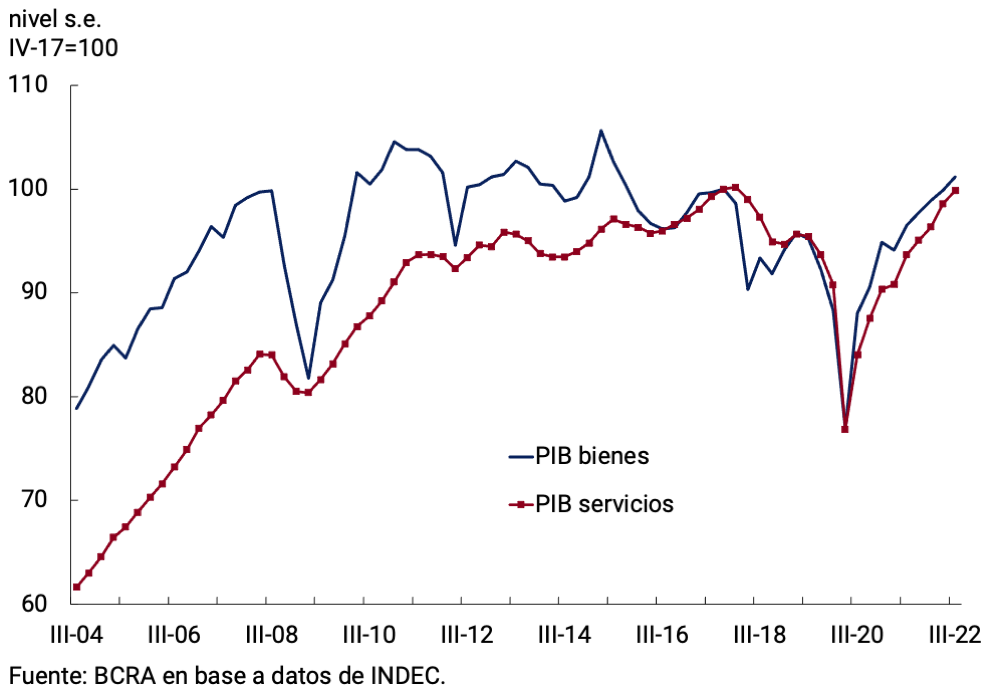
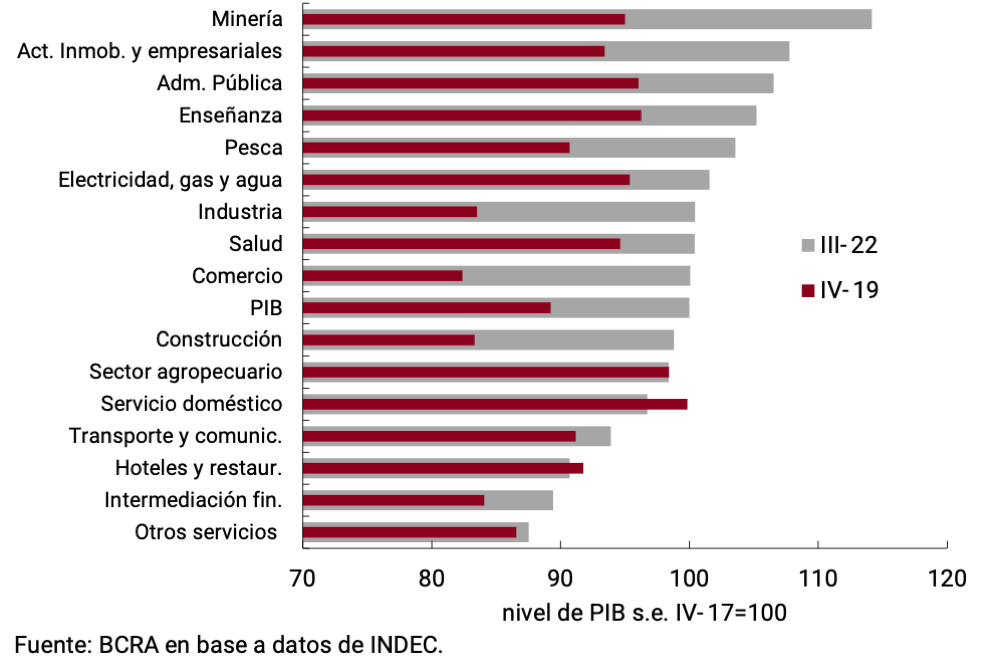
At the disaggregated level, there is great heterogeneity in the performance of services. Those whose activity had practically come to a standstill during the pandemic are those that have been recovering rapidly in 2022, but still operate below the highs of 2017: Hotels and restaurants (-10.3% s.e.), Transport and communications (-6.2% s.e.) and Other social and community services (-13.8% s.e.).
The performance of Real Estate, Business and Rental Activities stands out, the most dynamic item among services. Overall, this sector exceeded by 7.8% s.e. the maximum at which it operated at the end of 2017. The so-called Knowledge-Based Services (CBS) linked to computing, audiovisual and professional activity (development and administration of applications, information and communication, accounting, financial, HR, health and research and development, among others) are counted here. The SBCs are characterized by being competitive, by their broad and diverse nature that crosses all activities, by their growing international insertion and by their potential to diversify the export offer. New technologies, massively disseminated during the pandemic, make it possible to circumvent geographical restrictions to participate in this value chain from different parts of the world. In addition, the great advance of digitalization and telecommunications gave rise to simpler and more diverse modes of commercialization. For all these reasons, the SBC sector is considered a strategic sector and enjoys special incentives granted by public policies, which largely explains its performance in recent years (see Section 2. Initiatives for the promotion of strategic sectors).
Among the goods-producing sectors, Mining – due to hydrocarbon developments in Vaca Muerta and lithium extraction – and Fishing far exceeded 2017 in terms of their Product levels (see Figure 3.5).
Figure 3.5 |Sectoral level of activity compared
Box. Droughts and frosts affecting agriculture
According to the National Meteorological Service (SMN), this year began with a phase of the La Niña phenomenon, established at the end of 2021 that remains active to the present day, making it the third consecutive episode with this adverse weather condition. This happened only twice since 1950.
At the end of November, the SMN identified 22 million hectares in a situation of severe drought in the national territory, a very considerable magnitude considering that the cultivated area is approximately 36 million hectares. The greatest water anomalies are concentrated in the center of Buenos Aires, a large part of Córdoba, central and southern Santa Fe, San Luis and western Entre Ríos. This situation has already caused great losses in wheat production, a great delay in the planting dates of soybeans and corn, an impact on fruit trees and a great impact also on livestock activity, with unloading of fields, sales of bellies and increase in forage supplementation requirements.
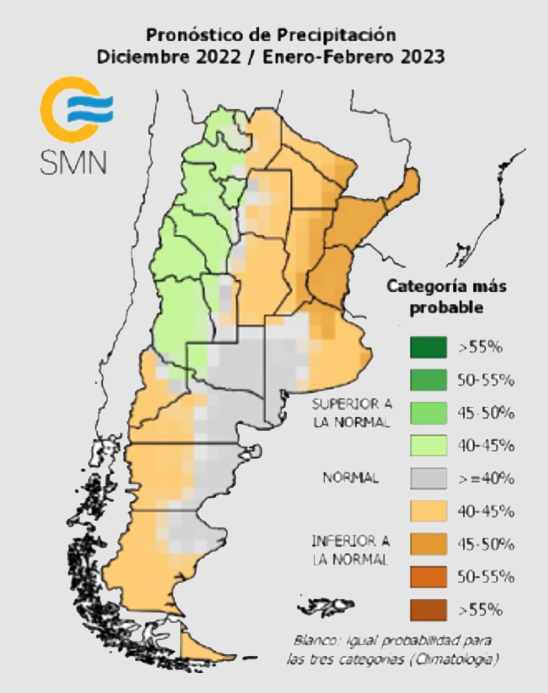
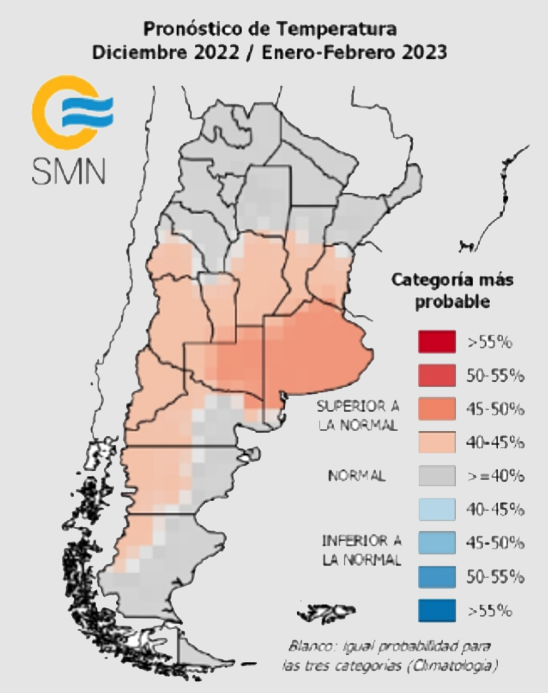
According to the dynamic and statistical models of the SMN, on average, in the coming months there is a 76% probability that the conditions of the La Niña phenomenon will continue, with forecasts of below-normal rainfall and higher temperatures (see Figure 3.6).
Figure 3.6 | Rainfall and temperature forecasts until February 2023
In addition to the lack of moisture in the soils, between the end of October and the beginning of November, there were sharp drops in temperature that caused late frosts in several areas of the country and had a negative impact on many regional economies. Among them, the loss of about 20% of Mendoza’s agricultural production, the significant damage to melon, tomato and grape plantations in San Juan, and, in the Upper Valley of Río Negro, vineyards, cherry trees, walnut trees and pumpkin plantations stand out. The situation is also particularly complex in Salta, Formosa and Tucumán5.
In this context, the short-term outlook for the agricultural sector is once again unfavorable. As for wheat, currently in the harvesting stage and with a similar area planted to the previous season, the Ministry of Agriculture, Livestock and Fisheries estimates an annual drop in production of 39.8%, to 13.3 million tons. The sowing process of the coarse crop is delayed and, for corn, at least a cut in production to 55 million tons is already expected (-6.8% compared to the previous season). Soybean production could reach up to 48 million tonnes, about 10% higher than the previous one, but it is subject to the amount of rainfall recorded during the coming weeks.
It should be noted that wheat grains, wheat flour and their derivatives totaled exports of about US$ 4,800 million in the previous campaign (2021/22), which meant a year-on-year increase of close to 70% in values (about 40% in quantities) and contributed about US$ 600 million in export duties to the fiscal accounts. In terms of Output, the wheat chain represents around 1.3%6.
3.1.3. El mercado de trabajo, con desaceleraciones puntuales, continúa expandiéndose
Con datos a septiembre del Ministerio de Trabajo, Empleo y Seguridad Social (MTEySS), el empleo registrado continuó expandiéndose durante el tercer trimestre de 2022, superando los niveles máximos registrados en los últimos trimestres. El ritmo de expansión entre julio y septiembre fue menor que el registrado durante el segundo trimestre del año, creciendo 0,9% promedio trimestral s.e. (respecto del alza de 1,3% promedio trimestral s.e. del segundo trimestre de 2022; ver Gráfico 3.7).
Figure 3.7 | Total registered employment and economic activity

During the third quarter of 2022, the growth in total registered employment was mainly explained by formal salaried employment, which, despite the positive dynamics, showed a more limited increase than during the previous period (1.2% avg. quarter, s.e.; -0.1 p.p. compared to the second quarter of 2022). On the other hand, the employment of self-employed workers (self-employed and single-payers) increased by 0.7% avg. trim. s.e., also slowing its growth rate compared to the previous quarter. This expansion was explained entirely by the one-off contribution of single-tax workers (1.1% s.e.), which more than compensated for the fall in self-employed workers (-0.9% avg. quarter). Public employment also slowed down the pace of growth in the period (0.4% avg. qq. s.e.), implying a decrease of 0.2 p.p. compared to the April-June quarter, while employment in private households registered a fall for the third consecutive quarter (-0.2% avg. qq. s.e.; see Figure 3.8).
Figure 3.8 | Employment Recorded by Category
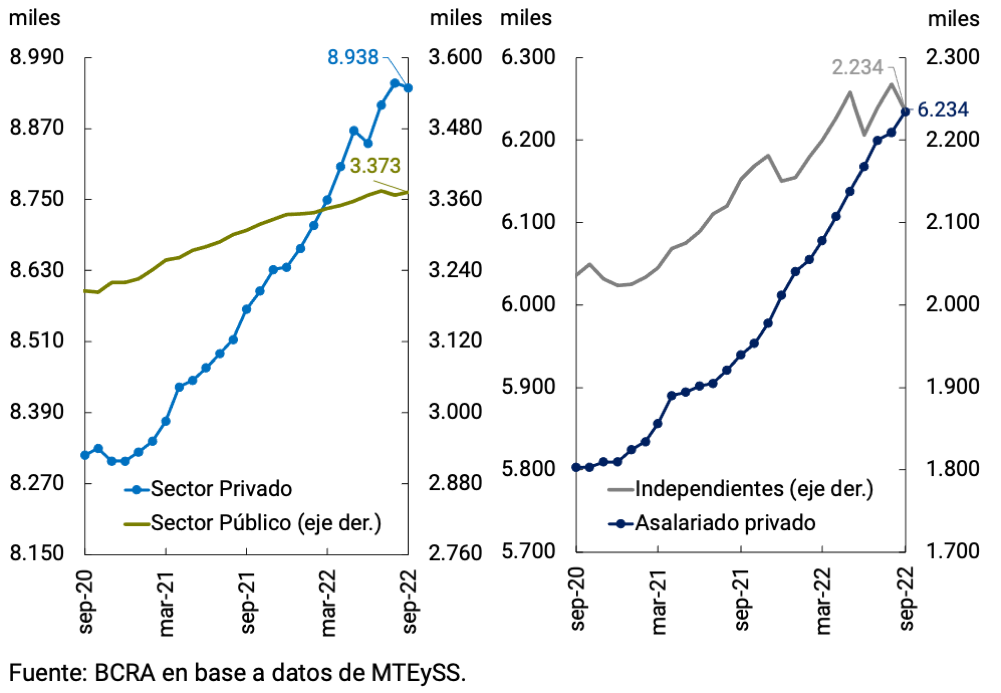
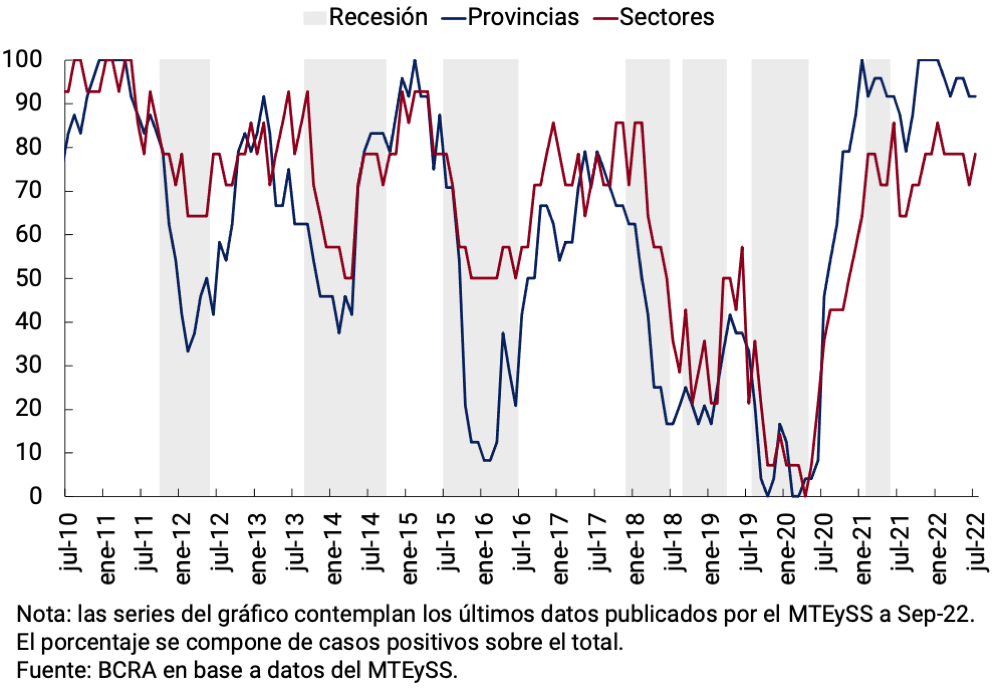
The diffusion of private wage employment growth as of September 2022 has remained, in both geographical and sectoral terms, at high values for both series (see Figure 3.9). In addition, it is possible to distinguish, as in the previous quarter, a strong dynamism in branches such as Hotels and restaurants (4.3% s.e. acum.), Mines and quarries (2.6% s.e. acum.), Construction (3.1% s.e. acum.) and Commerce (1.5% s.e. acum.).
Figure 3.9 | Private employment registered by sector and region
Var. % avg. quarter 5 months centred
The Labor Indicators Survey (EIL) as of October 2022 continues to exhibit favorable net hiring expectations, chaining, since February 2021, 21 consecutive months of positive values. On the other hand, suspensions, after a sharp reduction during 2021, remained at levels within the average of recent years and the rate of layoffs remains in a limited range, moving away from the lows of October 2021 to approach the historical average.
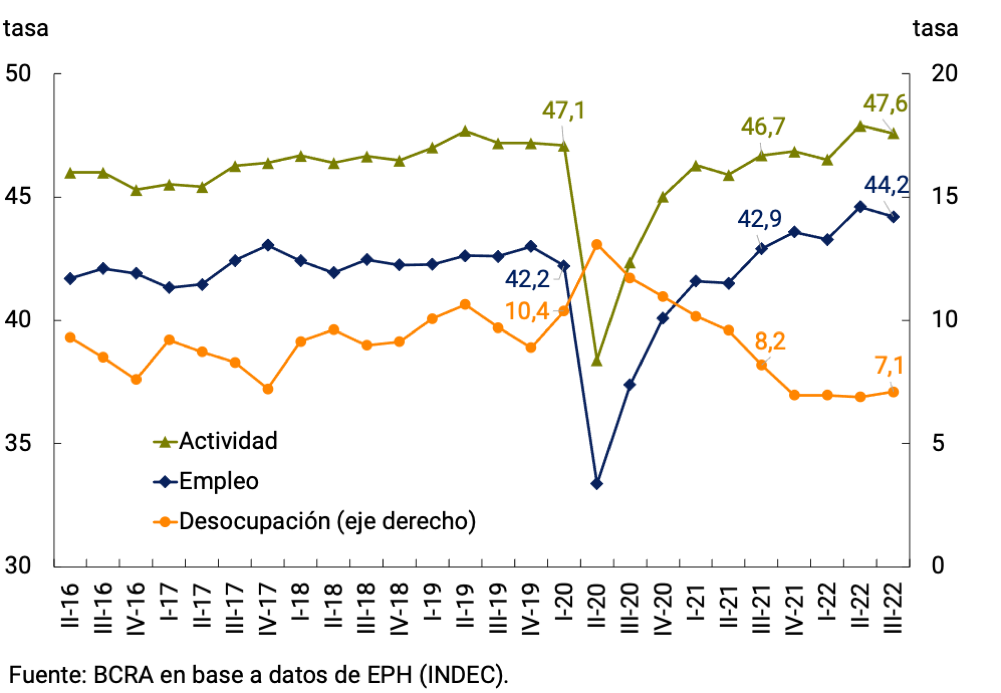
According to data from the Permanent Household Survey (EPH), in the third quarter of 2022 both the employment rate (44.2%, +1.3 p.p. y.o.y.) and the activity rate (47.6%, +0.9 p.p. y.o.y.), continued at high values, slightly below the rates observed in the second quarter of 2022. For its part, the open unemployment rate was 7.1% (-1.1 p.p. y.o.y.), reaching values close tominimum 7 for the fourth consecutive quarter (see Figure 3.10).
Figure 3.10 | Main labour market rates
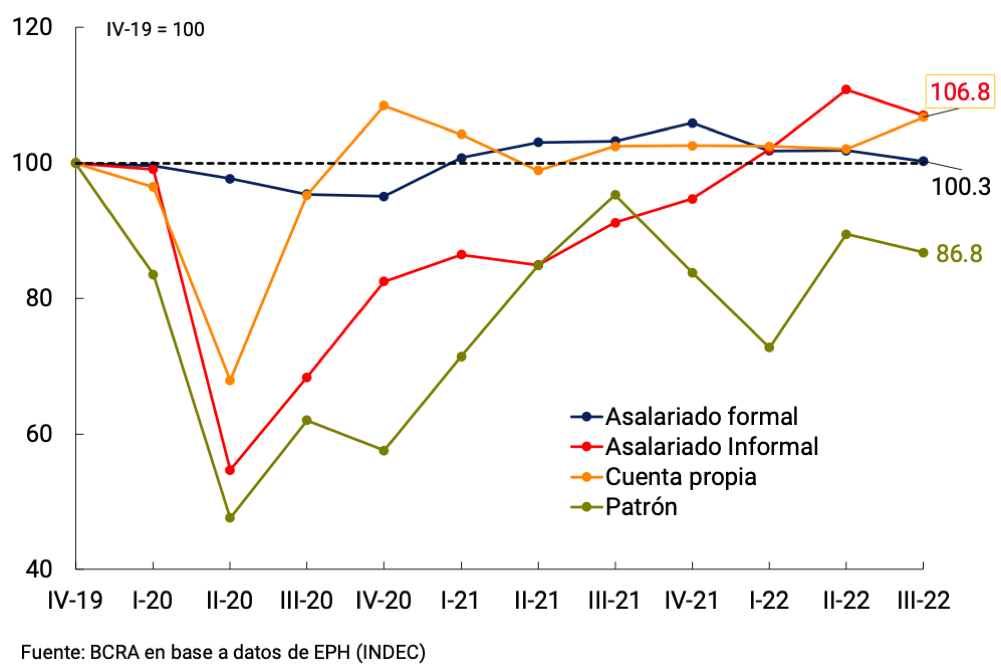
As for the evolution of the different occupational categories, self-employment was the only one that showed, during the third quarter of 2022, an increase compared to the previous quarter. In this way, self-employment grew again after four quarters in which it remained stable at a level slightly higher than the values prior to the health crisis. The “employers” category, on the other hand, fell compared to the second quarter and remains far from pre-pandemic levels. Within salaried employment, both formal workers8 andinformal workers 9 showed falls compared to the previous quarter. However, it should be noted that both informal and self-employed workers are at levels higher than pre-pandemic levels, while formal wage earners have remained relatively stable around this level from the second quarter of 2021 (see Figure 3.11). These trends have led to the crystallization of an employment composition in which the less formal categories have begun to gain greater weight to the detriment of formal salaried employment.
Figure 3.11 | Main labour market rates
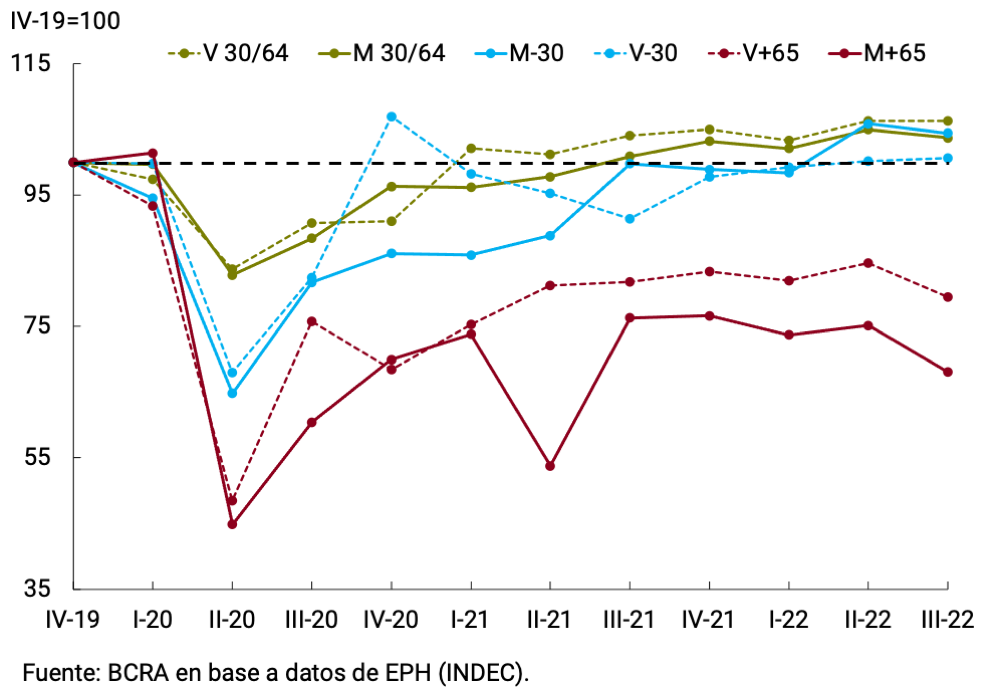
Regarding the age range and gender, it continues to be observed that the category of people over 65 years of age, both women and men, is the only one that has not yet managed to recover after the impact of the pandemic. Men between 30 and 64 years of age continue to be at maximums for the series while young people under 30 years of age remain in positive terms, although with a lower rate of growth. Finally, young women and those between 30 and 64 years of age who had previously exceeded the pre-pandemic level showed positive records during the third quarter of 2022 compared to the same quarters of previous years.
3.2. Perspectives
Economic activity grew until the third quarter, approaching the highest levels of 2017, sustaining job creation. During the fourth quarter, its growth would have slowed down. All in all, the Argentine economy is expected to expand by more than 5% this year, in line with current market expectations. According to estimates from the Market Expectations Survey (REM) at the end of November 2022, specialized analysts expect a growth of 5.3% for economic activity during this year, above the economic growth forecast contained in the 2023 National Budget Bill.
A slowdown in growth is expected for 2023. On the one hand, the global economy continues its slowdown process and the market incorporates the expectation of a global recession into the price of assets. At the local level, the public sector continues to pose a scenario of greater austerity on the part of fiscal policy and faces a significant challenge in relation to the policy of managing public liabilities (see Chapter 5. Public finances). Additionally, given that 2023 is a presidential election year, an increase in volatility in asset prices in domestic financial markets could be observed. The drought caused a sharp cut in the wheat harvest, largely destined for the domestic market, and conditioned the results of next year’s coarse harvest, whose planting is already delayed. In this context, the market’s forecasts for economic growth in 2023 stand at 0.7% annually, according to the median of the REM survey at the end of November, while the PFE-IMF contemplates a range between 1.5 and 2.5% average growth, whose center is the 2% contained in the 2023 National Budget Law.
In a more uncertain domestic and external context, the recent announcements linked to the fulfillment of the goals set with the IMF for the third quarter ratify the commitment to reduce the primary fiscal deficit, monetary financing and increase net international reserves for the rest of 2022 and 2023, in order to continue anchoring the policymaking and credibility necessary to consolidate macroeconomic stability and sustained growth.
Back to top
4. External Sector
In the third quarter of 2022, in a context of contraction in trade flows in seasonally adjusted terms, the economy operated with a current account deficit. The data on foreign trade in goods for the October-November two-month period anticipate a reversal of this dynamic, mainly in a context of lower economic growth.
The evolution of exports and imports of goods, added to the dynamics of commercial debt for these concepts, resulted in a positive net result in the exchange market for goods of US$18,600 million in the first eleven months of 2022, 30% more than what was observed in the same period of the previous year. Additionally, net outflows were recorded through the foreign exchange market for services, interest and other financial transactions for US$15,235 million, while entities made purchases for US$399 million. For its part, the BCRA bought US$3,734 million net in the foreign exchange market. Finally, net outflows were recorded for operations through the Local Currency System (SML) for US$735 million.
The BCRA’s international reserves stood at US$38,009 million at the end of November, positioning themselves US$1,654 million below their value at the end of 2021. This result is mainly explained by the decrease in the prices of the assets that make up the international reserves in relation to the US dollar, by the net payments made through the Local Currency Payment System, and by the reduction in the deposits of entities in the BCRA, which were partially offset by the net purchases of the BCRA in the foreign exchange market and net income of the IMF and others international organizations.
Within the framework of the Extended Facilities Program (PFE) with the IMF, the accumulation of Net International Reserves was above the target set for September 2022. In line with the commitments assumed by Argentina, the accumulation of reserves under the measurement guidelines established in said program will be US$9,800 million during 2022 and 2023.
4.1. In the last quarter of 2022, the economy would have returned to the current account surplus
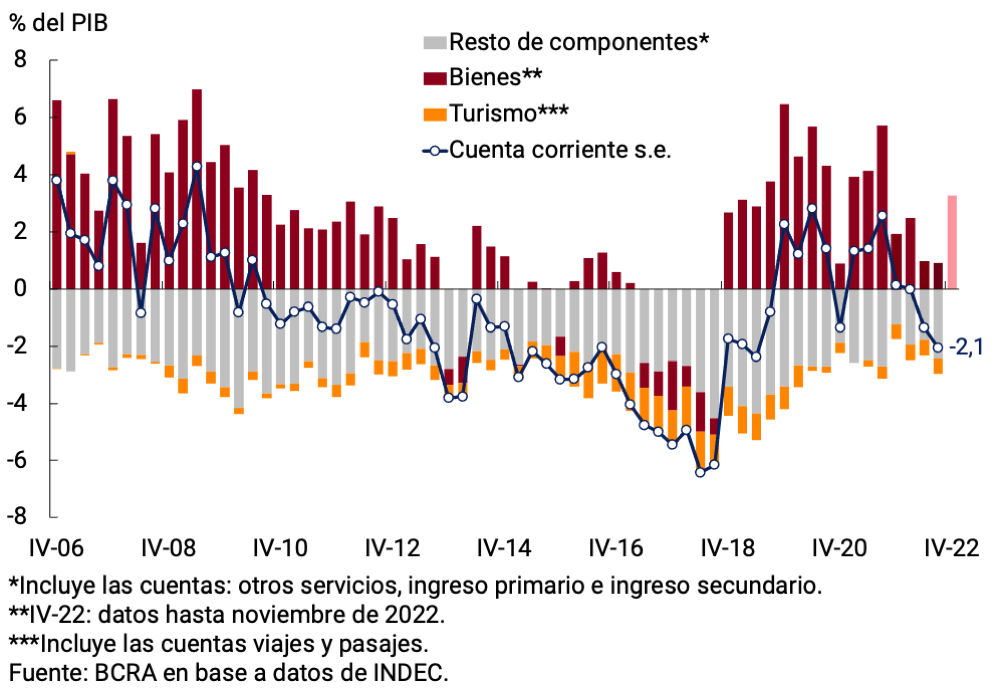
In the third quarter of 2022 (latest official data available) the Argentine economy recorded a current account deficit of US$3,031 million – equivalent to 2.1% of GDP in seasonally adjusted and annualized terms. This result occurred in the context of a contraction in trade flows compared to the previous quarter. The surplus from the exchange of goods (0.9 p.p. of GDP) was higher than the deficit in the tourism account (which stood at around 0.7 p.p. of GDP), but it was not enough to offset the deficit in the rest of the current account items.
In the two months of October-November 2022, the trade surplus in goods increased significantly compared to the previous two quarters, in a context of lower economic growth. Thus, the seasonally adjusted current account is expected to return to positive territory in the fourth quarter of 2022 (see Figure 4.1).
Figure 4.1 | Seasonally adjusted current account. Annualized values
Between July and September 2022, the exported values of seasonally adjusted goods reached US$21,261 million (Free on Board (FOB)) at current prices, which represented a drop of 8.3% compared to the level recorded in the second quarter of 2022. The declines in prices and quantities explained this evolution of exports in the third quarter of 2022. In the October-November two-month period, there was a strong recovery in exported volumes that was behind the rise in values.
On the other hand, in the third quarter of 2022, seasonally adjusted imports of goods totaled US$21,141 million (CIF) at current prices, 4.4% lower than the figure for the second quarter of the year. This performance of imported securities was explained exclusively by the fall in quantities (5.8% QoQ, s.e.), as prices showed a slight increase (see Chart 4.2). In the October-November two-month period, both prices and quantities contributed to the sharp decline in imports.
Figure 4.2 | Trade in goods. Seasonally adjusted series

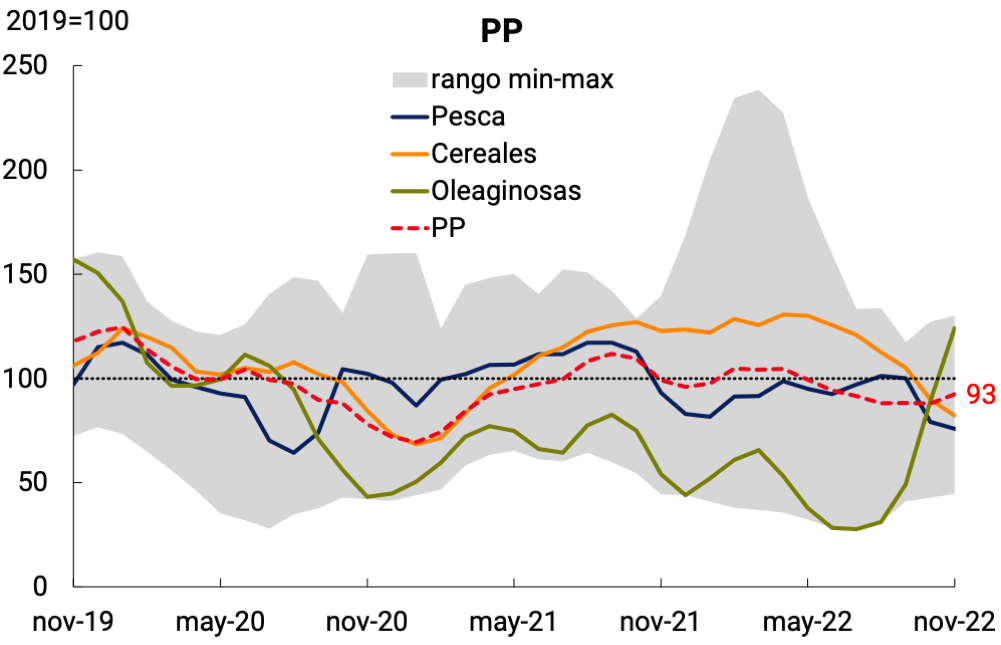
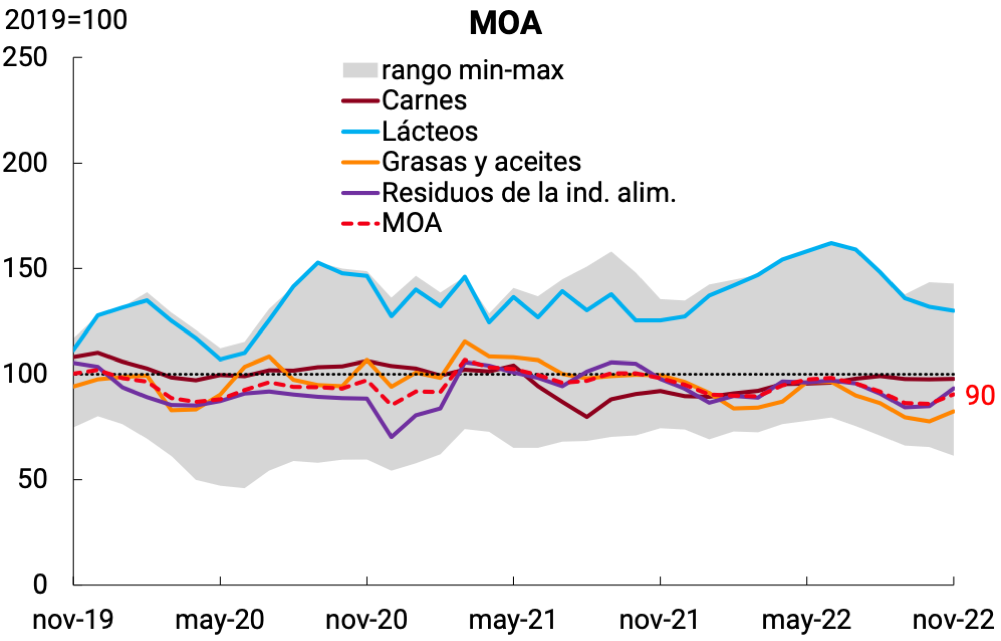
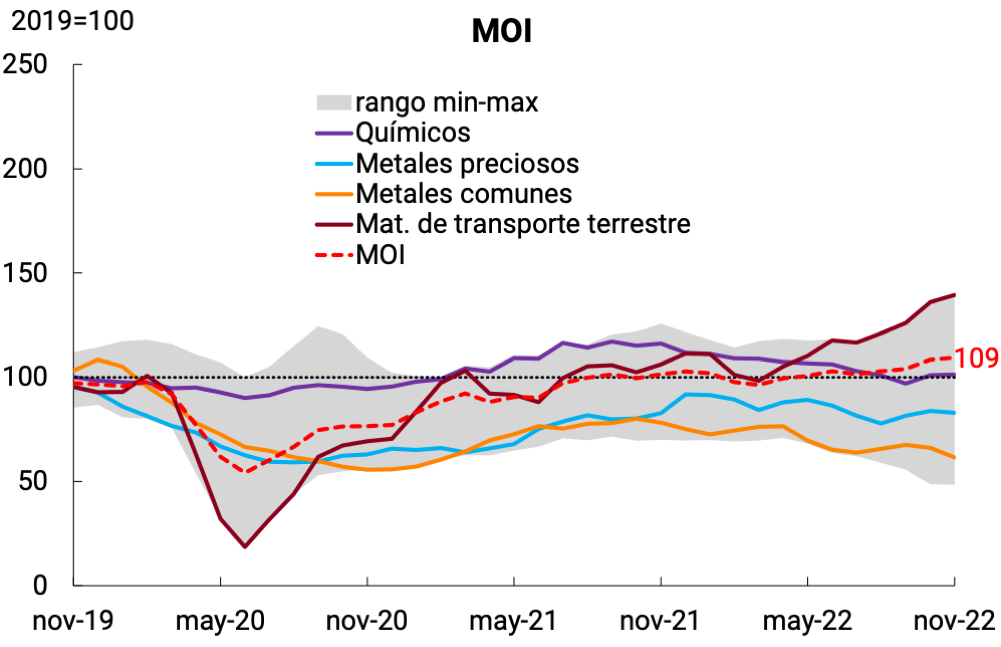
Two of the four main export items had increases in exported volumes in the third quarter of 2022. In the case of Manufactures of Industrial Origin (MOI, +1% qq. s.e.), growth was concentrated in higher vehicle exports; while the Fuels and Energy (S&E, +5% QoQ) item was underpinned by a new rise in oil and gas shipments. For its part, the exported quantities of Manufactures of Agricultural Origin (MOA) fell 12% s.e. in the third quarter of the year, mainly due to a drop in foreign sales of soybean derivatives, which fell to values similar to those of the first quarter of 2020. Finally, shipments of Primary Products (PP) fell (-6% QoQ, s.e.), with a strong negative impact on cereals. In the October-November two-month period, there was an increase in the volumes exported in all areas, with the increase in soybean exports standing out for its contribution and magnitude, driven by the first stage of the Export Increase Program (see Figure 4.3).
Gráfico 4.3 | Cantidades exportadas. Series ajustadas por estacionalidad
Prom. móv. 3 months

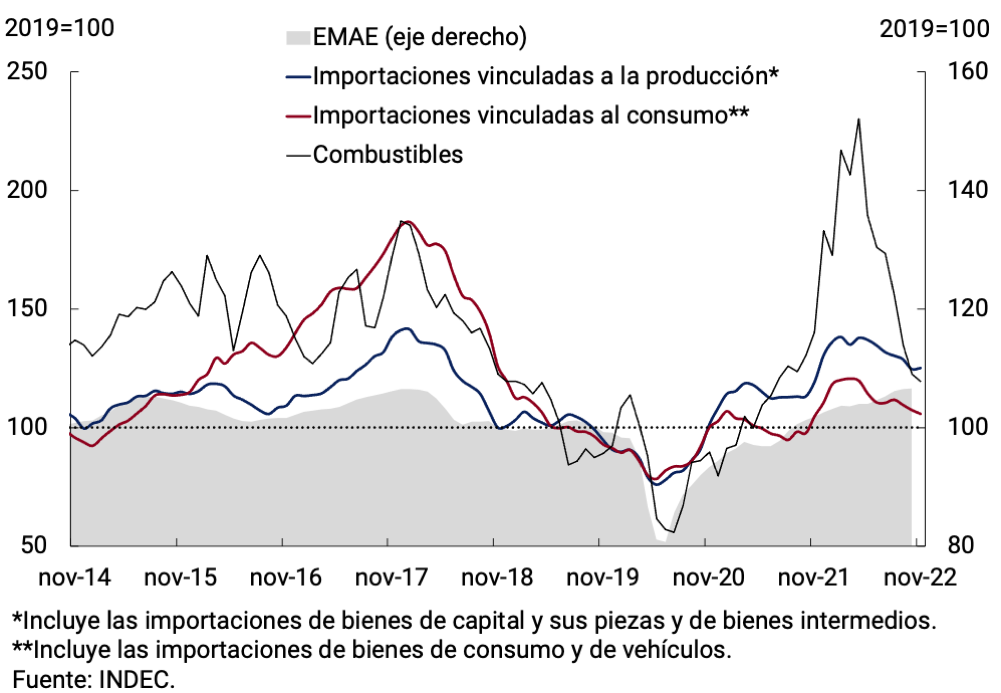
For their part, the quantities of imported goods have been on a downward trend since March 2022. Since then, and adjusting for seasonal factors, the cumulative falls were 48% in fuels, 17% in goods directly associated with consumption and 7% in those related to production. In the first case, the calculation of the recent fall was influenced by the high level reached by purchases of fuels made in the first months of the year. It should be noted that the imported quantities of goods directly associated with the production process have remained relatively stable since July 2022 (see Figure 4.4).
Figure 4.4 | Quantities imported. Seasonally
adjusted series Mobile Avg. 3 months
At the disaggregated level, there has also been a fall in the quantities imported in recent months. Of 19 categories of imported products, in November only 6 remained above the levels recorded in the fourth quarter of 2017, when GDP was at the same level in s.e. terms as in the third quarter of 2022. All of these categories are directly associated with the production process, chemical inputs and parts and accessories for transport equipment stand out for their incidence (see Figure 4.5).
Figure 4.5 | Quantities imported. Seasonally adjusted series

4.3. So far in 2022 (until November), the BCRA’s purchases in the foreign exchange market accumulated US$3,734 million
During 2020, the BCRA established a series of regulations that aim to promote the allocation of foreign currency more efficiently, with an impact on both the evolution of private commercial and financial debt. These rules were maintained throughout 2021 and continued to be refined throughout 2022.
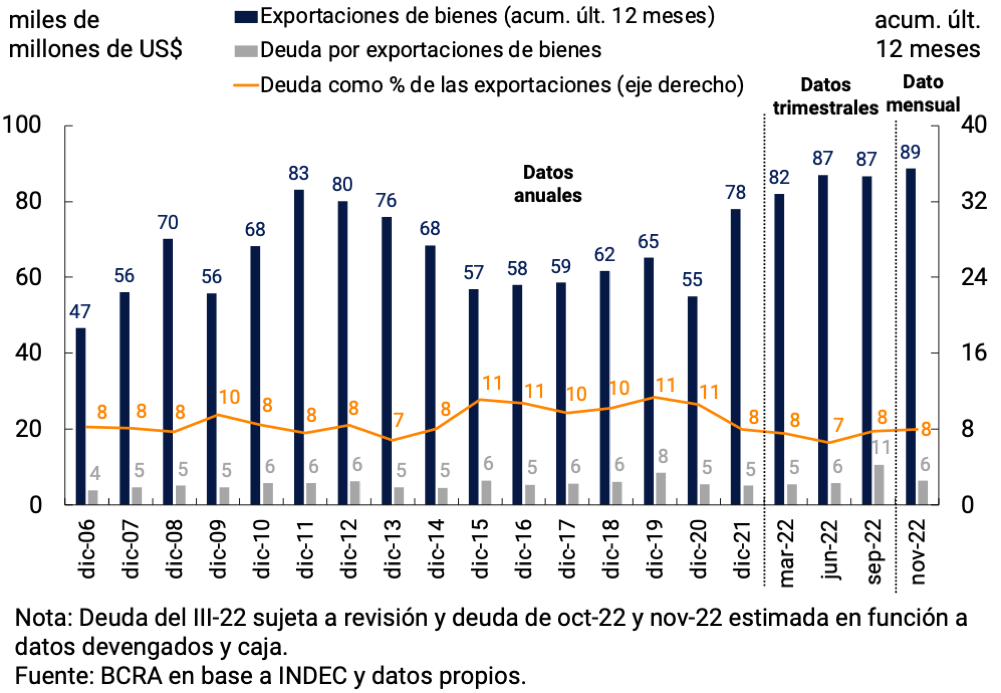
In this context, during the first eleven months of 2022, exporters recorded revenues from collections of exports of goods for about US$82,760 million. For its part, exports of goods totaled about US$82,100 million, so a slight increase in external debt is estimated for advances and pre-financing of goods of about US$670 million. Thus, the ratio of this type of indebtedness to exported securities is around 8% (see Figure 4.6).
Figure 4.6 | Assets. Exports and external debt for exports
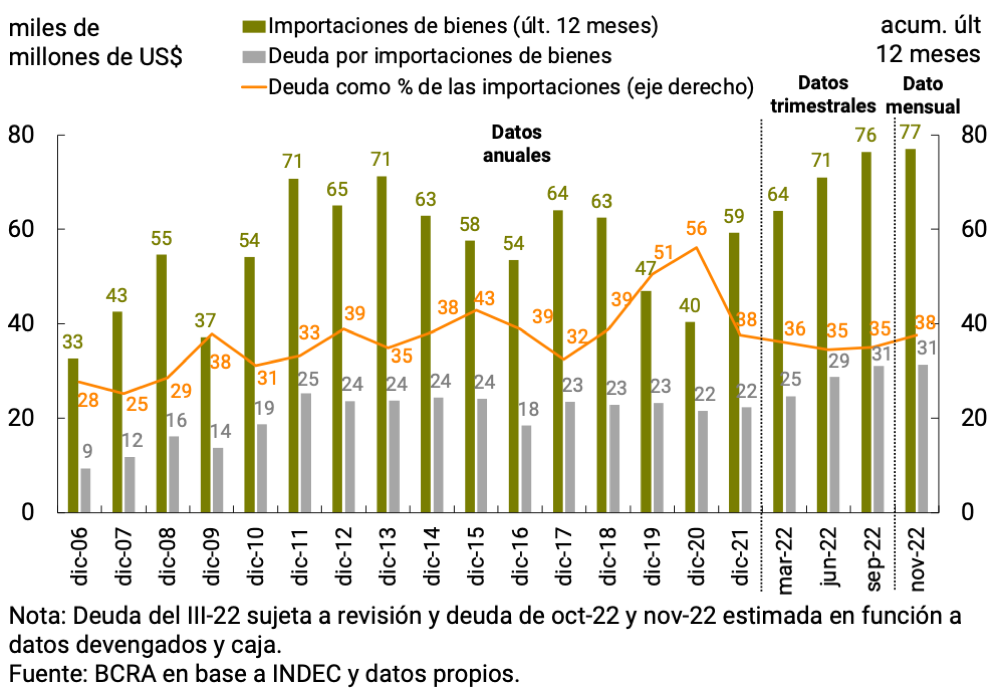
For its part, it is estimated that in the first eleven months of the year, the debt for imports of goods would have registered an increase of around US$9,00011 million. Thus, the ratio of external debt to the level of imports would have risen in November 2022, reaching 37.6% (see Figure 4.7).
Figure 4.7 | Assets. Imports and external debt for imports
The aforementioned evolution of trade in goods and trade debt for exports and imports, resulted in a net result for goods in the exchange market of US$18,600 million in the accumulated during the first eleven months of the year, showing a year-on-year increase of about US$4,300 million. This amount was about US$7,800 million higher than the result of the FOB trade balance for the same period, which registered a year-on-year drop of US$7,050 million.
With regard to financial debt, and as part of the current regulatory framework mentioned above, in September 2020, Communication “A” 7106 established the guidelines under which private sector companies could initiate a process of refinancing their respective external liabilities, which would allow their maturity profile to be adapted to the guidelines required for the normal functioning of the foreign exchange market. This communication, which reached certain capital maturities between 15-Jan-20 and 31-Mar-21, was extended by Communication “A” 7230, covering maturities from then until the end of 2021. Likewise, Communication “A” 7422 extended the term of the maturities until 30-Jun-22 and Communication “A” 7466 did so until 31-Dec-22. Recently, Communication “A” 7621 extended the capital maturities until Dec 31, 23.
In this context, based on the renegotiations recorded during the first eleven months of 2022, net payments made through the foreign exchange market represented 27% of the original maturities, impacting lower net purchases of about US$2,254 million. Since the beginning of the regulation, net payments made through the foreign exchange market represented 35% of the original maturities, which translated into lower net purchases of about US$4,781 million for the entire period.
Regarding the BCRA’s result in the foreign exchange market in the year to November, net purchases of US$3,734 millionwere recorded 12, while International Reserves fell by US$1,654 million in the same period (see Chart 4.8).
Figure 4.8 | Exchange market. Result

The variation in International Reserves up to November was explained by the decrease in the valuation of assets by about US$2,682 million, the fall in the foreign currency holdings of the entities by about US$2,370 million and sales in the Local Currency System by US$730 million. These movements were partially offset by the net inflows of foreign currency debt of the National Government of about US$467 million (net income of the IMF of about US$1,603 million and net payments of other debt in foreign currency of US$1,136 million) and the net purchases of the BCRA in the foreign exchange market of US$3,836 million13.
In addition to the measures implemented since July14, aimed at encouraging sales and settlement of agricultural products in the foreign exchange market, the “Export Increase Program” was created through Decree 576/22 of September 5, through which an exchange rate of $200 per US$1 was established. for exports of soybeans and their derivatives, valid until September 30. Based on the incentives generated by this program, the oilseeds and cereals sector liquidated US$7,650 million in the foreign exchange market through this mechanism in September. In October and November, the sector netly canceled debt for US$2,360 million and US$1,840 million, respectively. It should be emphasized that the cancellation of this type of indebtedness does not imply an outflow of foreign currency, but occurs when the export of previously financed goods materializes.
This resulted in the BCRA becoming a net buyer in the foreign exchange market again in September, and the goal for the accumulation of international reserves agreed with the IMF was exceeded.
Box. Inbound tourism
One of the sectors that is showing great dynamism since border closure measures were relaxed as part of the fight against COVID-19 is inbound tourism. Although at the end of 2021 tourist arrivals to the country were far behind the recovery of global tourism, so far this year there has been a notable recovery that brought the dynamics of inbound tourism in our country closer to what is observed both in the region and in the world in general (see Table 4.1).
Table 4.1 | Inbound tourism worldwide

This recovery of inbound tourism occurred heterogeneously among the main points of origin of arrivals. From the neighboring countries, a marked dynamism was observed in the entry of tourists from Uruguay, even exceeding the levels reached in the pre-pandemic stage. The real appreciation of that country’s currency could be behind this performance. In the rest of the cases, the recovery has been slower: tourism from Brazil, Paraguay and Chile is at around 75% of the level prior to the imposition of restrictive measures due to the COVID-19 pandemic, while the number of tourists entering from Bolivia is still around 50% of what it was in January 2020.
Figure 4.9 | Inbound
tourism Tourist entries by country of residence. All border crossings. Seasonally adjusted series
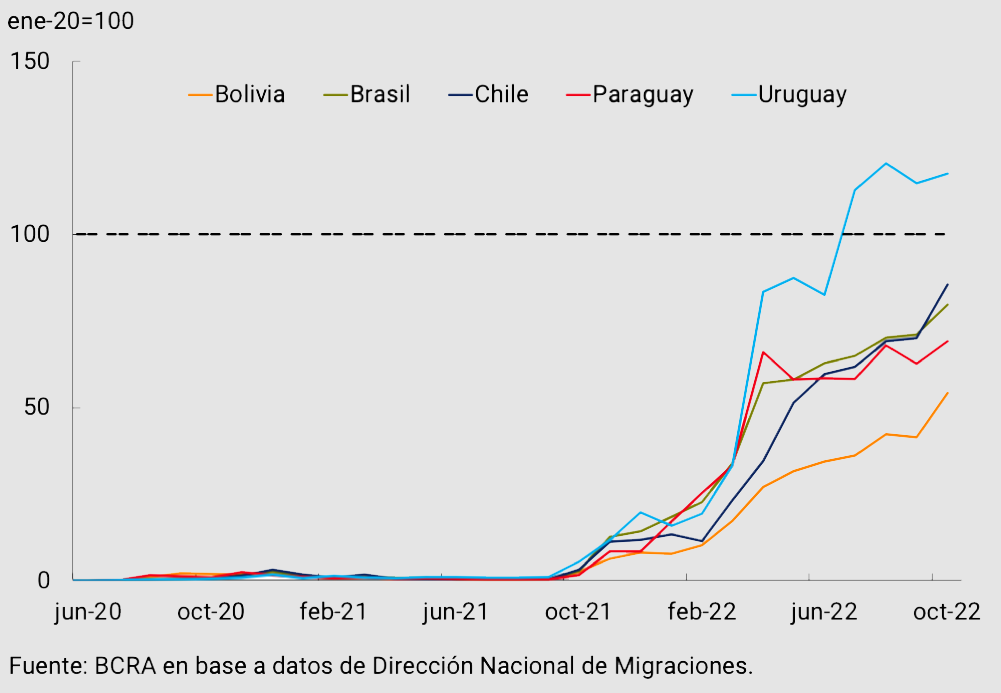
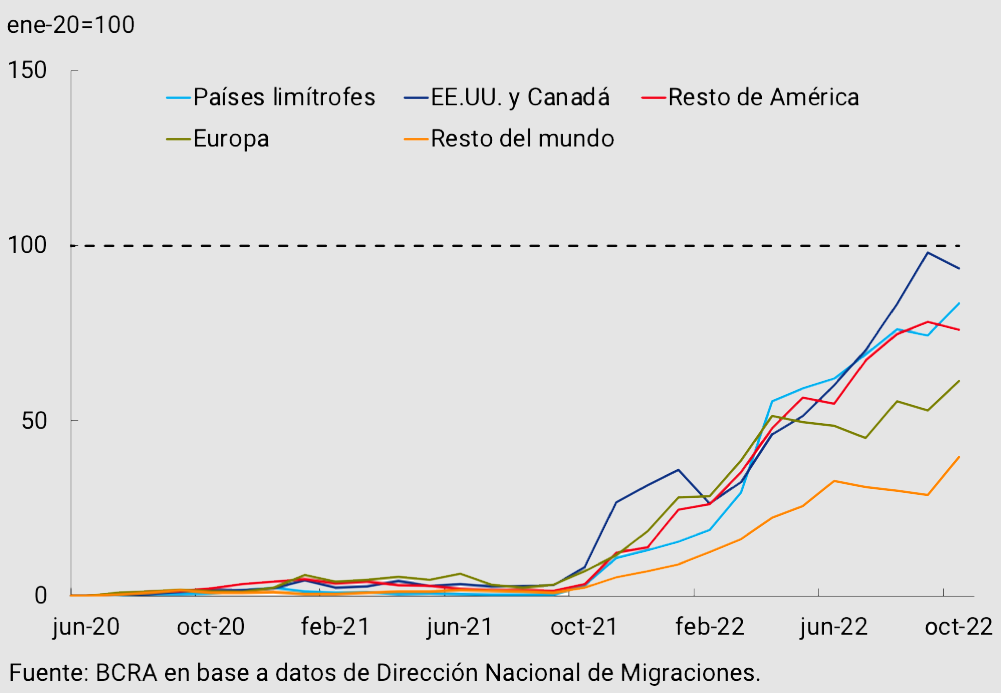
At the regional level, the recovery was also very marked in the case of the entries of residents in the United States and Canada, which practically returned to pre-pandemic levels, although in October they had a slight drop in seasonally adjusted terms. On the other hand, tourism from Europe and the rest of the world is lagging behind (see Figure 4.9).
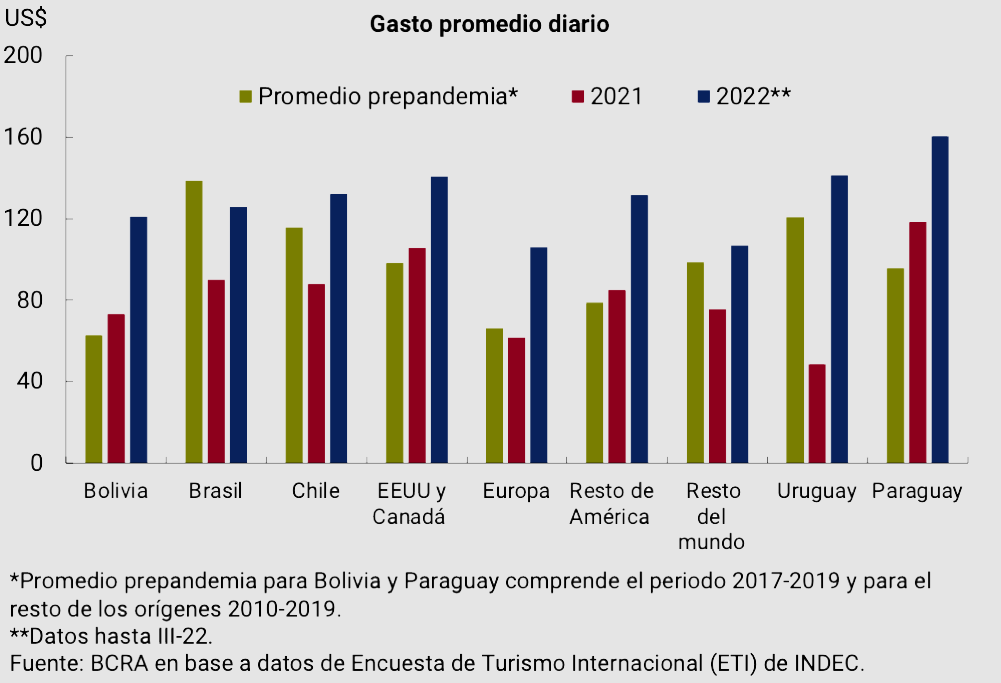
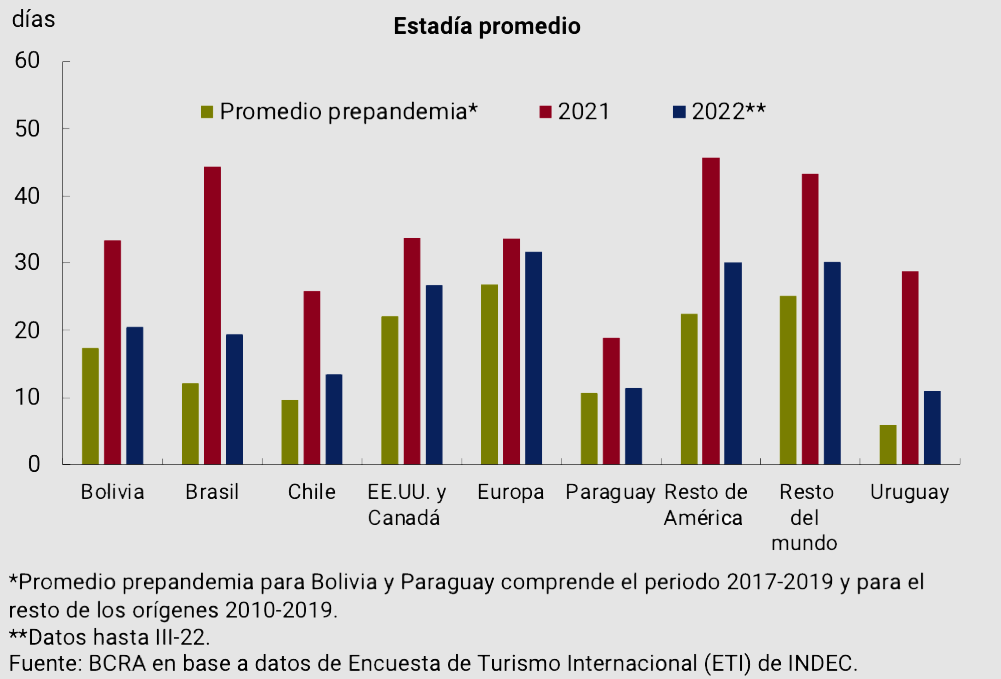
This recovery in tourist arrivals to the country was combined with changes in the patterns of stay and average spending, from almost all origins. In the case of overnight stays, although they decreased compared to the atypical level observed in 202115, all origins have a permanence higher than the pre-pandemic average. The daily expenditure declared by visitors is also above previous levels, except in the case of visitors from Brazil. This, combined with a longer stay in the country, implies higher income (total spending) for each tourist visiting Argentina (see Figure 4.10). So far in 2022, of the income to the country through the Ezeiza International Airport, according to the International Tourism Survey (ETI) prepared by INDEC, those who spend the most in Argentina are American visitors who do not belong to neighboring countries (US$3,971 per capita) followed by Americans and Canadians (US$3,770 p.c.) and residents in Europe (US$3,354 p.c.). The BCRA took different actions so that these currencies have a positive impact on International Reserves, among which Com. “A” 7630 of November 4, 2022 stands out, which exempts payment card operators (credit, debit and prepaid) from settling in the foreign exchange market the foreign currency that must enter to settle the consumption of their users in the country. in accordance with current legislation. It is hoped that in practice this will allow them to offer a better exchange rate to foreign tourists.
Figure 4.10 | Inbound tourism. Ezeiza Border Crossing
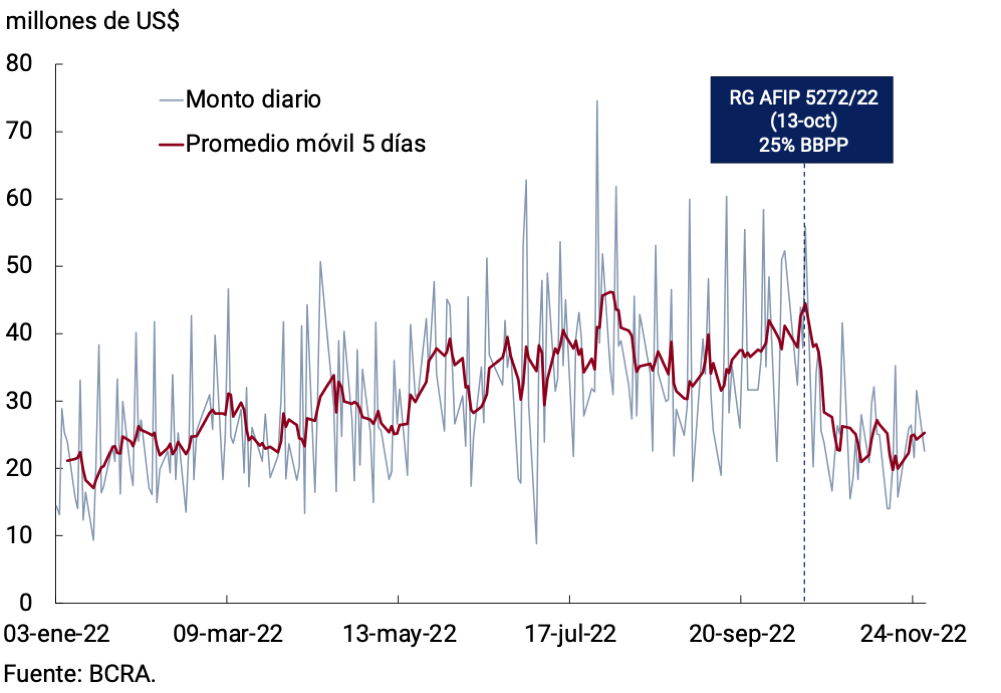
As for tourism, a significant normalization of inbound tourism was observed and the gradual recovery of outbound tourism compared to pre-pandemic levels is expected to continue. Net outflows for trips, tickets and other card payments abroad, accumulated until November, reached US$6,400 million. These expenditures are showing a reduction from what was established by the AFIP through General Resolution 5270/2022 of October 6, in which it was determined that as of the 12th of the same month, all monthly card purchases that exceed US$300 have to pay an extra 25% surcharge on the official dollar rate, on account of the Personal Assets Tax. This additional percentage was added to two other surcharges already in force: 30% of the PAIS tax and 45% on account of the income tax. Thus, the average daily gross expenditure for “Travel, tickets and other card payments” was US$25 million in November (see Figure 4.11).
Figure 4.11 | Exchange market. Gross expenses for trips, tickets and other card payments
During October and November, the BCRA was the net bidder of foreign currency, in a framework in which the import administration system was comprehensively modified through Communication “A” 7622 of October 13, which reported that, as of October 17, they could give access to the foreign exchange market to make payments for imports of goods to operations associated with a declaration in the Import System of the Argentine Republic (SIRA), which replaces the Comprehensive Import Monitoring System (SIMI).
On the other hand, the Argentine government announced an agreement with China to expand the availability of the currency swap that both countries signed in 2011. The new agreement will allow the country to have US$5 billion as freely available reserves. That is, they can be used to intervene in the foreign exchange market or to face imports and debt payments.
4.4. Perspectives
In the immediate term, leading indicators suggest a fall in exports for the December-January two-month period and a rise in imports (see Section 3 / Kiel Institute Trade Indicator). For the year 2023, the economy is expected to register a trade surplus in goods for the fifth consecutive year, within the framework of a managed floating exchange rate policy.
Regarding exports from the agricultural sector, the planting of the main grains has been strongly affected by the prolonged drought and repeated frosts in recent months, which caused delays in their progress compared to previous campaigns, so there is some uncertainty about the product and export values in the future. The prospect of lower wheat exports due to the impact of the drought would negatively affect the trade balance, while the commissioning of the Néstor Kirchner gas pipeline at the end of June 2023, which will substantially reduce fuel imports, would contribute positively. In a medium-term perspective, the policies to promote strategic sectors that are being deployed are expected to have a favourable impact on exports (Section 2 / Initiatives to promote strategic sectors)
The international context will continue to play a leading role in the risk matrix of the external sector of the Argentine economy. The ongoing contractionary monetary policy by the world’s major central banks will have an impact on the growth of our trading partners. Going forward, the duration and intensity of the rate hike cycle will shape global financial conditions, and greater volatility in asset, currency and commodity markets cannot be ruled out, with its negative consequences on global economic activity (see Chapter 2. International Context).
In this context, the BCRA continued to improve foreign exchange regulation in order to promote a more efficient allocation of foreign currency. In this regard, on November 27, Decree 787/2022 established the reestablishment of the “Export Increase Program”16, in force until December 31, in which an exchange rate of $230 per US$1 was established for exports of soybeans and their derivatives. With this new incentive, a greater dynamism of the foreign sales of the soybean complex is expected in the remainder of the year. Likewise, through Communication “A” 7621, the BCRA provided for the extension until December 31, 2023 of the provisions, referring to access to the foreign exchange market of the private sector to make payments of foreign financial indebtedness and capital of securities in foreign currency.
Going forward, and to the extent that macroeconomic conditions allow, exchange rate regulations will be made more flexible, with the aim of maintaining in the medium and long term a set of macroprudential regulations compatible with the dynamization of capital flows aimed at the real economy.
Back to top
5. Public Finance
Durante el segundo semestre los ingresos crecieron por encima de los gastos primarios, en contraste con lo ocurrido durante el primer semestre de 2022. Así, el resultado fiscal primario en base caja del Sector Público Nacional no Financiero (SPNF) acumuló en los últimos 12 meses a noviembre un saldo deficitario equivalente a aproximadamente 2,2% del PIB, habiendo cumplido la meta prevista en el Programa de Facilidades Extendidas con el FMI para septiembre. Este nivel de déficit se ubicó en niveles inferiores a los de fin de 2021 (3,0% del Producto) y resulta compatible con la meta de déficit primario de 2,5% del PIB para 2022 planteada originalmente en el programa con el FMI. Por su parte, el déficit financiero del SPNF representó 3,8% del PIB en igual período.
In the third quarter of the year, tax collection increased by 92.2% YoY (+8.0% YoY in real terms). Meanwhile, during the October-November two-month period, collection grew 90.8% YoY (0.3% YoY in real terms). Economic growth, the improvement in employment and formal wages and certain regulatory changes (advance payments of Income Tax for corporations and increase in the collection of operations in foreign currency) contributed to this tax performance. Export duties also made significant progress during September, when the “Export Increase Program” aimed at stimulating the commercialization of soybeans was in force, although they were retracted during October and November. However, since the end of November, the incentive for soybeans has been reinstated, so the recovery of the dynamism of these resources is expected in the last month of the year.
On the side of primary spending, it should be noted that the process of slowing down its growth rate was consolidated during the second half of the year. With lower demand for fuel imports and the update of public service rates (electricity, gas and water), the growth of associated subsidies was limited. On the side of social benefits, the inflationary acceleration in the third quarter implied a real drop in expenditures, mainly in retirements and pensions, which is sought to be recomposed in the following months through income policies, such as the granting of complementary bonuses for those who receive up to two minimum benefits. In turn, the Ministry of Social Development carried out audits of the Empower Work plan that determined suspensions of benefits and limited the expansion of the number of holders of said program. Meanwhile, priority was given to expenses related to the construction of the Vaca Muerta gas transportation infrastructure, which will contribute to generating significant savings in the future.
The financing strategy allowed obtaining net funding of about $2.3 billion so far this year. The stock of National Public Debt at the end of November 2022 represented approximately 81% of GDP, exhibiting a reduction of about 8 p.p. compared to the end of 2019. Recently, the National Government announced a new agreement with the official external creditors grouped in the so-called Paris Club, accounting for a new milestone in the normalization of international financial relations.
For the year 2023, it is expected that fiscal consolidation will continue in line with the provisions of Law No. 27,701 of the 2023 National Budget, recently approved by the National Congress.
5.1. National tax collection continued to strengthen both due to strong economic growth and regulatory changes
National tax collection increased 92.2% during the third quarter of 2022 compared to the previous year (see Figure 5.1), which meant a real growth of 8%. With data as of November, during the fourth quarter the collection advanced 90.8% y.o.y. (0.3% y.o.y. in real terms). The performance of taxes in the third quarter responded to the consolidation of the economic recovery and the improvement in wages and formal employment. Taxes associated with foreign purchases also had a real advance, although more limited in the margin. Export duties were reduced, impacted by the drought and by the commercial decisions of the sector’s players.
Figure 5.1 | Contribution to the growth of national tax collection
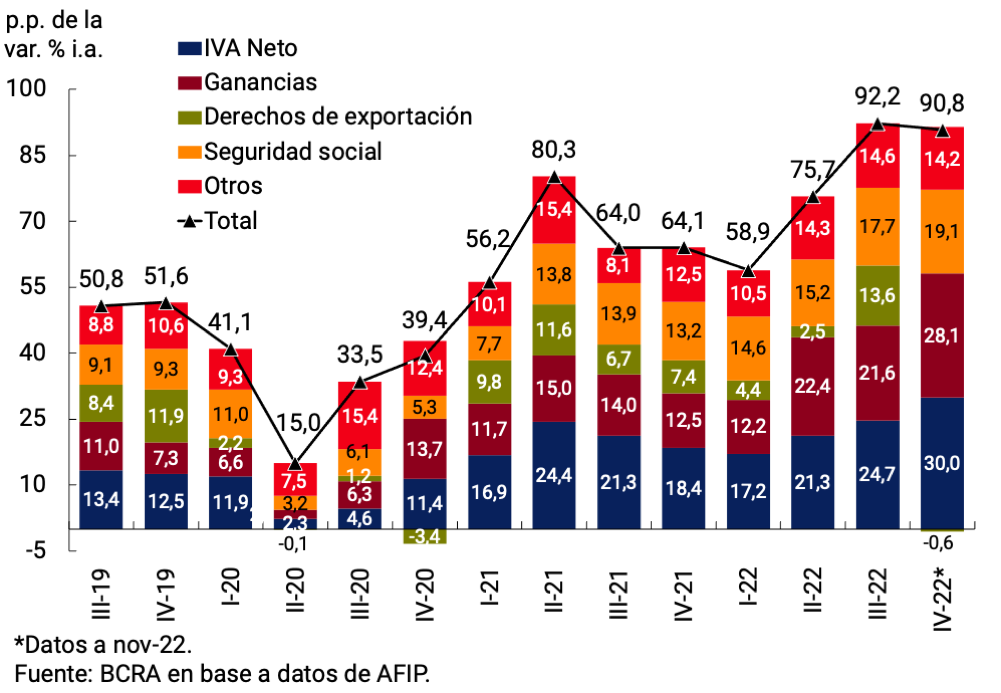
The vast majority of taxes related to the domestic market (Value Added Tax (VAT), Profits, among others) continued to show a good performance due to the maintenance of the recovery of economic activity and regulatory changes. The income tax showed great dynamism due to the effect of the extraordinary payment on account made by the companies, with the end of the year from August to December, whose amount of the tax determined in the affidavit for the fiscal period 2021 or 2022, as applicable, is equal to or greater than $100 million22. Likewise, the increase in the withholding on account of taxes on Income (and Personal Assets) for the consumption of foreign currency for travel and expenses abroad had an upward impact23. Social security resources were driven by improvements in the labor market (see Chapter 3. Economic Activity and Employment), both due to increases in registered employment and improvements in formal wages.
Other taxes continued to show a more limited advance such as Internal Taxes, Fuels – mainly due to the postponement in the update of tax24 – and Personal Property. Import duties and the statistical tax limited their increase due to the slower rate of expansion of imported values compared to the first half of the year and the fall in the margin (see Chapter 4. External Sector).
Finally, export duties had a disparate behavior, due to the validity, in September, of the Export Increase Program25 aimed at stimulating the commercialization of soybeans, with an effect on the collection of duties. The aforementioned program was reestablished26 in an extraordinary and transitory manner, from the end of November until the end of 2022. Due to this, it is expected that during the last month of the year the income from these rights will be dynamic.
In real terms, seasonally adjusted national tax collection grew 1.7% in the third quarter of 2022 and fell 2.8% during the fourth quarter with partial data as of November. In any case, this indicator was 8.0% above the level shown in 2019 between October and November (see Figure 5.2). This performance reflects the consolidation of tax revenues27 following the adverse effects of the COVID-19 pandemic.
Figure 5.2 | Real national tax collection seasonally adjusted

The evolution of tax revenues allowed the total revenues of the National Non-Financial Public Sector (NFPS) to increase in nominal terms by 62.0% YoY in the third quarter (-8.5% YoY in real terms) and 86.8% YoY in the fourth quarter (-1.7% YoY in real terms, with partial data as of Nov-22). The performance of resources in the third quarter was negatively affected by the comparison effect due to the registration of income as a current transfer of Special Drawing Rights (SDRs) received from the IMF28 and non-tax income from the Solidarity and Extraordinary Contribution to help mitigate the effects of the pandemic during 2021. Net of these effects, funds would have shown a nominal increase of 98.5% YoY in the third quarter. Tax and social security revenues increased by 89.8% YoY in the third quarter and 90.2% YoY in the fourth quarter with data as of November.
Meanwhile, tax collection in all provinces showed a similar behavior to that observed at the national level. According to the partial information available, in the third quarter of the year the nominal advance of own tax resources would have shown an increase of around 90.0% y.o.y.
Regarding next year, a Tax Agreement29 (TIEA) was recently signed between the Argentine Republic and the United States of America, which provides for the exchange of financial information on individual accounts and beneficiaries of companies in both countries, which will allow building a path for the externalization of undeclared capital. As a complement to this understanding, and after the extension of the incentive regime for Construction (laundering), the Government sent to Congress for its consideration a project that promotes externalization. The bill contemplates a low preferential rate for the declaration of assets that are in the country or that will be repatriated when declared, if they are abroad. In addition, the creation of a specific fund for the cancellation of the debt with the International Monetary Fund is foreseen, to which 20 percent of the proceeds from the “laundering” will be allocated.
5.2. The fiscal order made it possible to achieve the objective of reducing the primary deficit
In line with the provisions of the Ministry of Economy in the sense of ordering the public accounts to comply with the current budget, public revenues continued to grow above the rate of expansion of primary spending, reaffirming a fiscal path compatible with an annual deficit of the NFPS on a cash basis of up to 2.5% of GDP.
Among other measures, increases in the rates of public services (electricity, gas and water) were arranged, which, together with a seasonal reduction in the demand for imports of relatively more expensive fuels, allowed for savings in energy subsidies. Meanwhile, the inflationary acceleration in the third quarter implied a real drop in expenditures, mainly in retirements and pensions, on which a recomposition is expected in the following months through income policies, such as the granting of complementary bonuses for those who receive minimum benefits. In turn, the Ministry of Social Development carried out audits of the Empower Work plan that determined suspensions of benefits and limited the expansion of the number of holders of said program, while progress is made in the implementation of a program that seeks the gradual incorporation of current beneficiaries of social plans into jobs in the private sector. Priority was given to expenditures related to the construction of the Néstor Kirchner gas pipeline, which will contribute to significant savings in the future (see Table 5.1).
Thus, NFPS primary expenditure showed a nominal increase of 71.3% YoY during the third quarter and 70.5% YoY in the fourth quarter – with partial data as of November – that is, 16 p.p. below the nominal increase in revenues in the same period. Therefore, real spending was reduced compared to a year ago. During the third quarter, real primary expenditures contracted 4.1% compared to the same period in 2021, after having an expansion of 11% real YoY in the first half of the year.
Table 5.1 | National Non-Financial Public Sector Expenditures
In millions of $
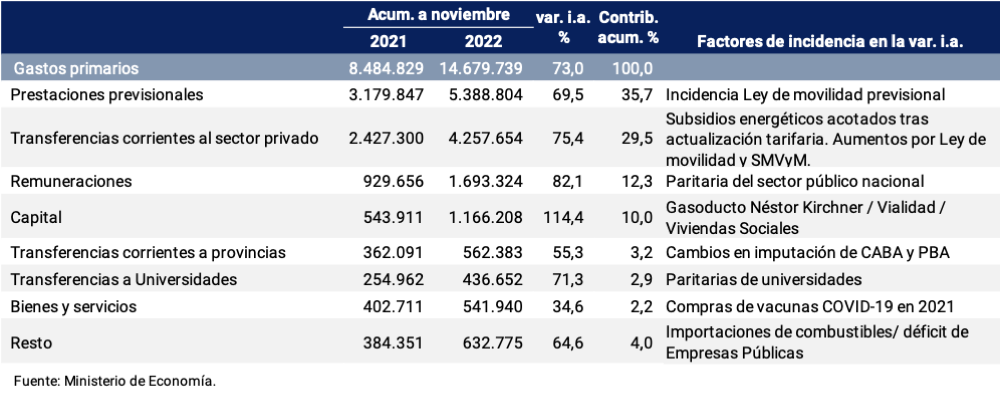
This evolution reflected the National Government’s effort to clean up the public accounts in order to meet the goals contemplated in the Extended Facilities Program agreed with the International Monetary Fund (IMF), while limiting the financing needs of the National Treasury. In this sense, seasonally adjusted real primary expenditure contracted compared to the previous quarter. However, it is still 12% above the average for 2019 (see Figure 5.3). It should be noted that, despite the contraction in primary spending, and based on the analysis of the cyclically-adjusted fiscal result, in 2022 fiscal policy would have contributed to preserving the recovery of economic activity (see Section 4 / Primary result of the National Non-Financial Public Sector adjusted for the cycle).
Figure 5.3 | Real seasonally adjusted primary expenditure of the SPN
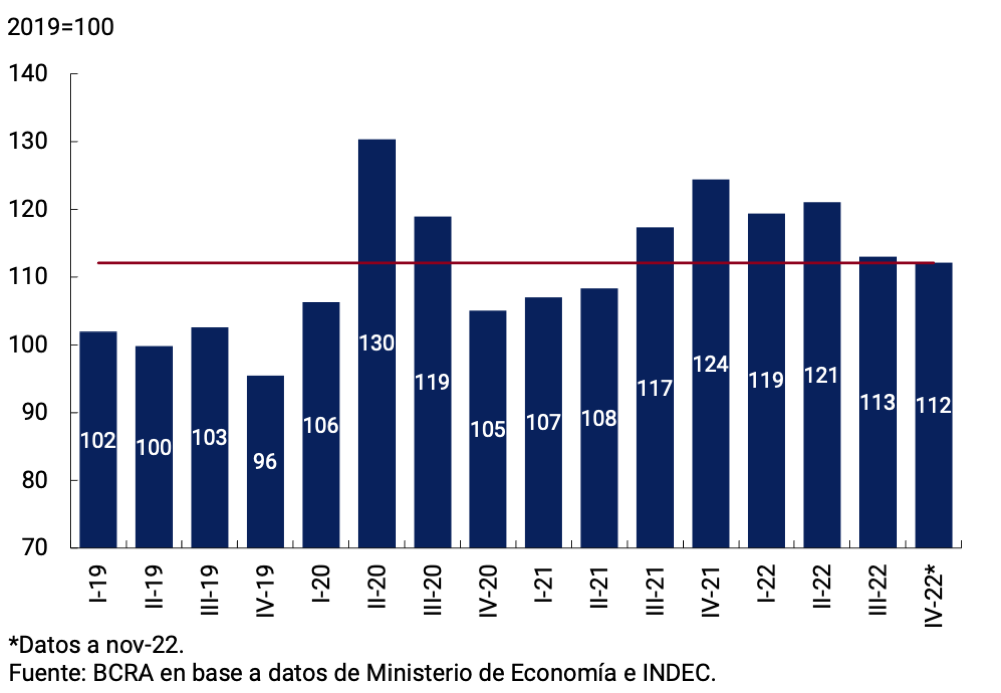
Considering eleven months of 2022, NFPS revenues grew 77.8% YoY (4.8% YoY in real terms) – net of the effect of current transfer income from Special Drawing Rights in September 2021 by $427,400 million – and primary expenditures advanced 73.0% YoY (+2.7% YoY in real terms). Therefore, the primary deficit of NFPS accumulated in the year is approximately 1.7% of GDP and, in the last 12 months, around 2.5% of GDP30 (see Figure 5.4). For its part, the financial deficit of the accumulated NFPS stood at 3.0% of the estimated annual GDP of 2022, and approximately 3.8% of the Product contemplating the last 12 months. Interest represents 1.6% of GDP in the accumulated of the last 12 months.
Gráfico 5.4 | Resultado fiscal del SPNF
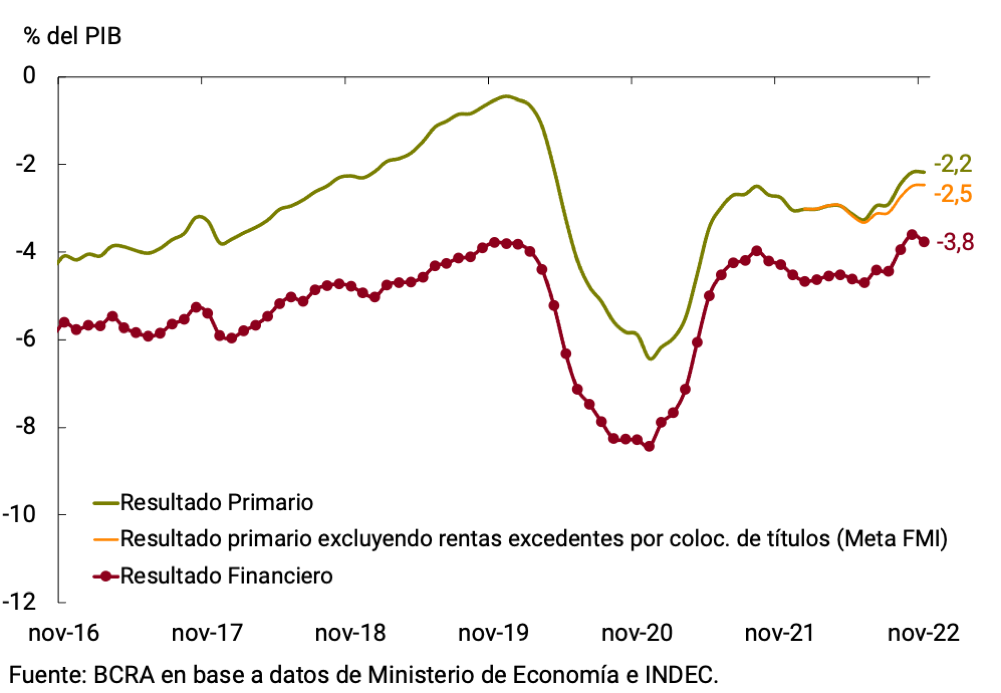
The fiscal strategy allowed the fulfillment of the NFPS primary result target established within the Extended Facilities Program (EFP) with the International Monetary Fund (IMF) for the third quarter of the year (See Figure 5.5). In the first nine months of 2022, if the annual limit for the calculation of income from property income linked to primary issuances of public securities, equivalent to 0.3% of GDP (established for the purposes of the policy objectives contained in the Economic Program consistent with a primary deficit target of 2.5% of GDP), is considered, the primary deficit of the NFPS was $1.1 trillion (-1.3% of GDP). In turn, the National Congress approved the National Budget Law for the year 202331, which contemplates convergence to a primary deficit for next year of 1.9% of GDP after a deficit balance of 2.5% of GDP forecast for this year.
Figure 5.5 | Compliance with the Cumulative Primary Fiscal Deficit Target

5.3. The financial needs of the National Treasury continued to be covered mainly through placements in the local debt market
So far in 2022, the TN achieved a refinancing of 144.1% of principal and interest services, which implied a net financing of approximately $2.27 trillion. It should be noted that, in the accumulated months of September, October, November and so far in December, a significant refinancing of 167.0% of principal and interest services was obtained, which implied a net financing of approximately $939,700 million.
Debt instrument issuances so far in the fourth quarter were mainly concentrated in discount bills and securities adjustable by the Reference Stabilization Coefficient (CER), while, to a lesser extent, dollar-adjusted securities and dual bonds (CER/DLK) were placed. The maturities of the instruments issued, both at a discount and those tied to the evolution of the CER, decreased by the margin. Considering discount bills as a reference, nominal interest rates rose slightly: from an average APR of 85.9% in September, these instruments were remunerated with an average APR of 87.96% in December.
For its part, during the months of June, July, August and November 2022, voluntary debt conversion operations were carried out that significantly decompressed the profile of short-term maturities. The last operation managed to decompress most of the maturities of November and December 2022, in exchange for dual instruments (tied to the greater evolution between inflation and the exchange rate) maturing in June, July and August 2023.
So far in 2022, and in line with the forecasts in the framework of the agreement with the IMF, the net financing of the NT contemplated, in addition to the result of the auctions of market instruments in pesos and the net disbursements of the IMF and other international financial institutions, the net transfer of $620,051 million of Transitory Advances (TA) of the BCRA. It should be noted that no additional requests from this source are expected for the rest of 2022.
The stock of National Public Debt at the end of November 2022 reached approximately US$384,668 million and represented about 81% of GDP, exhibiting a reduction of about 8 p.p. compared to the end of 2019.
Going forward, significant progress in the normalization of international financial relations, by reaching a new agreement with the official external creditors grouped in the so-called Paris Club, would facilitate the obtaining of additional bilateral and multilateral financing. At the same time, the joint policy of the BCRA and the National Government to deepen the local capital market will seek to improve domestic financing, allowing monetary assistance to be reduced and favoring the accumulation of reserves.
Back to top
6. Pricing
The monthly inflation rate has been reduced since September and, although it remains high, it stood at 4.9% in November, the lowest level since February of this year. This moderation occurred after the significant acceleration of the general price level that had been verified in July (7.4%) and August (7.0%), in a context of greater local financial volatility, exchange rate uncertainty and increased inflation expectations.
As a result of this evolution, the third quarter ended with an average monthly inflation of 6.8% (+1.3 p.p. compared to II-22) while the first two months of the fourth quarter averaged 5.6% monthly (-1.2 p.p. compared to III-22). The year-on-year inflation rate continued to rise over the past few months to reach 92.4% in November.
The moderation of monthly inflation rates was partly the result of a series of measures adopted by the National Government and the BCRA to contain the acceleration verified in the third quarter. The BCRA has repeatedly raised the monetary policy interest rate, stimulating savings in domestic currency and thus contributing to an environment of greater exchange rate stability. The National Government implemented policies aimed at consolidating the process of reducing the fiscal deficit and deepening the domestic debt market to reduce monetary financing needs, the liquidation of exports was encouraged to strengthen international reserves and reference price agreements were reached on certain sets of goods and services.
The reduction in inflation in recent months occurred mainly in the Core category. The launch of the Fair Prices Program, in mid-November, contributed to deepening the slowdown of the category due to its direct effect on the prices of a wide variety of basic necessities, especially food. In particular, seasonal prices also slowed down in November, after four months with very high increases. In contrast, Regulated prices increased the average rate of increase so far in the fourth quarter, within the framework of the process of segmentation of electricity, gas and water rates.
For the coming months, this trend of gradual decline in core inflation is expected to continue, favored by the process of fiscal consolidation, the higher level of international reserves, the interest rate policy that promotes savings in pesos and the coordination between prices and wages aimed at reducing inflationary inertia.
The National Government and the BCRA will continue to adopt different types of measures to reduce inflation. The BCRA will conduct its monetary policy keeping interest rates in positive territory in real terms and managing liquidity in an appropriate manner to preserve monetary, exchange rate and financial balances.
6.1. The monthly inflation rate declined, returning to levels at the end of the second quarter
Inflation has fallen significantly in recent months and, while still high (4.9 percent), was at its lowest level since February in November (see Figure 6.1). This moderation occurred after the marked acceleration of the general price level that had been verified in July (7.4%) and August (7.0%), in a context of greater local financial volatility and exchange rate uncertainty that had a negative impact on inflation expectations. As a result of this evolution, the third quarter ended with an average monthly inflation of 6.8% (+1.3 p.p. compared to II-22 and 77.6% year-on-year), showing increases in the rates of increase in the three main categories: Core (6.5% monthly average, +0.9 p.p. compared to II-22), Seasonal (10.6%, +5.4 p.p.) and Regulated (5.2%, +0.3 p.p.). So far in the fourth quarter, average inflation was 5.6% monthly (-1.2 p.p. compared to III-22), while the year-on-year rate continued to rise to reach 92.4% in November.
Figure 6.1 | | CPI. Monthly and quarterly evolution of the General Level
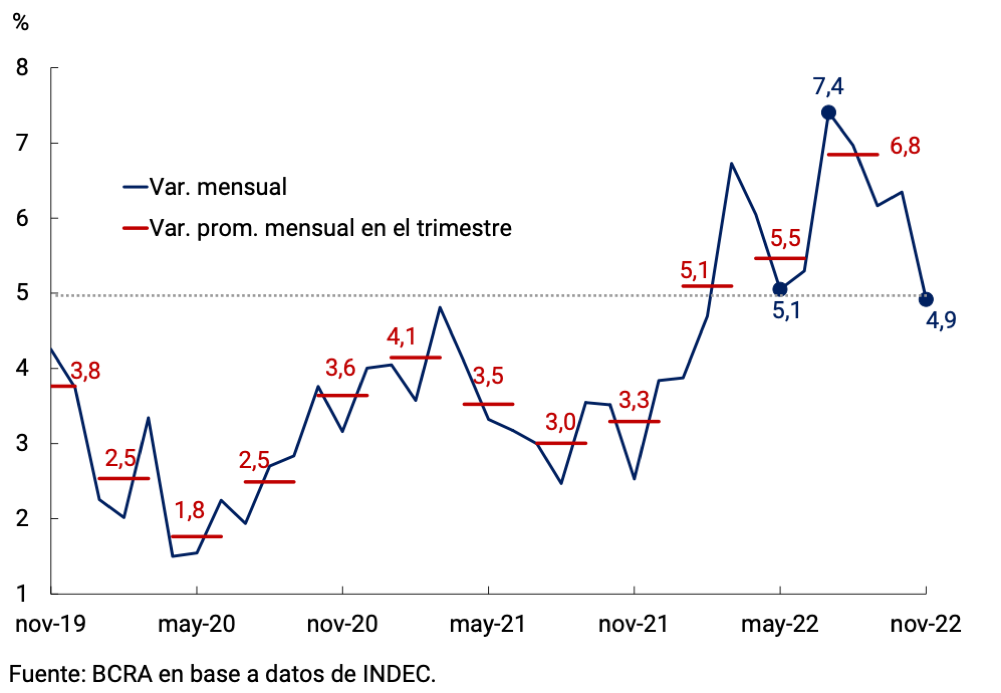
The moderation of monthly inflation rates between August and November was partly the result of a series of measures adopted by the National Government and the BCRA to contain the acceleration verified in the third quarter. The BCRA has repeatedly raised the monetary policy interest rate, stimulating savings in domestic currency and thus contributing to an environment of greater exchange rate stability. The National Government implemented policies aimed at consolidating the process of reducing the fiscal deficit and deepening the domestic debt market to reduce monetary financing needs, the liquidation of exports was encouraged to strengthen international reserves and reference price agreements were reached on certain sets of goods and services.
These measures mainly impacted the Core category of the CPI, which reached a monthly average of 5.2% so far in the fourth quarter (-1.4 p.p. compared to III-22) and 4.8% in November (-2.6 p.p. compared to the last peak recorded in July). The Seasonal category also slowed down so far in the fourth quarter (6.5% average monthly increase, -4.0 p.p. compared to III-22), especially in November when it reached 4.1% monthly increase after four months with very significant increases (10.2% average in the July-October period). In contrast, the Regulated category (6.8% monthly average in the October-November two-month period, +1.6 p.p. compared to III-22) accelerated within the framework of the process of segmentation of electricity, gas and water tariffs (see Figure 6.2).
Figure 6.2 | CPI. Main categories
Contributions in p.p. to the average monthly variation

So far in the fourth quarter, the percentage of CPI groupings that rose at a rate of less than 7.0% per month increased considerably, returning to levels prior to the acceleration episode of the third quarter of the year. During July and August, there had been very high increases in the prices of a large number of goods and services simultaneously, with a level of dissemination and coordination that is usually verified only in episodes of jumps in the official exchange rate, such as in 2018 and 2019 (see Figure 6.3).
Figure 6.3 | CPI. Percentage of grouped according to range of increases*
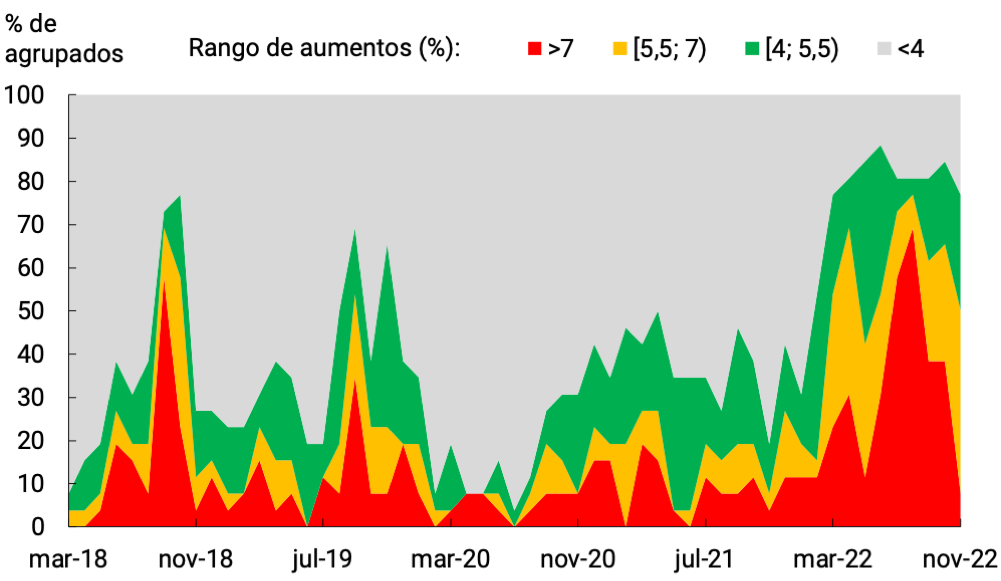
* Prepared based on information from the CPI considering the largest openness available. A total of 26 groups were used, 9 of which belong to the Non-ALC Food and Beverages division. The series of Electricity, Gas and Other Fuels, Communication and Education were excluded.
Source: BCRA based on INDEC data.
The reduction in monthly inflation rates in October and November was driven by the slowdown in goods, which rose 5.9% and 4.5% month-on-month respectively, significantly lower than the peak of 7.4% verified in August and the 7.2% average recorded during the third quarter. Among the divisions of the CPI made up entirely of goods, the one that contributed the most to the slowdown in the General Level was Food and non-alcoholic beverages (4.8% monthly average in October-November, -1.8 p.p. compared to the third quarter), due to its greater relative weight in the index. Secondly, the slower rate of increase in the Clothing and footwear division (5.7% monthly average, -4.0 p.p.) stands out, mainly attributable to seasonal factors and, to a certain extent, to the price agreement between the National Government and companies in the sector35. On the other hand, the Alcoholic Beverages and Tobacco division also contributed, although to a lesser extent, to the slowdown in goods (5.9% monthly average, -1.7 p.p.), due in part to the fact that the increases authorized in cigarettes during the period were more limited.
Among those grouped composed of goods belonging to other divisions, the slowdown verified in October and November in Vehicle Acquisition (4.3% monthly average, -2.0 p.p. compared to the third quarter) and Newspapers, newspapers and magazines (6.4%, -3.2 p.p.) stood out. On the other hand, Medicinal products, artifacts and equipment for health (5.8%, +0.2 p.p.) showed a slight acceleration in the period due to the end of the agreement between the Government and the companies in the sector that was in force until November 1836. For their part, fuels and lubricants also increased the rate of increase in the two months considered (6.2%, +2.0 p.p.), although from December 2022 to February 2023, increases of up to 4% per month will be authorized within the framework of the Fair Prices37 program launched in mid-November.
With regard to Food and non-alcoholic beverages, a highly weighted division in the consumption basket, it gradually slowed the rate of increase from the verified peak in August (7.1% monthly), and in November the deceleration deepened (3.5% monthly, -3.6 p.p. compared to August) mainly due to the falls in vegetable prices. the moderation in Meats and derivatives and the entry into force of the Fair Prices program in the middle of the month. Within the division, the prices of fresh (non-packaged) foods were the ones that verified the sharpest deceleration in the two months considered (3.7% monthly average in October/November, -2.2 p.p. compared to III-22; see Figure 6.4).
Figure 6.4 | Monthly evolution of fresh and packaged food prices
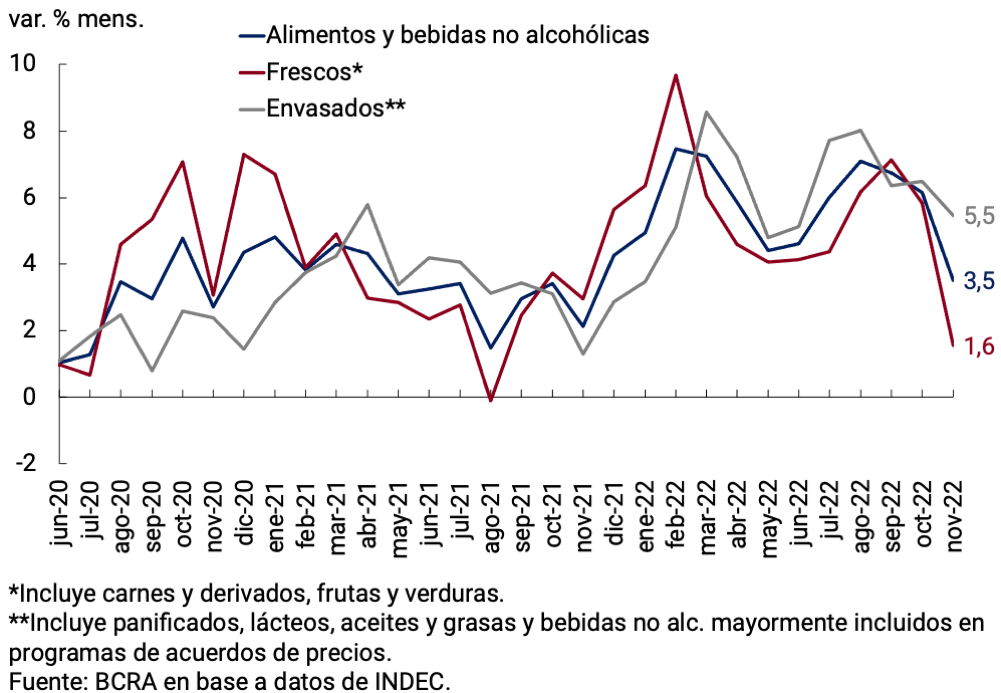
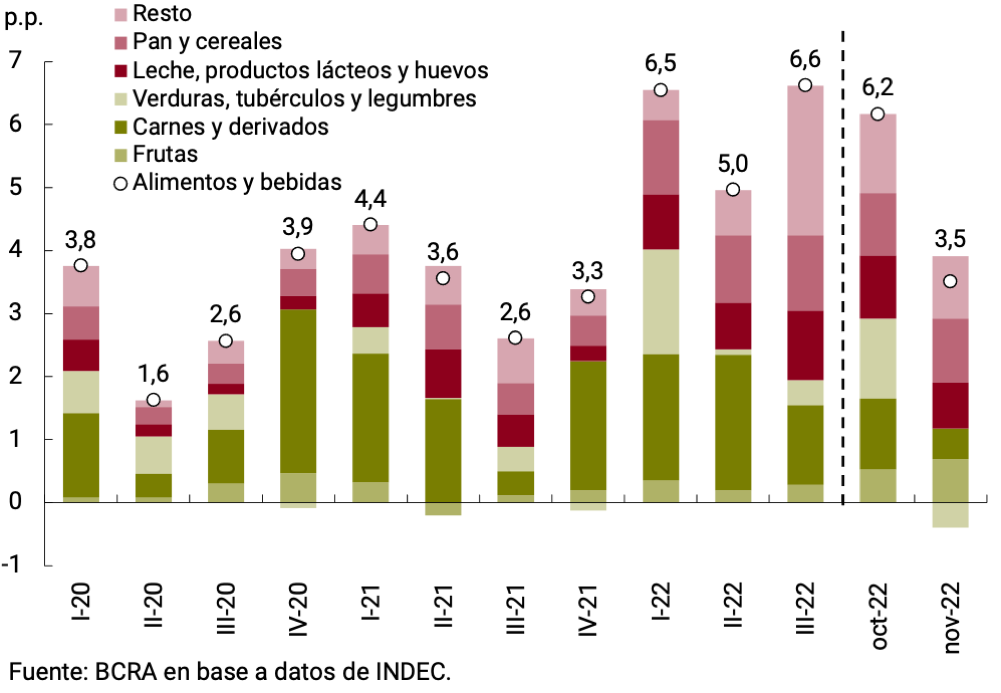
The lower rate of increase in fresh food in November (1.6%) was due to the 3.3% drop in the group of Vegetables, tubers and legumes (-3.3% monthly) and the lower rate of increase in Meat and derivatives (1.5%) compared to the already limited records of the third quarter (3.3% avg. mens. in III-22). Fruits, on the other hand, had increases of 11.1% and 14.2% respectively in October and November, being even higher than the high records of the third quarter, (8.2% avg. mens. in III-22).
The high participation of the Meat and Derivatives group in the CPI merits a particular analysis of its recent evolution38. One of the factors that explained the limited variations of this group in recent months is the lower availability of feed for livestock as a result of the drought. This has encouraged greater slaughter, limiting the prices of live cattle and, therefore, moderating the consumer sales prices of beef cuts (which account for approximately two-thirds of the grouping of Meat and derivatives). So far in December, the evolution of cattle prices measured by the Steer Index of the Agricultural and Livestock Market (INMAG, see Figure 6.5) suggests that retail prices would maintain a higher rate of increase than in November, although possibly below core inflation. On the other hand, the reduction in livestock stock and the seasonal behavior of retail beefprices 39 could explain an acceleration in the first months of 2023.
Figure 6.5 | Monthly evolution of retail and wholesale meat prices
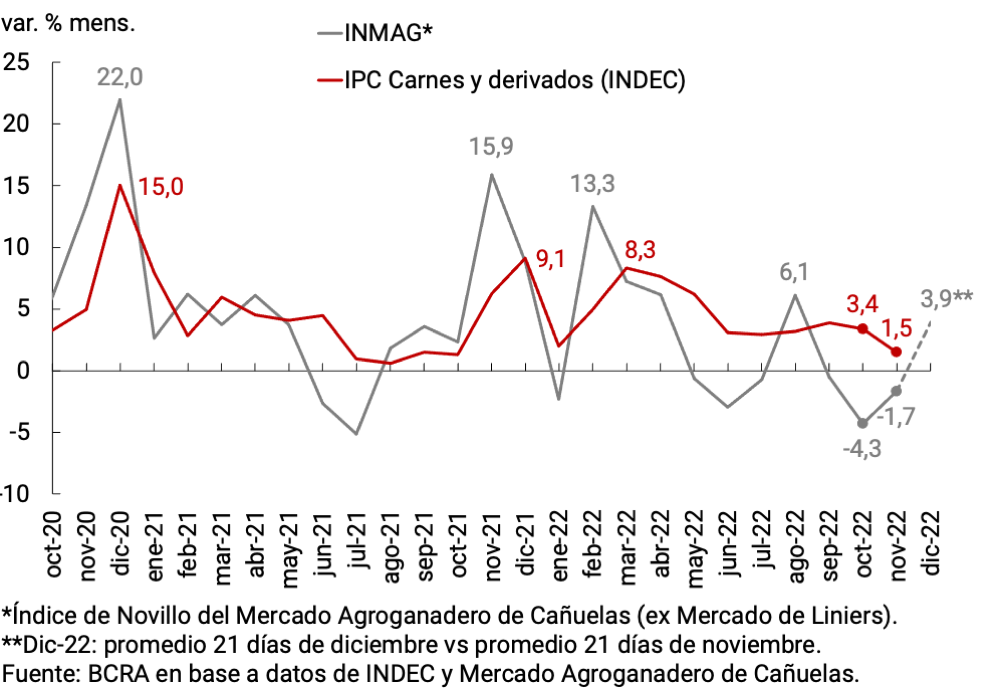
With regard to packaged food and beverages, the slowdown so far in the fourth quarter (6.0% avg., -1.4p.p. compared to III-22) was concentrated in November (5.5%) and was favored by the high participation of these items in the basket of the Fair Prices program, which was partially in force in the month and will be full in December (see Figure 6.6). The most pronounced decelerations were verified in oils and fats (4.3% monthly average in October/November, -6.0 p.p. compared to III-22), sugars and sweets (5.1%, -5.0 p.p.) and infusions (4.3%, -2.2 p.p.). Bakery products (5.9%, -0.7 p.p.) and dairy products (6.3%, -1.4 p.p.), although they registered more limited decreases in their growth rates during the two months considered, also contributed to the moderation of Food and beverages due to their high weighting in the division.
Figure 6.6 | Composition of the basket of products included in Fair Prices* Includes medicinal products, coffee filters

, batteries and lamps not included in the other groups.
Source: BCRA based on data from the Ministry of Economy.
Contrary to what was observed in goods, so far in the fourth quarter services increased their rate of increase compared to the previous period (6.6% monthly average in the October-November period, +0.8 p.p. compared to III-22), with a higher average variation in regulated services compared to non-regulated services. This evolution represented an incipient recovery of the relative price of services versus goods and occurred after a negative trend that began in April 2018, explained both by the fall in real wages and by the policy of administering public service tariffs.
The acceleration of public services, whose prices are regulated, was explained by the authorized increases in electricity and gas within the framework of the tariff segmentation process implemented since October. Thus, the Electricity, gas and other fuels grouped accelerated to 9.5% monthly average in the two months of October and November (+6.6 p.p. compared to the third quarter). Meanwhile, increases in public transport moderated to 5.2% monthly average (-1.6 p.p.), highlighting during this period the increases authorized in taxis and subways in the City of Buenos Aires.
As for private regulated services, a generalized acceleration was observed so far in the fourth quarter, highlighting the incidence of telephone and internet services, which increased their rate of expansion significantly to 9.3% monthly average (+5.5 p.p. compared to the variation of III-22) after averaging relatively limited increases during the first nine months of the year (3.3% monthly average until September). On the other hand, the grouped Prepaid Expenses (5.5% monthly average, +0.4 p.p.) and Education (5.4%, +0.5 p.p.) registered lower accelerations compared to the previous quarter.
On the other hand, the acceleration of unregulated private services in the two-month period mainly reflected the increase in the rate of increase in rents and expenses related to housing (7.0%, +3.1 p.p. compared to III-22), largely explained by a significant impact of the salary brackets of the staff in charge of buildings on expenses. The rest of the unregulated private services showed a slight slowdown so far in the fourth quarter compared to the previous quarter. The Restaurants and Hotels group, with a high weighting, rose 6.5% monthly average between October and November (-0.6 p.p. compared to III-22), while Recreational and Cultural Services slowed down to 4.2% monthly average in the period (-0.8 p.p.).
6.2. Wholesale prices also slowed compared to the third quarter
After averaging in the third quarter the highest rate of expansion compared to that recorded in recent years (6.9% in III-22, +1.6 p.p. compared to II-22), wholesale prices captured by the Domestic Wholesale Price Index (IPIM) registered a similar evolution to that of retail prices and slowed down so far in the fourth quarter to 5.5% monthly average (-1.4 p.p. compared to III-22; see Figure 6.7). As in the case of retail prices, the average decline in the monthly records of the IPIM was also favored by the context of lower financial volatility and exchange rate uncertainty that occurred after July. In addition, the trajectory of this set of goods was influenced by the context of greater stability in international commodity prices. As mentioned in the September IPOM, the greater correlation between the monthly variations of the IPIM and the CPI is verified contemporaneously (see Section 5 / Is the IPIM a good predictor of the CPI?).
Figure 6.7 | Evolution and contributions of the IPIM and nominal exchange rate
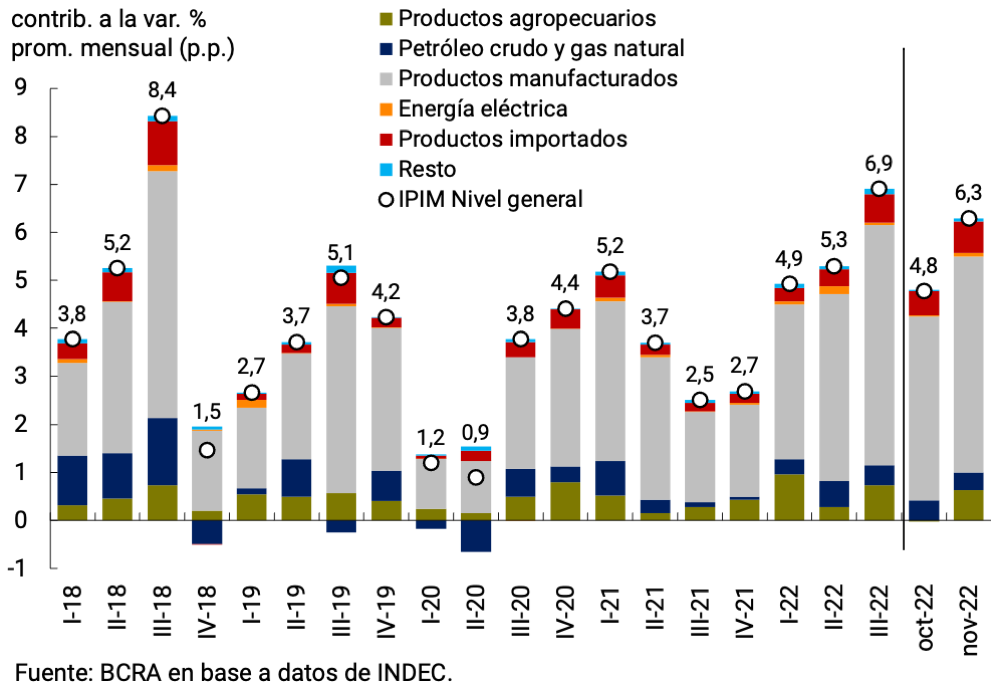
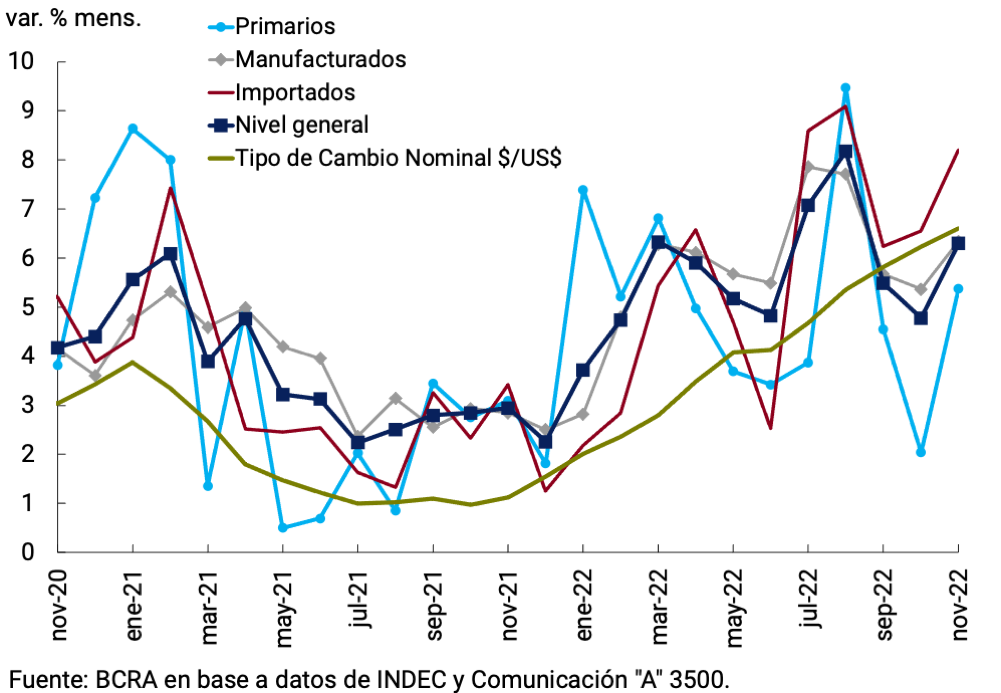
Within the IPIM, the higher rate of expansion during the third quarter had mainly reflected the acceleration of Manufactured Products, the category with the highest weighting in the index, which rose 7.2% on a monthly average (+1.6 p.p. compared to II-22). To a lesser extent, the increases in the expansion rates of Primary Products and Imported Products were influential. The moderation of the IPIM so far in the fourth quarter was disseminated among its categories, with the exception of Electric Energy, which increased its rate of increase after a third quarter with relatively limited variations. Regarding imported products, although they also slowed down in the October-November period, their rate of expansion (7.4% average) was higher than that of the rest of the divisions and that of the official exchange rate.
Construction costs measured by the ICC (Construction Cost Index) also slowed their rate of increase so far in the fourth quarter (6.6% monthly average, -0.7 p.p. compared to III-22) after having accelerated significantly in the third quarter (7.3%, +1.8 p.p. compared to II-22; see Figure 6.8). The average slowdown in October and November reflected a marked moderation in the prices of Materials (5.7% monthly average, -3.3 p.p.), while the Labor component exhibited a greater variation than in the third quarter (7.4%, +1.5 p.p.).
Figure 6.8 | Construction costs

6.3. The year-on-year inflation rate continued to rise, highlighting the rise in the Seasonal category
The year-on-year inflation rate at the retail level increased during the year to 92.4% YoY in November, 41.5 p.p. higher than the figure for December 2021 (50.9% YoY). This upward trend was observed again in the three main categories that make up the CPI, which maintained very heterogeneous rhythms, amplifying the differences in their relative weight within the index. In fact, the year-on-year variation of Seasonal Items rose to 132.1% in November, far exceeding those of the rest of the categories. Core inflation reached 89.1% YoY, a variation similar to that of the General Level due to its high weighting in the index. Finally, the goods and services that make up the Regulated category rose 79.7% YoY and, although they have accelerated, their relative prices have deteriorated again so far in 2022. For its part, year-on-year wholesale inflation stood at 87.7% in November, maintaining a lower pace than the CPI as it was verified throughout 2022, after the opposite situation occurred in 2021 (see Figure 6.9).
Figure 6.9 | Retail (CPI) and wholesale (IPIM) prices
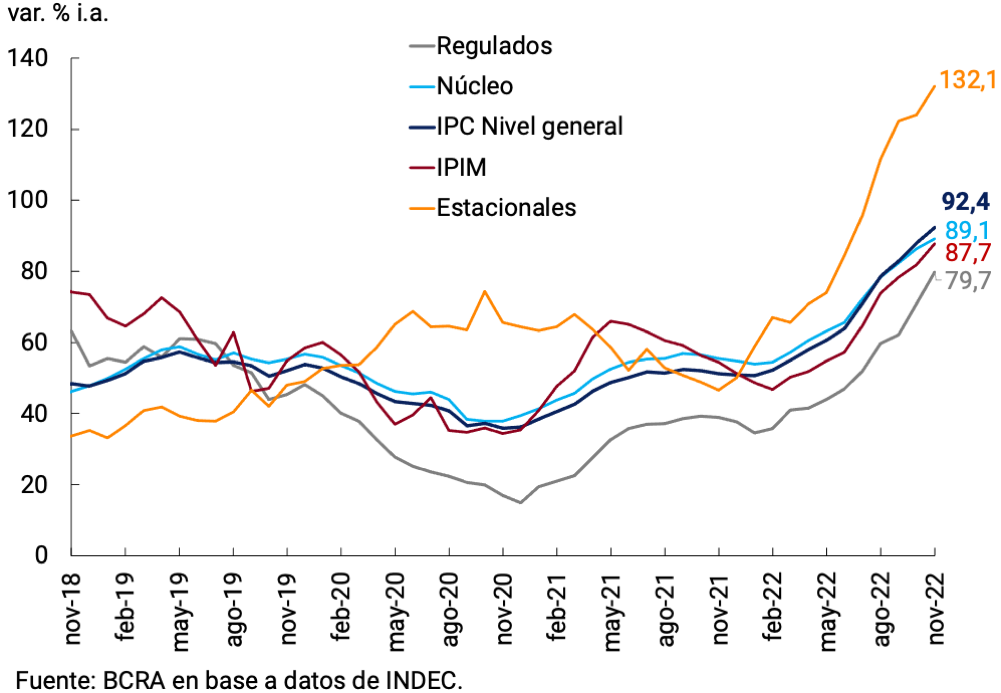
The high year-on-year rates of change in seasonal events, which throughout 2022 exceeded those of the rest of the CPI categories, were mainly explained by the evolution of three of the four grouped categories that make it up: Outerwear, Vegetables, tubers and legumes, and Services associated with tourism (see Figure 6.10).
The prices of Outerwear40 – grouped with the highest weighting within the Seasonal – increased by approximately 129% YoY in November (+61.6 p.p. compared to Dec-21), accumulating successive monthly increases of high magnitude, even in periods in which, due to seasonal factors, there are usually limited variations or even falls. Supply constraints and the recovery in demand are factors that could explain the acceleration evidenced by clothing in the last two years.
Figure 6.10 | Contribution to the year-on-year variation of the Seasonal category of the groups that make it up
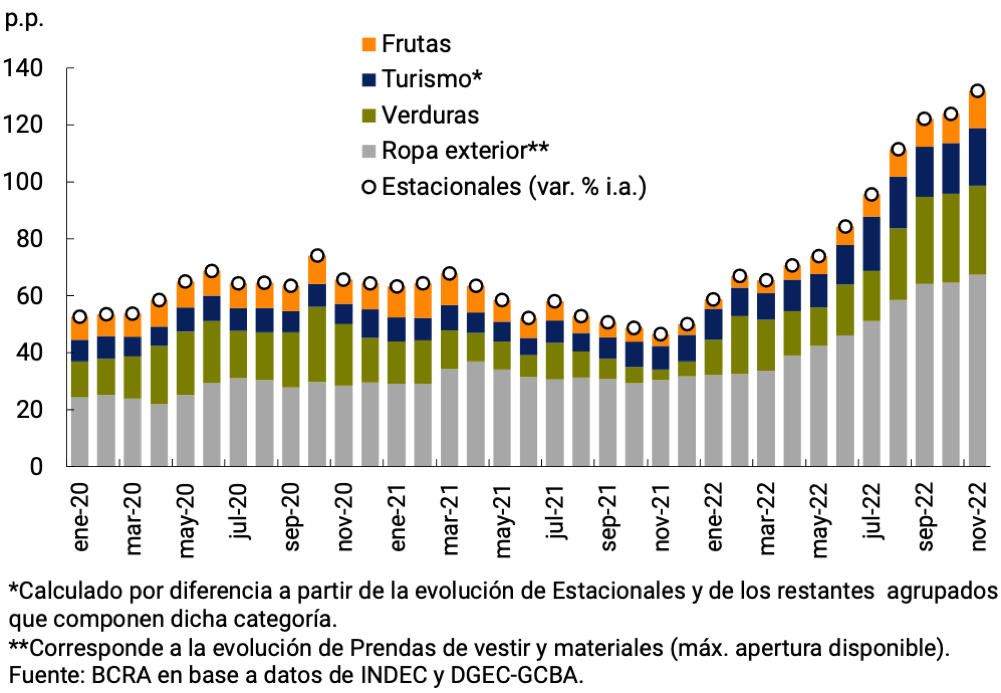
On the other hand, the prices of services linked to tourism41 expanded by approximately 147.3% y.o.y in November (+81.6 p.p. compared to Dec-21), driven by the recovery in demand after the pandemic and the boost of sectoral stimulus programs such as Previaje.
During the year, the acceleration of Vegetables, tubers and legumes was also noteworthy (142.5% y.o.y. in November, +120.6 p.p. compared to the year-on-year variation of Dec-21), grouped that had registered a limited rise and lower than that of the general level during 2021 (21.9% y.o.y.). It should be noted that the evolution of 2022 was influenced, among other factors, by adverse weather conditions that were occasionally recorded in the producing regions.
Finally, Fruits were the group with the lowest increase in relative terms among the seasonals and the only one that registered year-on-year increases on average below those of the General Level of the CPI so far in 2022. However, in recent months, Fruit prices accelerated and reached a year-on-year increase of 108.9%, exceeding the variation of the General Price Level, but remaining the group with the lowest year-on-year increase within the Seasonal category.
In this way, during the year Vegetables recovered part of the weighting in the Seasonal category that they lost during 2021. Services associated with tourism also rose above the category, while Outerwear and especially Fruits lost weighting during 2022.
6.4. Perspectives
The measures adopted by the National Government and the BCRA in response to the acceleration of prices in July and August contributed to the decline in monthly inflation rates to reach 4.9% in November (-2.5 p.p. compared to the peak in July). As anticipated in the previous IPOM, the reduction in inflation was mainly verified in the Core category, while the Regulated accelerated due in part to the segmentation of electricity, gas and water tariffs aimed at making the distribution of subsidies more efficient and thus favoring the reduction of the fiscal deficit.
For the coming months, between December 2022 and February 2023, core inflation is expected to continue on a path of gradual decline. In accordance with the usual seasonal pattern, increases lower than the Core are expected in the goods and services that make up the Seasonal category during the first two months of 2023. Finally, the prices of Regulated goods and services would maintain the average pace verified in recent months since in January increases in electricity, gas and water rates and in public transport, among others, would coincide.
The prospect of a gradual decline in inflation is based not only on the aforementioned fiscal and monetary policies that were implemented since the third quarter of this year, but also on the price agreements recently reached between the National Government and different private companies. These agreements pursue the objective of reducing inflationary inertia in the last month of the year and the first months of 2023, limiting the price increases of a wide variety of basic necessities such as food, beverages, personal hygiene and medicines, among others. Additionally, the National Government limited the authorized increases in gasoline to 4% per month, while distributing between December 2022 and January 2023 the increase in prepaid medicine fees originally authorized for December. Likewise, the increases originally planned for December 2022 in AMBA train and bus fares were postponed to January 2023. These policies are expected to contribute to coordinating the evolution of prices with the other macroeconomic fundamentals raised in the 2023 National Budget bill, where a forecast of 60% inflation for 2023 was contemplated.
The expected gradualness of the decline in core inflation contemplates certain factors that give persistence to the inflationary process. Among them, high inflation expectations, possible second-round effects of updates to utility and fuel rates, and the advancement and concentration of recently signed wage agreements that imply heterogeneous sectoral increases in terms of terms and magnitudes. The National Government and the BCRA will continue to adopt measures aimed at meeting the objective of reducing inflation by facing the challenges previously stated. As for the BCRA, it will conduct its monetary policy by keeping interest rates in positive territory in real terms and managing liquidity to preserve monetary, exchange rate and financial balances.
Back to top
7. Monetary Policy
The BCRA continued to calibrate its monetary policy, adapting it to a changing macroeconomic environment. In the last quarter of the year, economic activity exhibited a more limited dynamism; meanwhile, the inflation rate registered a moderation, although it remained at high levels. In this context, the BCRA decided to maintain the monetary policy rate in the last part of the year. Thus, the real monetary policy interest rate was consolidated in positive territory, which will contribute to consolidating financial and exchange rate stability.
On the other hand, the BCRA continued to use its intervention capacity through open market operations, in order to promote greater liquidity, depth and transparency of the sovereign debt markets, in line with what was announced in a timely manner.
In the area of exchange rates, the rate of change in the nominal exchange rate continued to be gradually adjusted in order to maintain adequate levels of external competitiveness. The latter was complemented by the improvement of the current regulatory framework of the foreign exchange market, seeking to promote an efficient allocation of foreign currency and enhance the accumulation of international reserves. It is worth highlighting the creation of the “Export Increase Program”, which allowed the soybean complex to liquidate foreign currency at an exceptional and transitory exchange rate and had a positive impact on International Reserves of US$5,000 million during September and an additional US$1200 million since the end of November at the close of this edition.
Finally, with the aim of consolidating a path of gradual lowering of inflation that is consistent with the sustainability of public finances and the external sector, the BCRA will maintain a prudent administration of monetary aggregates, sterilizing any surplus liquidity, to avoid imbalances that directly or indirectly threaten the disinflation process underway.
7.1. The BCRA continued to calibrate its policies according to the macroeconomic environment
The BCRA’s monetary assistance to the National Treasury through the Transitory Advances remained within the limits established in the Extended Facilities Program (PFE) agreed with the IMF. Likewise, and as had been announced in due course, the National Treasury fulfilled its commitment not to use the remaining balance of transitory advances in the last part of the year. Thus, the cumulative primary expansion of the public sector in terms of GDP was among the lowest in recent years, representing only 0.8% of GDP (see Figure 7.1).
Figure 7.1 | Primary issuance linked to the National Treasury*
Accumulated as of December 22 of each year

The foreign exchange purchase operations from the soybean complex carried out within the framework of the “Export Increase Program” implied a considerable expansion of liquidity during September. More recently, the National Government decided to reopen this mechanism at the end of November (see Box. Operation and Results of the “Export Increase Program”).
Box. Operation and Results of the “Export Increase Program”
One of the objectives of exchange and trade policies is to increase the supply of foreign currency through the establishment of export incentives, in order to tend to strengthen International Reserves. In line with this structural objective of the national government’s economic policy, the “Export Increase Program”49 was created in September, through which the soybean complex was allowed to liquidate exports at an exceptional and transitory exchange rate of $200/US$ between September 5 and 30.
In a complementary way and with the aim of encouraging the settlement of foreign currency, the Government announced that those producers who have sold more than 85% of their 2021/22 harvest will have access to the incentive programs that are created for the 2022/23 campaign. On the other hand, and in the same sense, the BCRA raised the cost of financing for producers who maintain a soybean stock greater than 5% of their production50. This measure came into force on September 9 and will be in force for a period of 180 calendar days.
For producers who enter the program, access to sight accounts was enabled with adjustment based on the reference exchange rate (Com. “A” 3500)51. The measure was extended to other sectors exporting goods, in force until November of this year, provided that they meet certain conditions (one of them is that they anticipate the settlement by more than thirty days with respect to the term determined for each sector)52. In order for entities to cover the exchange rate risk of these deposits, the BCRA made available Bills with adjustment according to the value of the dollar (LEDIV).
In September, through the Export Increase Program, the BCRA acquired US$7,646 million. Given that, for the rest of the foreign exchange operations, the BCRA was a net seller of US$2,633 million, the net accumulation in September was around US$5,000 million. The operations linked to the programme implied a net expansion of liquidity, which was sterilized through interest-bearing liabilities (see Section 6 / Evolution of interest-bearing liabilities). Specifically, some $117,000 million were channeled into demand deposits adjusted according to the value of the dollar (“chacareros deposits”) that were sterilized, in part, with LEDIV.
To cover the equity impact of the exchange differential generated from the discrepancy between the official price and that of the program, the National Treasury integrated a non-transferable bill into the BCRA. This bill was integrated on September 30, has a term of 10 years, pays an interest rate equivalent to that obtained for the reserves that will be liquidated semiannually and its value amounts to US$2,961.7 million.
Recently, the National Government resolved to reopen the Program from November 28 to December 30, with an update in the exchange rate to $230/US$, so in real terms it would be a value similar to that of its launch53. So far in December, foreign currency purchases from the soybean complex amounted to US$2,222 million, while net sales for other concepts were US$1,026 million, increasing international reserves by around US$1,200 million. Due to the exchange rate differential, the National Government will reintegrate the difference through a bill with identical conditions to those of September.
Another factor that implied an expansion of liquidity during the period under analysis was the purchases of Treasury securities in the secondary peso debt market, which resumed after months without the participation of the BCRA54. In fact, in mid-October, the BCRA intervened again, reaffirming its commitment to operate on the yield curve of public debt in local currency. Thus, it continued to ensure that returns in the secondary market remain in a reasonable relationship with those determined in the framework of the Treasury’s primary tenders and tending to a medium-term strategy that allows monetary policy to be conducted using open market operations.
The expansion of liquidity was ultimately channelled into monetary regulation instruments (see Figure 7.2). As a result, in the second half of the year there was an increase in the balance of interest-bearing liabilities. The stock of interest-bearing liabilities of the BCRA reached a value of 9.3% of GDP in November, 1.4 p.p. below the maximum reached during 201855 (see Section 6 / Evolution of interest-bearing liabilities).
Figure 7.2 | Factors explaining the Monetary Base
Cumulative change
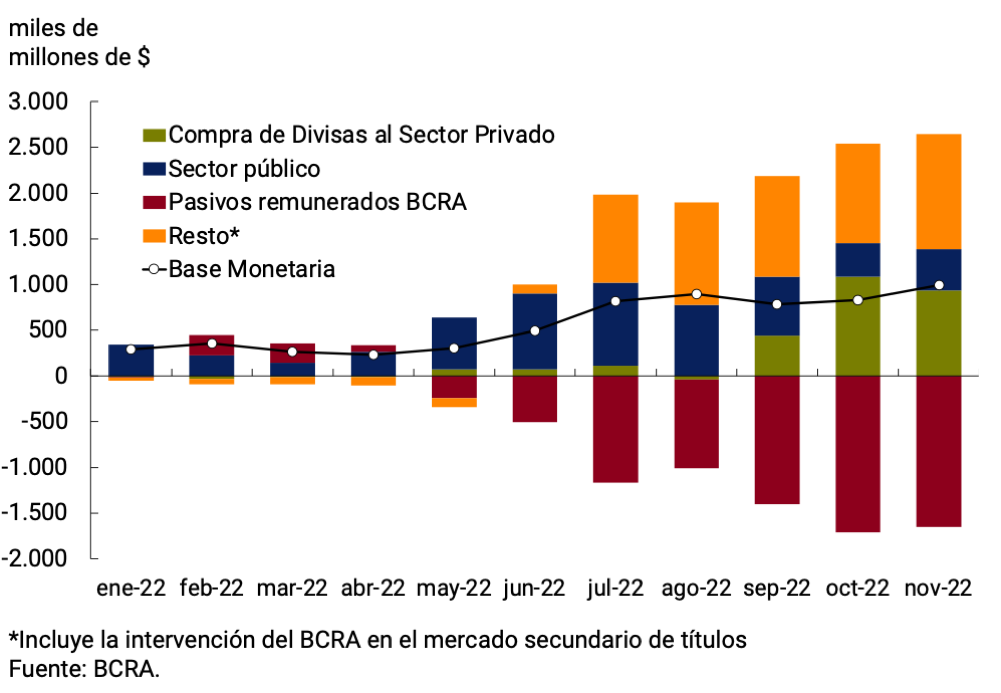
All in all, the Monetary Base remained relatively stable in the latter part of the year, registering a nominal increase of 2.6% monthly average between October and November. Seasonally adjusted and at constant prices, it continued to contract and is at historically low levels. Thus, in the last twelve months it has accumulated a real fall of around 26%. Similarly, in terms of GDP, at the end of November the Monetary Base would stand at 4.5%, a figure around the lowest values since 2003 (see Figure 7.3). Finally, with respect to the Monetary Base, it is worth mentioning that in October the simplification of the minimum cash regime established in June56 came into force.
Figure 7.3 | Historical evolution of the monetary
base Cumulative change
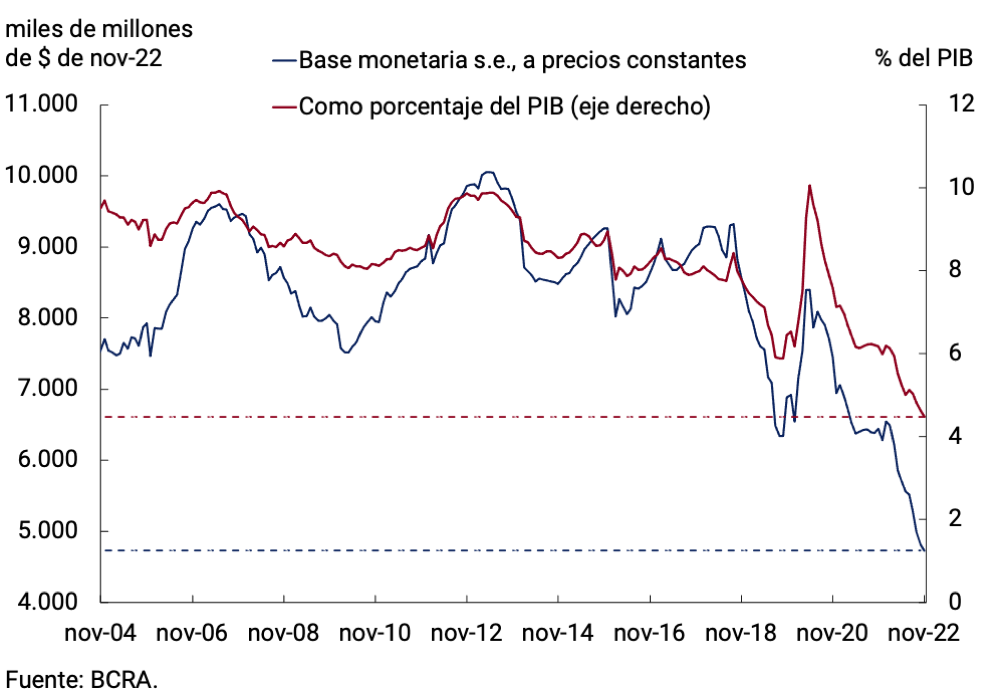
The BCRA currently conducts its monetary policy through the interest rate of the 28-day Liquidity Bills (LELIQ), this being the main instrument of monetary policy. After 9 consecutive monthly increases, since October the BCRA kept interest rates unchanged because the inflation rate began to reduce. Thus, the real monetary policy interest rate was consolidated in positive territory, which will contribute to consolidating financial and exchange rate stability.
Figure 7.4 | Economic Policy Interest Rate Structure
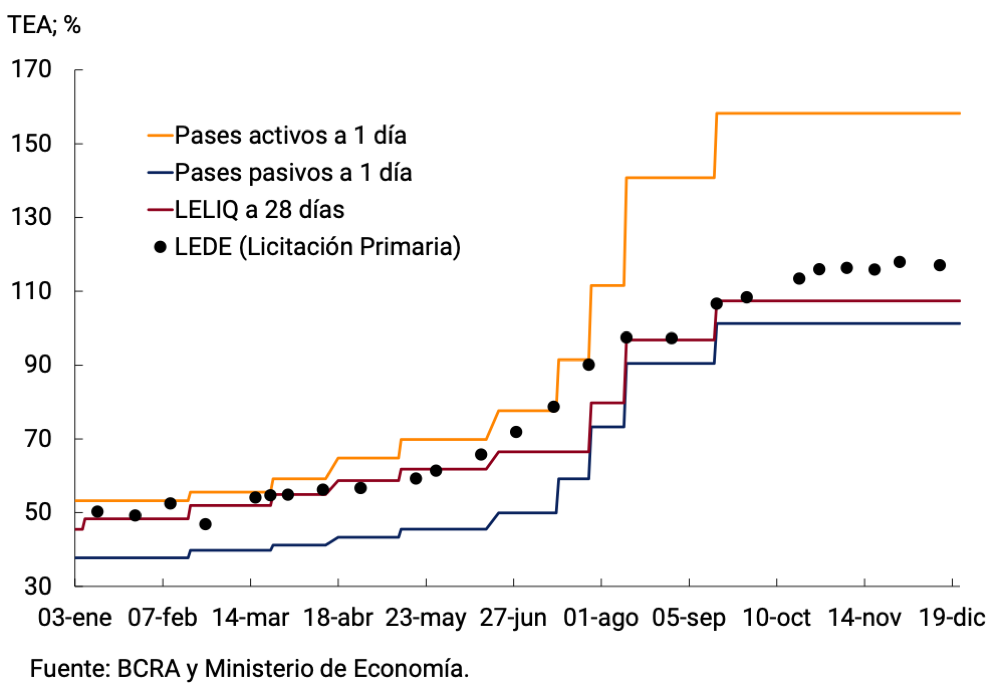
Currently, the 28-day LELIQ rate stands at 75% nominal annual -n.a.- (107.35% effective annual -e.a.-), while the interest rate of the LELIQ with a 180-day term is 83.5% n.a. (101.23% e.a.). As for shorter-term instruments, the interest rate on 1-day pass-throughs stands at 70% n.a. (101.24% y.a.); while the interest rate on 1-day active passes is 95% n.a. (158.25% e.a.). Finally, the fixed spread of the NOTALIQ in the last auction of the month was set at 8.5 p.p.
The BCRA’s temporary interest rate structure is coordinated with that of the tenders of the Ministry of Economy of the Nation so that they present a reasonable relationship. Indeed, the interest rate of the shortest instrument in the last National Treasury auction, the Discount Bill (LEDE) maturing on March 31, 2023, was tendered in the primary market at a rate of 87% n.a. (117.1% e.a.; see Figure 7.4).
7.2. Dynamics of the demand for monetary balances
7.2.1. Transactional means of payment in terms of GDP were around the lowest values of the last 20 years
Transactional means of payment, at constant prices and adjusted for seasonality, contracted at an average monthly rate of 1.5% between October and November57. In this way, this aggregate contracted systematically throughout the year. In terms of its components, this behavior was explained both by the dynamics of working capital held by the public and of non-interest-bearing demand deposits. Thus, in November, private transactional M2 registered a year-on-year drop of approximately 20% in real terms.
Figure 7.5 | Means of payment in terms of GDP
Series without seasonality
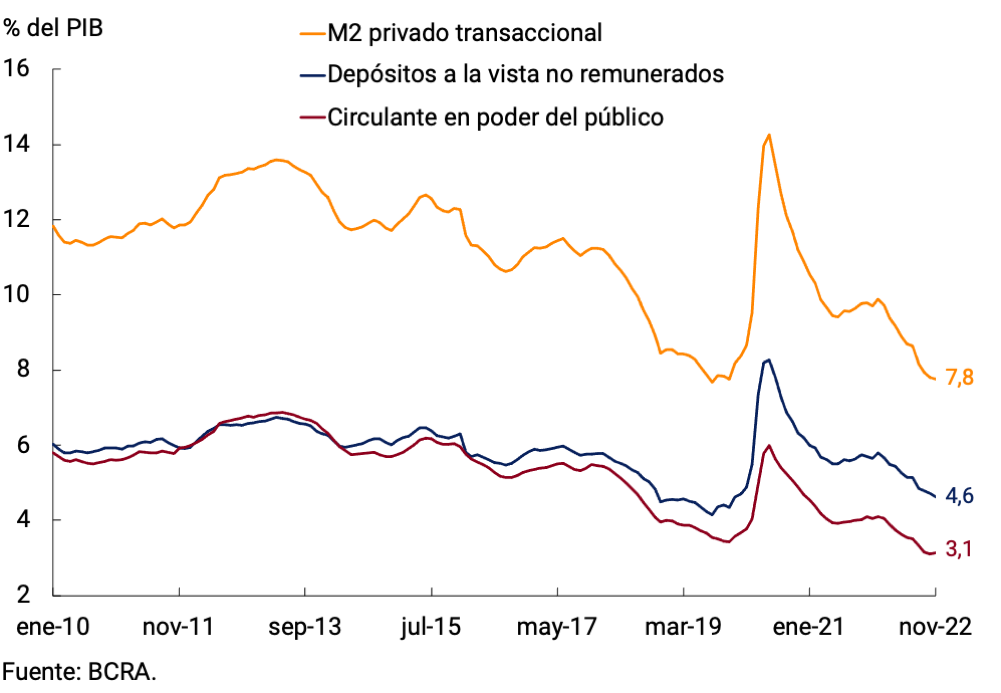
As a Product ratio, payment methods would have stood at 7.8% in November, exhibiting a decrease of 2 p.p. in the year. Both components of the means of payment remain in terms of GDP at around the lowest level of the last 20 years and, in the case of working capital held by the public, a new low was set (see Figure 7.5).
This dynamic of the means of payment is explained by several factors. The process of raising reference interest rates carried out by the BCRA raised the opportunity cost for agents to maintain non-remunerated holdings in pesos. This effect was reinforced by the inflationary acceleration observed in the middle of the year, in a context in which regulations to access the foreign exchange market are maintained. This led agents to choose to rotate their holdings of pesos towards interest-bearing deposits, directly through the instrumentation of fixed-term deposits or indirectly through the subscription of Mutual Funds (FCI MM) whose portfolio is mainly composed of interest-bearing demand deposits and fixed-term placements.
7.2.2. Savings instruments in pesos showed a marked growth, which was at the cost of a lower demand for means of payment.
As with the monetary policy rate, the BCRA decided to keep the minimum guaranteed interest rates on fixed-term deposits unchanged in the last quarter of the year. Thus, the interest rate for placements of individuals for up to $10 million remained at 75% n.a. (107.05% y.a.), while the interest rate paid to the rest of the depositors in the financial system remained at 66.5% n.a. (91.07% y.a.).Question 58.
Unlike the means of payment, the relationship between fixed-term deposits and interest rates is positive and stable over time (see Figure 7.6). In this context, in real and seasonally adjusted terms, fixed-term deposits registered an average monthly growth rate of 4.9% between October and November. As a result, in November they set a new high in historical terms and as a percentage of GDP they would stand at 7.6%, closing the year at a level similar to the maximum reached during the pandemic (see Figure 7.7).
Figure 7.6 | Ratio of time deposits to means of payment and interest rate of fixed-term deposits

Analyzing the evolution of term placements by strata of amount, although all segments contributed positively to the expansion of the period, the most dynamic was the $1 to $20 million segment, with an average monthly expansion rate of 7.4% s.e. at constant prices. For its part, the wholesale segment (more than $20 million) registered an average monthly growth of 4% s.e. in real terms between October and November. Finally, retail placements remained largely unchanged.
Figure 7.7 | Fixed-term deposits in pesos from the private sector
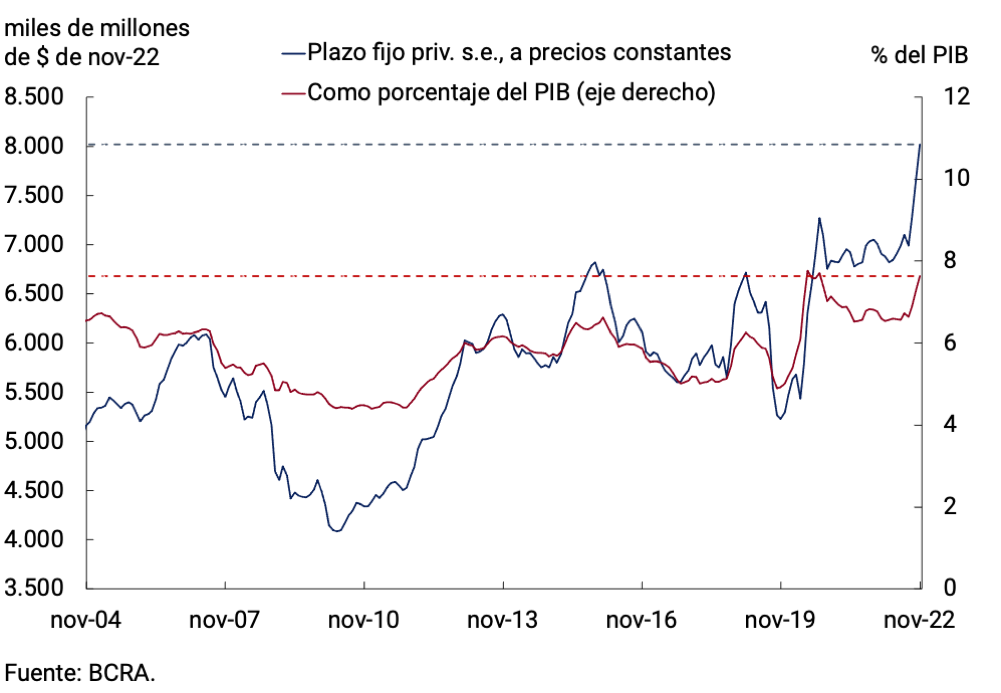
Term deposits adjustable by CER continued to show a downward trend in real terms. The average monthly drop was 5.7% s.e. in the last part of the year (October-November two-month period). This behavior could be associated with the lower relative performance of these placements given the interest rate hikes promoted by the BCRA, the moderation in the inflation rate and the prospect that this process will continue. At the end of November, the balance of these deposits was $365,000 million (4.9% of total time deposits). On the other hand, fixed-term deposits adjusted for the value of the reference exchange rate, known as the dollar IVA, registered sustained growth between July and October, partially offset by a fall in November. Thus, at the end of November they reached a balance of $40,700 million.
All in all, the broad monetary aggregate M3 private registered an average monthly expansion of 1.4% s.e. at constant prices between October and November (-4.6% y.o.y.)59. As a ratio of Output, this monetary aggregate stood at 17.4%, which implied a fall of 0.9 p.p. compared to the end of last year.
7.3. Credit policy continued to focus on productive development
The BCRA maintained its credit policy focused on productive development. The Productive Investment Financing Line (LFIP) continued to be the main tool used to channel productive credit to MSMEs under favorable conditions.
Figure 7.8 | Financing granted through the Productive Investment Financing Line (LFIP)
Accumulated amounts
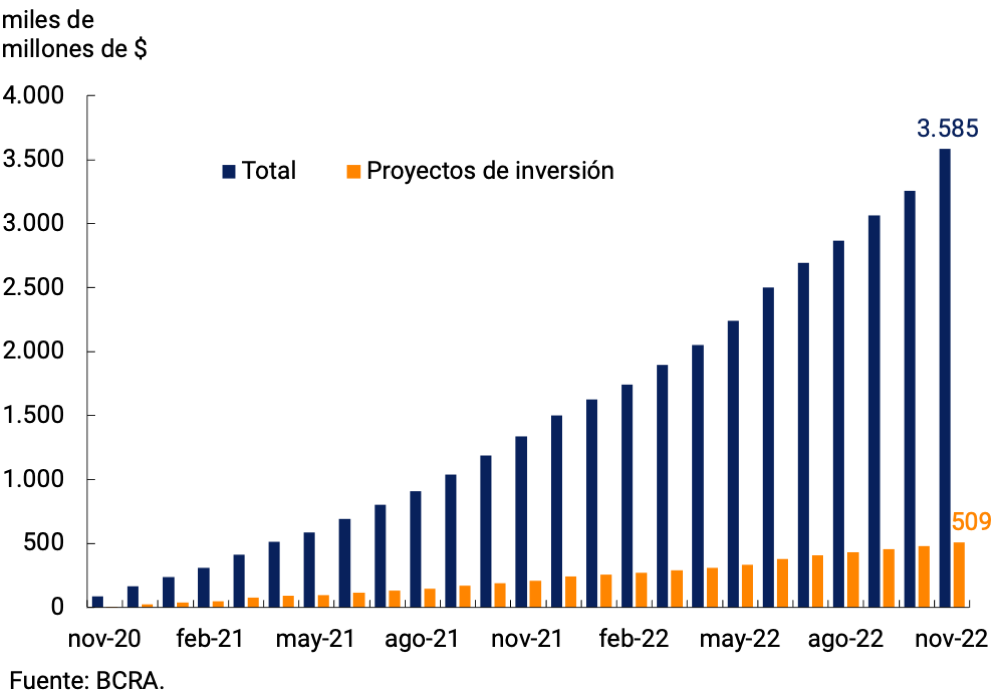
From its implementation to November 2022, loans granted under the LFIP accumulated disbursements of approximately $3,585 billion since its implementation (see Figure 7.8). This implied an increase of 5% at constant prices compared to the record last September. By the end of the eleventh month of the year, more than 350,000 companies had accessed loans under the LFIP. Regarding the destinations of these funds, approximately 86% of the total disbursed corresponded to the financing of working capital and the rest to the line that finances investment projects. It should be noted that the average balance of active financing granted through the LFIP reached approximately $1,056 million in October (latest available information). This balance represented about 17.5% of loans in pesos to the private sector and 42% of total commercial loans.
Despite the boost from LFIP60, in a context of less dynamism in economic activity, loans in pesos to the private sector, measured at constant prices and without seasonality, registered a systematic fall in the last part of the year. Between October and November, credit contracted at an average monthly rate of 2.2% s.e., accumulating a fall of close to 12% in the year. Thus, in terms of GDP, bank financing to the private sector in pesos stood at 6.3% of GDP at the end of the year (see Figure 7.9).
Figure 7.9 | Loans in pesos to the private sector as a percentage of GDP
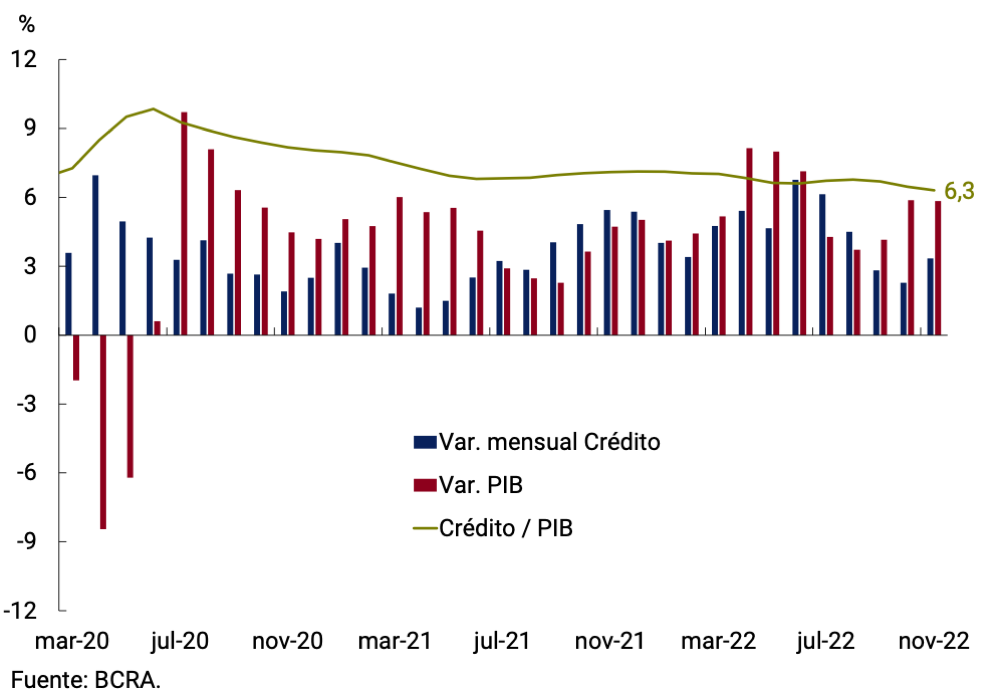
Commercial loans exhibited an average monthly contraction of 1.6% s.e. at constant prices in the October-November two-month period, with a year-on-year fall of around 7% in November. This drop was explained both by the behavior of loans instrumented through documents and current account advances. When we analyze the composition of commercial loans by type of debtor, it can be seen that loans to MSMEs at constant prices fell in the quarter under analysis and would have remained unchanged in the year (-1.0%). Meanwhile, financing for large companies exhibited a contraction of 15.6% in the year.
As for lines with real collateral, collateral loans fell between October and November at an average monthly rate of 2.1% s.e. at constant prices, but accumulate an expansion of 8.6% in the last twelve months. For its part, the balance of mortgage loans fell at an average rate of 4.1% s.e. per month in real terms, registering a contraction of around 28% year-on-year.
Among loans associated with consumption, financing granted through credit cards showed an average monthly decrease of 2.8% s.e. at constant prices in the two months and was 12.8% below the level of a year ago. Something similar happened with personal loans, whose average monthly rate of change in the period was -1.8% s.e. real and -15.9% year-on-year at the end of 2022.
7.4. Exchange rate policy continued to be adjusted in order to maintain external competitiveness
Towards the end of the year, the BCRA continued to gradually adjust the crawl rate under the current managed float regime, in order to maintain adequate levels of external competitiveness (see Figure 7.10). In this way, it sought to strengthen the position of International Reserves, based on the genuine income of foreign currency from real flows.
Figure 7.10 | Monthly change in nominal exchange rate
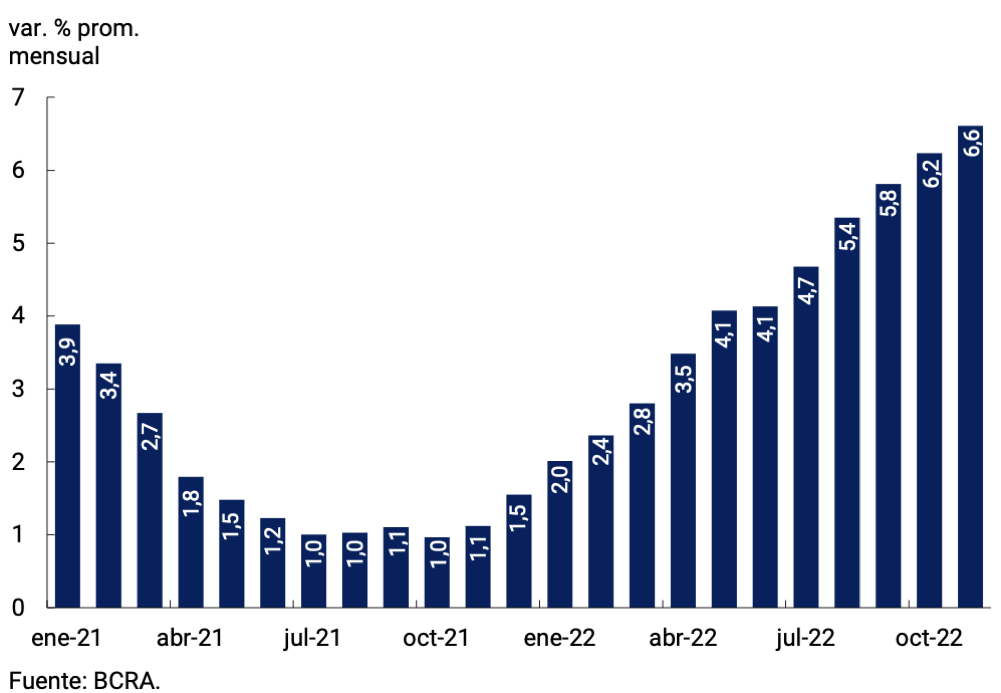
During the year, a series of regulatory modifications were made in foreign exchange matters, which sought to achieve multiple objectives61. In particular, measures were taken in the latter part of the year to improve efficiency in the allocation of foreign exchange. On the one hand, regulations related to the refinancing and cancellation of principal maturities of liabilities in foreign currency were extended and, on the other, conditions were established to give access to the foreign exchange market to customers from various productive sectors. Among the latter, access to the foreign exchange market for companies that are beneficiaries of the regimes of access to foreign currency for the incremental production of oil and/or natural gas, to make payments of debt principal, repatriation of investments and payments of profits and dividends stands out. In addition, certain exceptions were established regarding access to the foreign exchange market, within the framework of the new Import System of the Argentine Republic (SIRA) regulated by the National Government (see Chapter 4. External Sector).
On the other hand, the “Export Increase Program” was created, which increased the supply of foreign currency (see Box “Export Increase Program”). The settlement requirement for charges for the provision of services by residents to non-residents was relaxed. Access to the foreign exchange market for the purchase of foreign currency and the performance of transactions with securities and securities with settlement in foreign currency was also limited to beneficiaries of subsidies in public services and to companies that have sold soybeans within the framework of the Export Increase Program. At the same time, it was decided to tax with an additional levy certain consumption in foreign currency that exceeds a certain amount, as well as some services (personal, cultural and recreational) contracted abroad.
In this context, the BCRA’s International Reserves stood at US$43,267 million as of December 22, reflecting an increase of US$6,532 million compared to August 31 (see Figure 7.11). The main factor of expansion in the last part of the year was the net purchases of foreign currency from the private sector under the Export Increase Program for US$9,868 million and the disbursements received from the IMF of Special Drawing Rights (SDRs) for US$8,089 million, under the PFE. These effects were partially offset by the principal and interest payments made to the organization (about US$6,600 million) and by the net sale of foreign currency to the private sector (excluding the Export Increase Program) for US$5,215 million.
Figure 7.11 | International Reserves. Explanation
factors Acum. since August 31, 2022
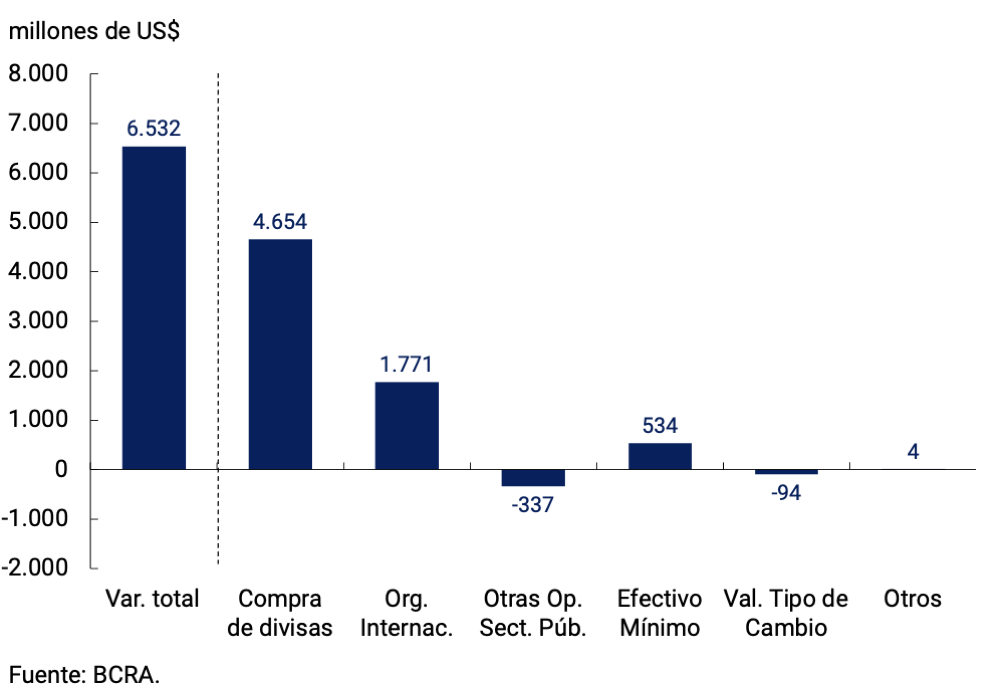
7.5. Monetary policy outlook for 2023
The BCRA will continue to calibrate its policies with the aim of consolidating the disinflation process. It will continue to actively set the monetary policy interest rate and the rest of the interest rate structure in pursuit of this objective. To this end, the BCRA will continue to monitor the macroeconomic situation, paying special attention to the past and prospective evolution of the general price level, and the dynamics of the foreign exchange market, particularly in an election year where greater volatility tends to be observed in the financial markets. All this within the structural objective of tending towards returns that allow safeguarding the value of investments made in instruments denominated in domestic currency and consolidating exchange rate and financial stability.
Exchange rate policy will continue to be aimed at preserving adequate levels of external competitiveness and enhancing the accumulation of international reserves. In this context, the BCRA will continue to gradually adjust the rate of change of the nominal exchange rate to levels in line with the inflationary dynamics observed and to carry out a prudent management of the current regulatory framework of the foreign exchange market. To the extent that macroeconomic conditions allow, regulations will be relaxed, with the aim of maintaining in the medium and long term a set of macroprudential regulations compatible with the dynamization of capital flows oriented to the real economy.
In the medium term, sustained growth in economic activity and a moderation in the inflation rate will lead to greater demand for real money balances.
In terms of credit policy, the BCRA will continue to stimulate credit intermediation through the LFIP, in particular that linked to productive development, which is still at very low relative levels.
In order to avoid excessive volatility in the local financial market, the BCRA will continue to evaluate the performance in the secondary market of Treasury instruments, eventually intervening in the event that the spread between the market rate and that of the last primary auction exceeds 200 basis points (bp). Likewise, the BCRA seeks to gradually converge towards managing the economy’s liquidity through open market operations (OMA) with Treasury bills and other short-term securities denominated in local currency. This type of mechanism is similar to that used in other countries and is in line with what is expressed in the Memorandum on Economic and Financial Policies within the framework of the current program, where this reform is considered a convenient alternative to reduce the quasi-fiscal cost of monetary policy. To achieve this, the local capital market must assume an increasing importance in the financing of economic actors (public and private).
In line with what was agreed in the PFE, and given the better conditions of the domestic debt market compared to the first years of management, during 2023 the BCRA will continue to reduce monetary assistance to the National Treasury. In this context, it is expected that the monetary sterilization effort will be gradually reduced. This will favor the demand for the monetary base to be provided by the interest associated with the BCRA’s interest-bearing liabilities and, potentially, by a reduction in its stock. However, the BCRA will maintain a prudent administration of monetary aggregates, sterilizing any surplus liquidity, in order to preserve monetary balance.
Section 1 / Financial vulnerabilities of the global economy
Monetary and fiscal policies in response to the pandemic led to interest rates at historic lows and strong fiscal deficits and increases in public debt. Higher global inflation has led many countries to raise policy interest rates, negatively impacting the prices of financial assets, increasing the cost of financing for the public and private sectors, and generating capital outflows from emerging and developing countries (although these impacts have been reduced at the margin). Thus, certain financial vulnerabilities could amplify the consequences of the global tightening of monetary policy. These include the growing weight of debt, the evolution of the real estate sector, the possibility of contagion to other sectors from the fall in cryptoassets and the role of non-bank financial intermediation.
From 2007 to 2019, total global debt grew 33 p.p. to 228% of world GDP, driven first by governments’ response to the global financial crisis and then by low interest rates. In this period, public debt grew by 23 p.p., mainly in advanced countries, and private debt by 10 p.p., mainly due to non-financial corporate sector and household debt in China. During the pandemic, fiscal deficits rose sharply, driving up public debt, and low interest rates and other government stimulus boosted private borrowing. Thus, total debt accumulated on a scale only comparable to what happened during the two world wars, rising 29 p.p. to 257% of global GDP in 2020, mainly explained by government indebtedness, which accounted for 55% of this increase (see Graph 1). Likewise, the largest increase in debt was observed in advanced countries, where it increased 34 p.p., followed by emerging countries with 22 p.p. and then by lower-income countries with 8 p.p. In 2021, the recovery of economic activity and the rise in inflation allowed a significant drop in the debt burden, but it remained well above the pre-pandemic level.
Graph 1 | Public and private debt as a percentage of global GDP
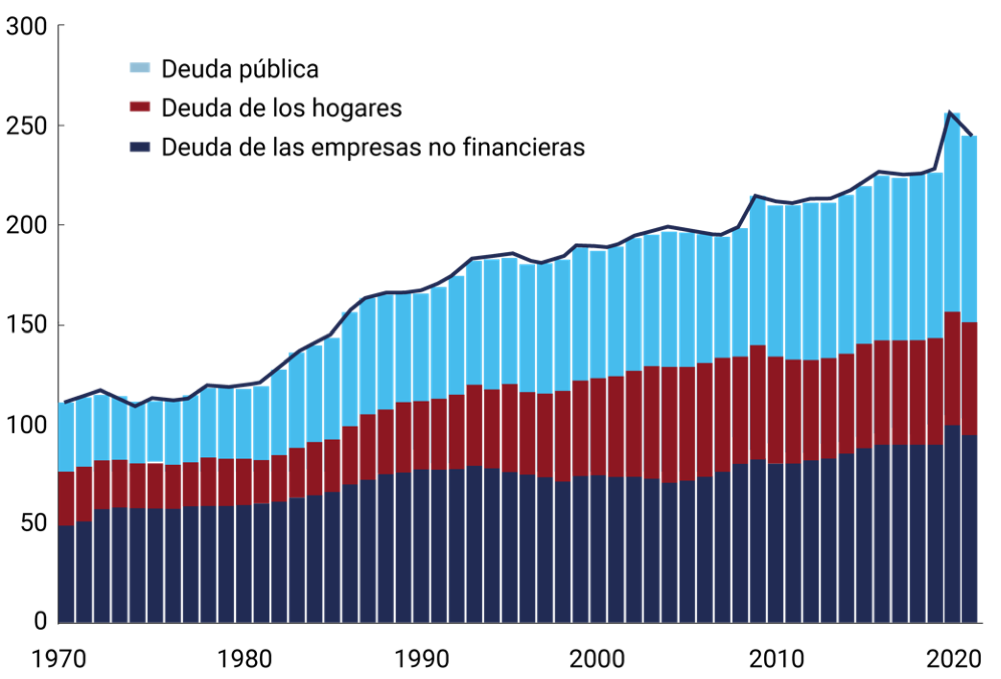
The current monetary policy cycle is reminiscent of that of the mid-1970s and early 1980s (Section 1 / The current global economy and the stagflations of the 1970s and 1980s, from the September 2022 IPOM): several of its features entail global financial risks. The intense and unaccompanied rise in interest rates in advanced countries can affect the cost of debt in emerging and developing economies. In addition, the speed and magnitude of rate hikes has been different between the Federal Reserve (Fed), the European Central Bank (ECB), the Bank of England and Japan (the only country in the G7 that continues to take expansionary measures). This has had an impact on the British debt and currency markets (partly due to idiosyncratic factors) and also on the depreciation of the Japanese yen, which led its government to intervene heavily in the foreign exchange market. Finally, it is the first time that a large-scale quantitative contraction (QT) process has been performed. No specific impacts have yet been recorded, but in the only previous QT (the Fed between 2018-2019) there was such stress in the US Treasury bond market that the Fed interrupted it; This cannot be ruled out now. On the other hand, since the ECB has not yet started its QT policy, the level of public debt that is not in its hands is so low that it is often difficult to find bonds to use as collateral in pass operations in the interbank market. All of the above can affect not only emerging countries, but also the financial markets of advanced countries.
Real estate could be another source of vulnerability. Unlike other historical episodes, the latest policy rate hikes were quickly transferred to the other rates in the economy. Rates on 30-year fixed-rate mortgages in the United States rose to more than 7 percent, a value not seen since 2002 (see Figure 2a). Years of very low rates led to sharp increases in house prices in most countries, and higher interest rates could lead to disorderly price declines. One country with drawbacks in its real estate market is China, although the problems in the Asian giant were generated more by the over-leverage of developers in recent decades. After the Chinese government made regulatory changes, several developers suffered difficulties and are not being able to finish pre-sold properties. It is estimated that this year the real estate sector can contribute 2 p.p. less to China’s GDP growth.
Graph 2 |
A. Fixed Rates 30-Year Mortgages in the United States
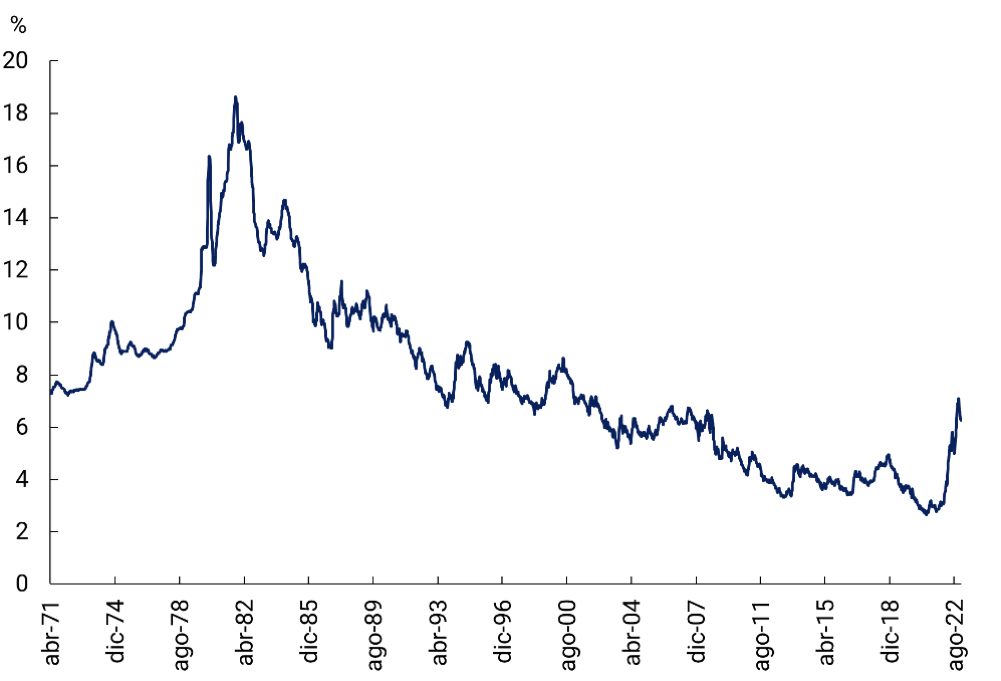
B. Índice BCGI de criptomonedas
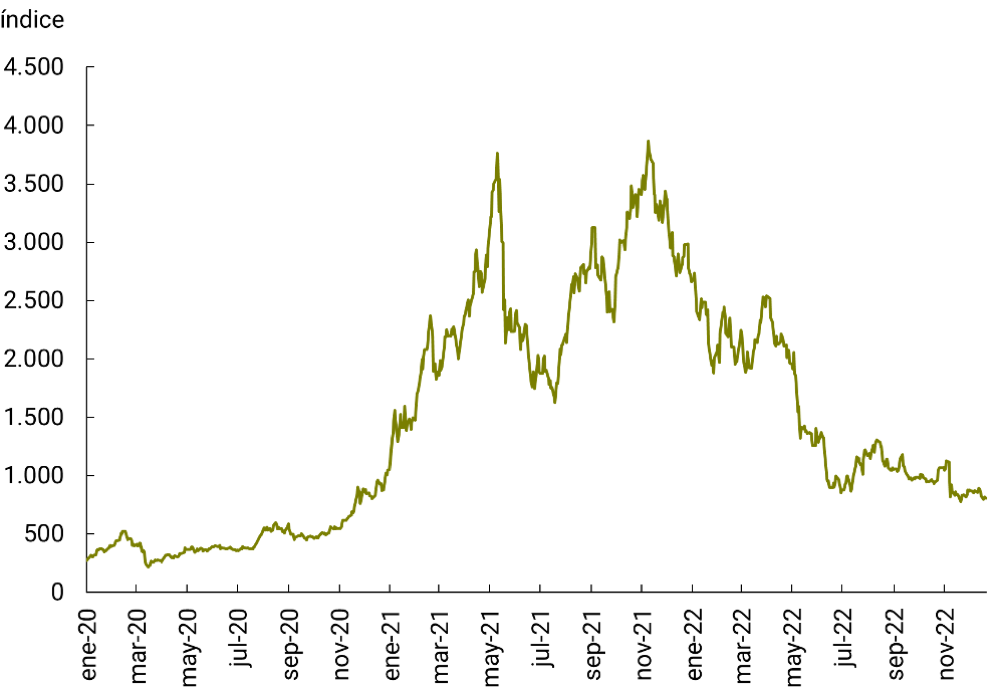
Meanwhile, when global risk asset declines began, cryptocurrencies proved not to function as a store of value. Since the highs of November last year, cryptocurrencies have lost 79% of their value, according to the BCGI index, and 17% since the close of the previous IPOM (see Chart 2b). The crypto asset market was particularly affected in early November, with the fall of the FTX cryptocurrency exchange platform, one of the most important. For the time being, there has been no contagion of magnitude towards traditional finance, although the market does not yet seem to have cleansed the market of the excesses of recent years.
Another vulnerability factor could arise from the global banking system. In the case of the United States, the Federal Reserve of New York produces an indicator that takes into account four types of vulnerabilities: 1) capital; 2) liquidity; 3) to a bank run; 4) and forced asset sales (“fire-sales”) and the impact of these sales on capital. According to these indicators, the vulnerability of the U.S. banking system increased in the second quarter of 2022 from historically low levels. In particular, the forced sales vulnerability index exceeded levels reached during the pandemic, driven by larger banks, higher aggregate leverage, and an increase in interconnectedness. On the other hand, measures of capital and liquidity vulnerability appear largely contained.
But while the risks of the banking system seem contained, others are emerging in the face of the growing importance of non-bank financial intermediaries, which at the end of 2020 accounted for more than 48% of global financial assets (see Section 3 / Investment funds and financial stability at the global level, of the Financial Stability Report (FSR) of December 2020). Investment funds are the most significant players in this segment, characterized by their procyclicality (they exacerbate the oscillations of the global financial cycle), as well as by their mismatches in terms and liquidity, leverage, interconnection with the conventional financial system and between different countries. For example, in the event of a real or financial shock, these intermediaries can make rapid forced sales of assets in their portfolio, which not only impact the market in which they operate, but also cross-border capital flows. A clear example took place at the beginning of the pandemic, when, faced with the sudden need for liquidity, investment funds in advanced countries sold public bonds, putting strong pressure on short-term funding markets, including the interbank market and triggering the Fed’s intervention through its swap network. In addition, non-bank financial intermediaries played a role in the recent episode of volatility in the bond market in Great Britain, in response to which the central bank of that country intervened.
In short, the current cycle of contractionary monetary policy could generate financial “spillovers” not only among emerging countries, but also among advanced countries themselves. This would enhance the negative impacts of the monetary contraction on global activity.
Back to top
Section 2 / Initiatives to promote strategic sectors
In Argentina, there is a broad consensus that a set of productive sectors has the necessary characteristics to efficiently face a process of transformation and diversification of the productive structure. These are the so-called bioeconomy, knowledge-based services, the automotive industry, energy, mining and the infrastructure sector, among others. All of these are competitive activities, distributed throughout the national territory, which can generate quality employment and, fundamentally, foreign exchange due to higher exports or import substitution. Some structural features and the main public policy initiatives around these strategic sectors are described below.
The bioeconomy comprises the set of activities associated with the production of goods and services through the use or transformation of biological resources. It crosses a large part of the productive matrix, both primary and industrial sectors. 31 agri-food value chains are identified in our country, among which those of soybeans, corn, wheat, cattle, dairy, poultry, pork, forestry, rice, yerba mate, biofuels, fertilizers, bioplastics and lubricants stand out. The 31 chains represent approximately 13% of GDP, employ more than 2 million people and account for approximately 55% of annual exports.
The bioeconomy is gaining more and more weight in the world’s main economies. Bio-based products not only replace fossil derivatives, but also convert waste into marketable products through the use of technologies, which adds value to them. Patent development and investment in research and development (R+D) are fundamental in the development of biotechnology. The United States, Canada and some European countries lead the world in the number of biotechnology patents. Argentina has a lot of potential to develop these fields and position itself as a country brand in R+D-intensive activities, with great talent and international recognition.
The so-called Knowledge-Based Services (KBS) are among the most dynamic activities of the economy and include a wide range of services: financial, IT, audiovisual, telecommunications, real estate and health, among others, including the development and administration of applications and e-commerce.
They are versatile services, easy and quick to relocate geographically for reasons of scale that are characterized by providing solutions to all productive sectors. Thus, these services generate and transmit competitiveness and efficiency to the entire economy. They intensively employ medium-high skilled people, but they also generate low-skilled jobs, in demand both in the domestic and foreign markets. The foreign market mainly demands from Argentina software and computer services, audiovisual products and professional services.
World exports of SBC are growing steadily above those of goods. According to the Chamber that brings together the main SBC references, Argencon, its foreign sales increased last year by 15% annually in current dollars on a global scale, accumulating a 78% increase in the last decade. The most prominent countries for their SBC exports in that period were Belarus (273%), the Philippines (213%), Poland (169%) and Ukraine (129%). In Latin America, only Costa Rica had a growth above that average (162%).
Argentina ranks 41st in the SBC world export ranking. In the last 15 years, there has been an auspicious performance of the sector, which has boosted the dynamics of associated employment (see Graph 1). In the second quarter of 2022, SBC’s total formal private employment totaled 482 thousand positions, reaching an all-time high. This value represents 7.4% of total national private employment. The category with the highest percentage growth was that of services related to databases, with 28% y.o.y. Employment in this sector is undergoing strong changes. Among its most significant trends are the high incidence of teleworking, the growing participation of freelance work driven by the demand for global talent, the concentration of employment in the segments of higher education and the employment of female personnel, above the averages of traditional industries.
Between 2006 and 2021, Argentine exports of SBC increased by an average of 8.4% per year. So far in 2022, SBC’s foreign sales continued to grow, reaching a new all-time high in seasonally adjusted terms of approximately US$2,000 million quarterly. Legal and accounting services and software and computer services are the most prominent categories, accounting for almost 60% of the total SBCs.
Graph 1 | Knowledge-based services. Employment and exports
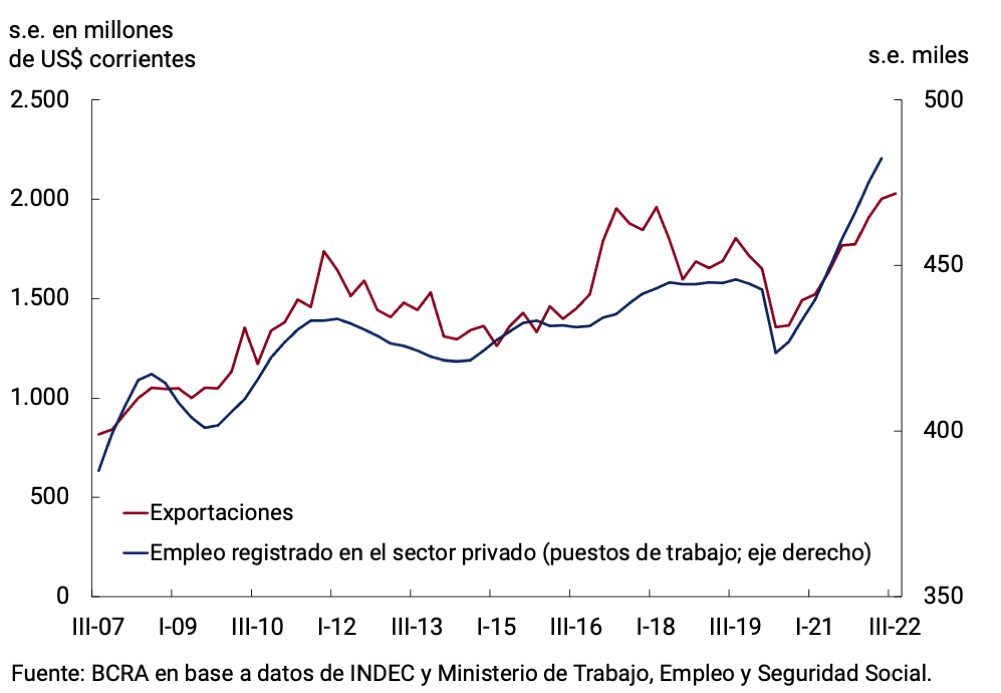
The development potential of SBCs is very significant. The war in Ukraine is causing a redesign of the global chains of these services. This ebb of value chains privileges the political and regulatory security of the supplying countries, over the search for the best cost. In this context, Argentina has the opportunity to capture new investments and business from Western countries.
Another sector that is considered strategic is construction (including infrastructure), which includes the component associated with both public and private, residential and non-residential works, and accounts for about 3% of GDP directly and generates about 7% of total registered employment. It is usually considered a non-tradable sector, however, depending on the end use of the infrastructure, it can have significant effects on international trade in goods: improving infrastructure allows productivity to be increased and production to be effectively and efficiently channelled to its final destination. In the case of pipeline construction, some substitution of fuel imports and even the capacity to export fuels (e.g. from plants that allow LNG to be exported via vessels) may be envisaged.
Political initiatives that seek to promote strategic sectors generally consider the following three aspects:
• Incentives for the establishment of companies through tax exemptions/subsidies.
• Promotion of new ventures and research and development activities through soft financing lines.
• Training of human resources with integration of educational policies and continuous professional training.
In Argentina, for several years now, legislation has been incorporated and adapted to promote and develop these strategic sectors. Among the regulations in force in this regard are the Law for the Promotion of the Software Industry (2004), the Law on Biofuels and Fuel Cutting (2006), the Biotechnology Law (2007), the SME Law (2016), the National Connectivity Plan (2018) and the Knowledge Economy Law (2019), among others. It should be noted that a large number of specific plans and programs are in force that mainly carry out training and research activities10.
Recently, the national government has prioritized within the public agenda a set of initiatives to stimulate sectors considered strategic, including some incentives from exchange rate regulation, such as preferential access to foreign currency, the payment of salaries in dollars, among others (see Table 1). Through specific regulatory changes, already in force or under legislative consideration, it is expected to administer new benefits that will stimulate investment projects, develop and transfer new technologies, improve efficiency and competitiveness and strengthen the institutional framework to boost the local economy.
The construction, biotechnology and agribusiness, automotive, energy and mining sectors and the knowledge economy are part of the focus of public policy that seeks to promote investment, production, exports and employment in the country. Most of the recent initiatives were translated into laws with a broad public consensus. From now on, it is of vital importance to develop and sustain specific public policies for these strategic sectors over time, with the ultimate goal of overcoming external constraints and achieving sustained and inclusive economic growth in the long term.
Table 1 | Main initiatives on strategic sectors

Back to top
Section 3 / Kiel Institute Trade Indicator
The Kiel Institute for the Global Economy developed a novel indicator to track global trade in goods with a high frequency, which it called the “Kiel Trade Indicator (KTI)17“. It is an indicator built from the study of the movements of cargo ships in real time. Among the trends in economic analysis, this development is inscribed in the academic and professional interest in the processing of large masses of information available with high frequency. Estimates are not only reported for global trade in goods but also for several economies individually, including the Argentine economy. In the past, this indicator has shown a good performance in estimating the flows of exports and imports of our country and its forecasts are several weeks ahead of the data published by INDEC.
The KTI combines daily information on the location and direction of the navigation course of ships and stops at all ports in the world, from the Fleetmoon18 site and the characteristics of each of them (load capacity and minimum dredging), from the MarineTraffic19 site. Thus, for each vessel, the estimated cargo in transit or parked in port (loading or unloading) is equal to:

Where:
TEU: Universal 20ft
container measurement TEUi,max: Maximum load capacity of vessel “i” measured in TEUs (source MarineTraffic)
Draughtit : Vertical distance between vessel hull and water surface line (source Fleetmoon)
Draughtmin,max: Minimum and maximum dredging of vessel “i” (source MarineTraffic)
This information is computed for the 100 busiest maritime areas on the planet (where it is assumed that different directions of the course mean different destinations) and for the 500 most important ports in the world (for which arrivals and departures have been declared). Finally, the data associated with ports below the one identified as medium port20 are added to the nearest “large” port. The end result is 750 independent monthly series of TEU flows entering and leaving major ports and transiting major maritime areas. Finally, the Partial Least Squares (PLS) methodology is used to obtain the common factors between the constructed series that best fit the effective data of the seasonally adjusted growth rate of the exported and imported volumes of 76 economies from the Dutch Economic Analysis Bureau21 (CPB, for its acronym in English).
As it is a parametric estimate on panel data, the predictive capacity of the indicator can not only be evaluated contemporaneously, but also as data in advance of at least one month ahead. The working paper states that the mean square error of the KTI’s prediction (RSME) is lower than that of a simple Autoregressive Distributed Lag (ARDL) econometric model for 64 of the 76 economies evaluated for imports and for 60 of 76 for exports. in both projection horizons. In the case of Argentina, the KTI indicator performs better than the reference model and the standard error of each series.
The KTI indicator is updated twice a month: on the 5th and 20th of each month. In the first outing, the estimated seasonally adjusted variation of exports and imports of the immediately preceding month (nowcast 2) and the current month (forecast 2) is reported, and in the second outing, the same is reported with the current month (nowcast 1) and with the next month (forecast 1). Since it has the most information available, nowcast 2 is the best prediction of KTI.
The historical performance of the KTI in anticipating the seasonally adjusted variation of the quantities exported and imported from Argentina is acceptable (see Graph 1). The correlation between the observed data and the forecast is around 0.7. The greatest benefit in the use of this indicator lies in the fact that this prediction anticipates by approximately 15 days the official data published by INDEC on Argentina’s trade flows for the previous month.
Graph 1 | Argentina’s trade flows
Exports of goods
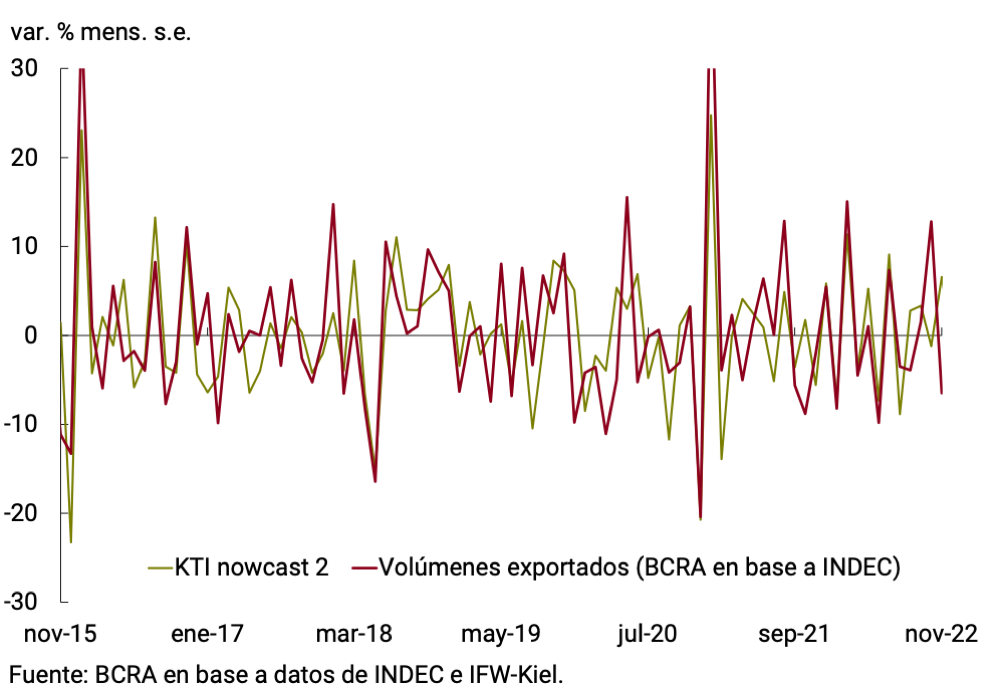
Imports of goods
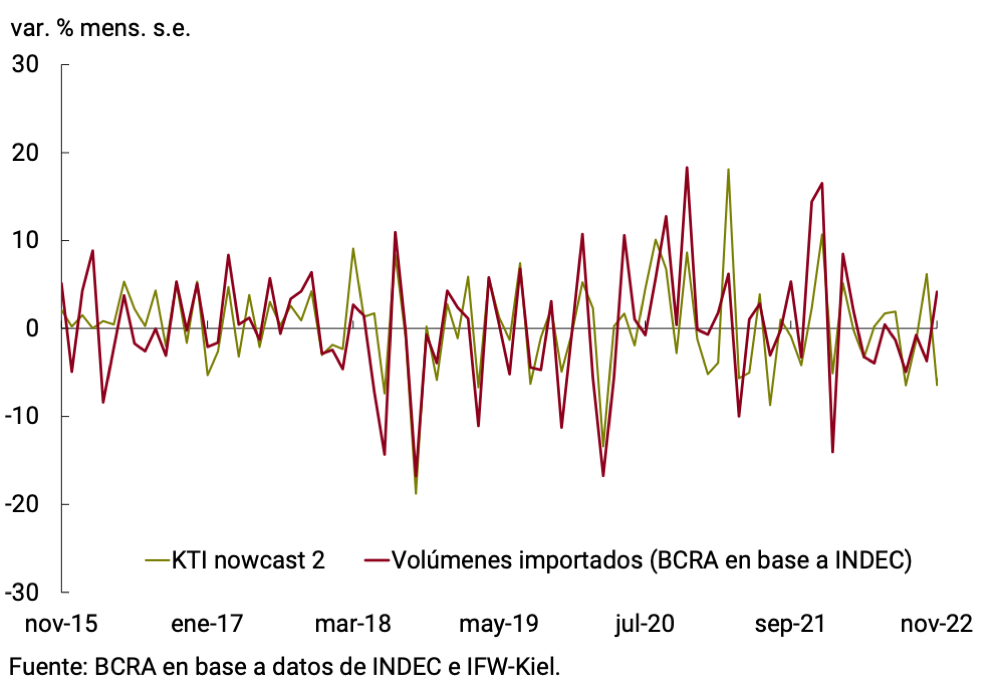
It should be noted that the correlation obtained between the INDEC series and those of the KTI indicator are similar taking the last output (nowcast 2; best possible prediction) and the second (forecast 2). This implies that on the 5th of each month, the KTI indicator provides a good estimate of what will happen to Argentina’s trade flows throughout that month (see Table 1). This means an anticipation of approximately 45 days with respect to the publication of the official data by INDEC.
Table 1 | Selected correlations. Apr-15 to Nov-22
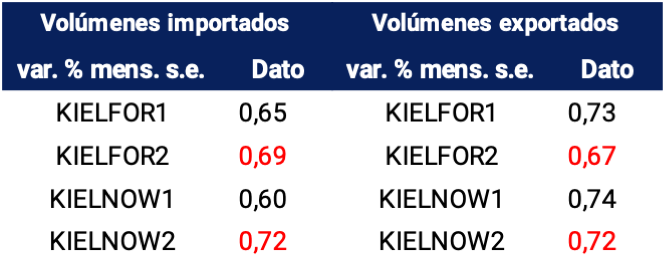
For December, the first nowcast of the KTI indicates a slightly negative variation for the quantities exported from Argentina and an increase in the quantities imported. For January, the first forecast of the KTI suggests a deepening of this dynamic (see Graph 2).
Graph 2 | Argentina’s trade flows
Exports of goods
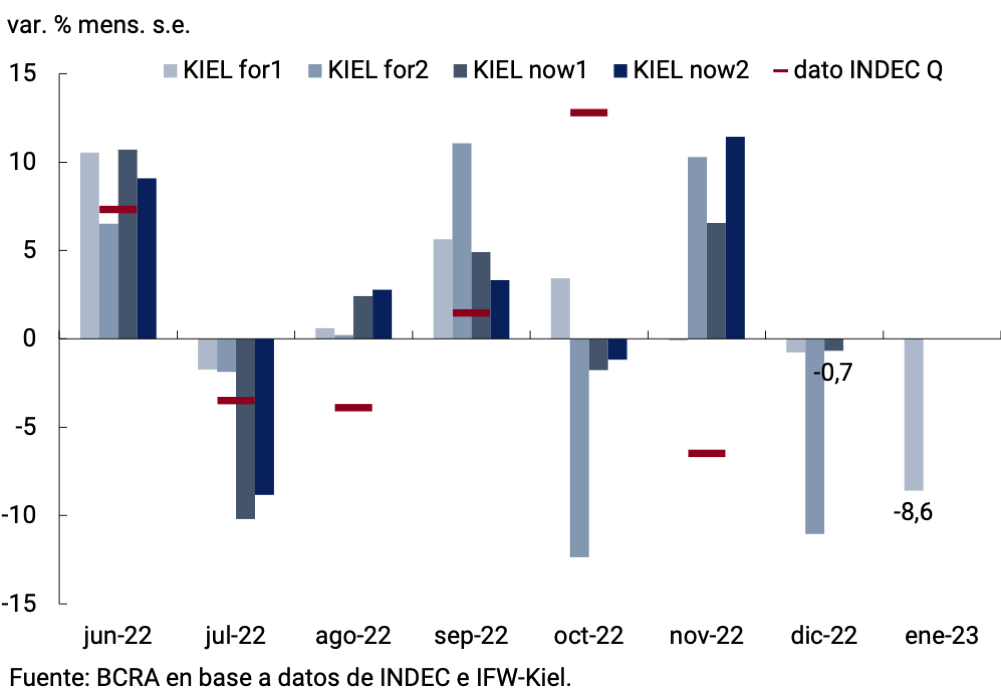
Imports of goods
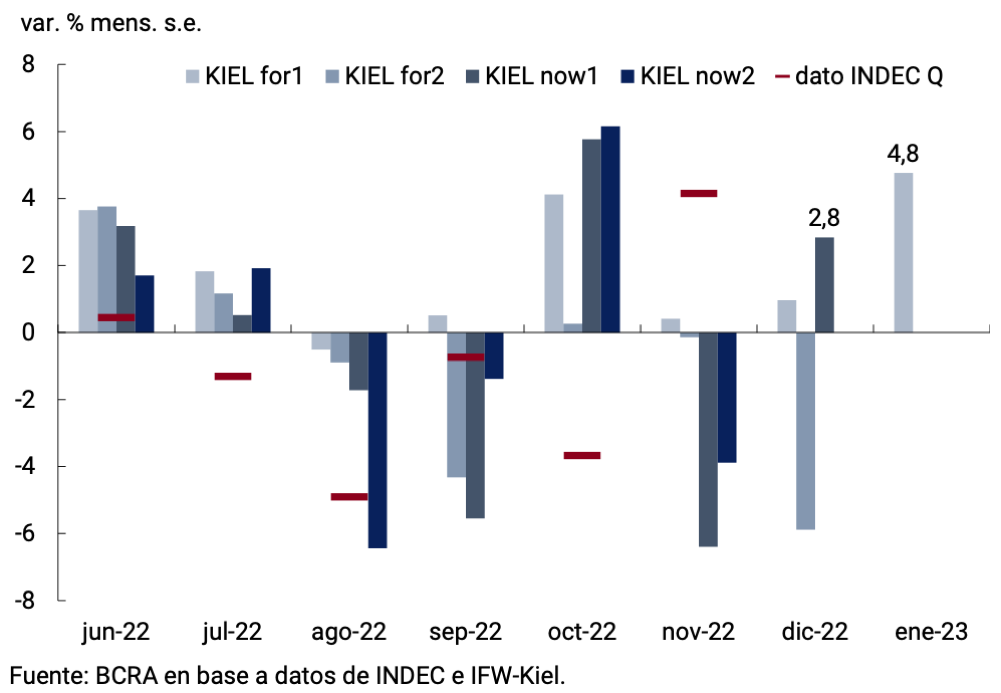
Back to top
Section 4 / Cyclically adjusted Primary Result of the National Non-Financial Public Sector
In monitoring the macroeconomic situation, it is useful to have indicators that allow understanding and quantifying the impact of fiscal policy on domestic demand and on the financing needs of the public sector. Ideally, these indicators should have certain qualities: on the one hand, they represent a broad coverage of government activities and on the other, the ability to be constructed in a simple way with the available public information. The task, however, is complex: because it requires certain adjustments to take into account how various economic variables affect the government budget.
An indicator usually used to assess the fiscal position is the primary result of the public sector. The primary result is the difference between revenues and expenditures (net of interest payments) of the public sector. It can be surplus (revenues greater than primary expenditures) or deficits (expenditures greater than revenues). Thus, a first reading of the indicator could lead one to think that fiscal deficits would result in an expansionary fiscal policy given that the negative impact of tax payments is more than offset by the positive effect of government spending. However, this result should be analyzed with greater caution.
The main fiscal variables (revenues and expenditures) tend to reflect both discretionary policy decisions or measures and automatic effects induced by changes in the macroeconomic context. It is likely that, during the downturn of the business cycle, revenues will be lower. Thus, a larger fiscal deficit should not necessarily be attributed to a relaxation of the fiscal position, but may simply reflect that the economy is approaching a recessionary phase of the cycle.
The Output Cycle Adjusted Fiscal Result (CAOB) is a tool that is applied to filter the impact of the business cycle on fiscal variables in order to assess the underlying fiscal policy. This indicator estimates the revenues and expenditures (and therefore the result) that the public sector would have if the economy were around the level of trend activity.
Fiscal stance (SF) provides insight into whether underlying fiscal policy is adding or subtracting domestic demand and can be defined as the adjusted fiscal outcome with a changed sign. If the bias is positive (adjusted deficit), fiscal policy is expansionary. The government spends more than it receives from cyclically-adjusted revenues. If the bias is 0 (balanced adjusted outcome), fiscal policy is neutral. If the bias is negative (adjusted surplus), fiscal policy is contractionary. In the latter case, the government receives more revenue (cyclically adjusted) than it spends. For this reason, the cyclically-adjusted fiscal result is an important input in any macroeconomic analysis.
Fiscal impulse (FI) is the difference between the fiscal bias of the current year (t) and the bias of the previous year (t-1). Thus, if the FI is negative, it implies that fiscal policy has become less expansionary or more contractionary. In this case, we would be facing a tightening of fiscal policy. If, on the other hand, the IF is positive, it means that it has become less contractionary or more expansionary. In that case, there would be a relaxation of fiscal policy.
To carry out a standard exercise, it was decided to cyclically adjust the amount of tax and social security resources using an elasticityof 32 to GDP of 1. An elasticity of 0 was assumed for the rest of the income33, as well as for expenses, the latter for simplicity since the proportion of expenditure subject to the cycle is usually relatively limited. These values were taken from those proposed in the International Monetary Fund (IMF) technical note: Computing Cyclically-Adjusted Balances and Automatic Stabilizers (2009). A Hodrick Prescott filter was used to calculate trend GDP34. The output gap is defined as the percentage difference between real GDP and trend GDP.
The primary deficit of the National Non-Financial Public Sector (NFPS) on a cash basis in 2020 stood at 6.4% of GDP, 6 percentage points above that observed a year ago due to the extraordinary effort made by the public sector to deal with the COVID-19 pandemic (p.p.; see Graph 1). However, part of the deterioration in the fiscal result was due to the impact of the fall in activity on tax and social security resources (partially offset by changes in tax legislation). As a result, the cyclically-adjusted result shows a lower fiscal impulse between 2019 and 2020: 3.8 p.p.
Graph 1 | Output gap, NFPS primary result and cyclically-adjusted primary result
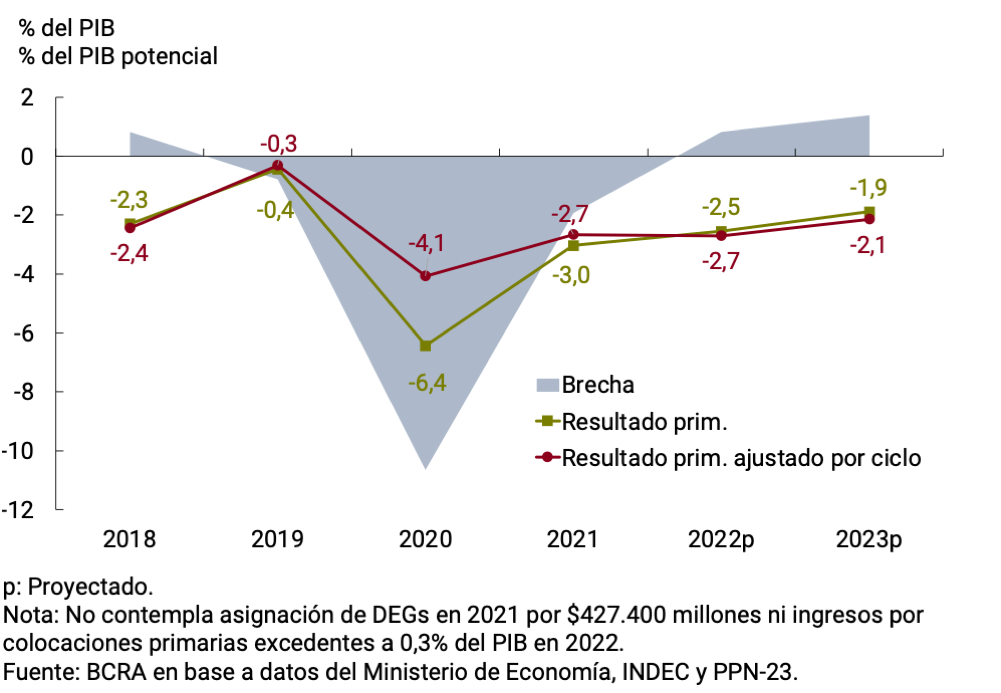
The estimated GDP gap from 2021 onwards is significantly adjusted to -2.2% of nominal potential GDP due to the strong economic recovery observed in the aftermath of the episode of greatest impact on economic activity due to the pandemic, so the primary and cyclically-adjusted results tend to be similar and stand at -3% of GDP and -2.7% of GDP respectively.
The 2023 Budget Bill (PPN-23) contemplates a closing of 2022 with a primary deficit of the NFPS of 2.5% of GDP (contemplating extraordinary income from primary placements of securities of 0.3% of GDP, which is the same percentage recorded in 2021 for this concept). Given that the HP filter assumes a trend GDP below the estimated cash flow, the cyclically-adjusted result stands at 2.7% of GDP. Thus, according to this simplified exercise, the fiscal policy boost during 2022 according to the fiscal guidelines set out in the PPN-23 was neutral with respect to 2021 (see Chart 2), reversing the negative impulse of a year ago. Breaking down by incidence, it can be seen that for 2022 the boost came mainly from revenues (+0.7%), which offset the negative impact of expenses (-0.7%). It should be noted that in 2021 the public sector received the Extraordinary Solidarity Contribution (Law 27605) that partially reversed the effect of the cyclical component of tax and social security resources.
Graph 2 | Fiscal boost
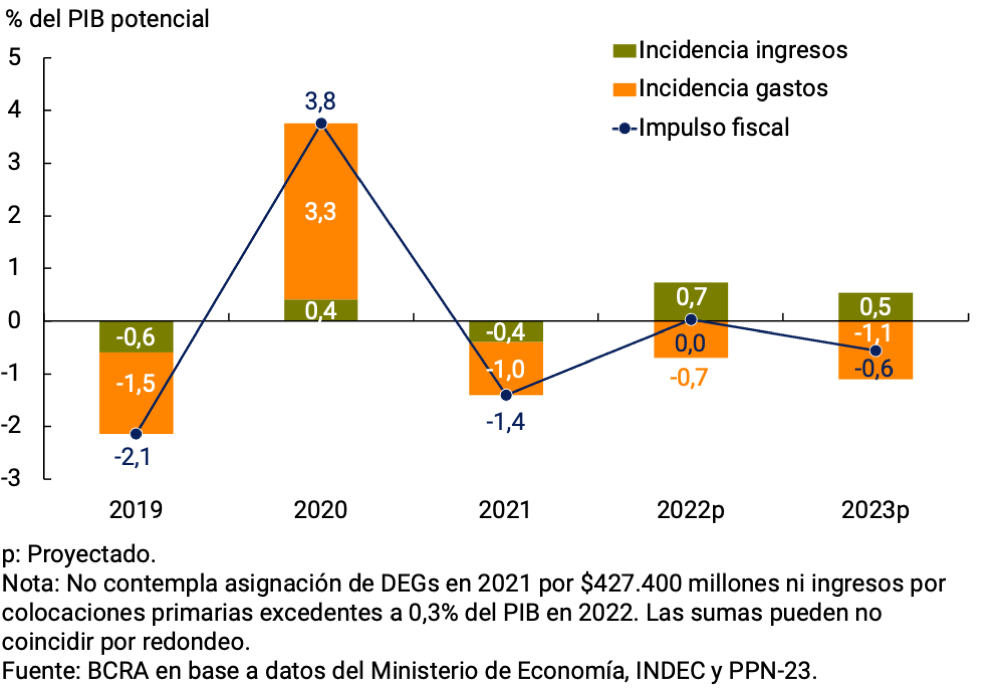
Thus, it was observed that the public sector acted countercyclically during the pandemic, being expansive during the bloodiest episode of the pandemic, while withdrawing the momentum as economic activity was restored to pre-pandemic levels.
According to the PPN-23, for next year the underlying fiscal policy would have a less expansionary bias than that observed during 2022. While the budgeted NFPS primary deficit is around 1.9 percent of GDP, the cyclically-adjusted fiscal deficit would be around 2.1 percent of nominal potential GDP. The fiscal stimulus expected for 2023 is thus less expansive at 0.6% of GDP with a strong incidence of expenditure (-1.1%), partially offset by revenues (+0.5%).
The usefulness of the cyclically-adjusted result is limited, among other things, by the difficulty in distinguishing the cyclical elements from those underlying the fiscal deficit. On the other hand, it should be borne in mind that a key part of the exercise rests on the assumptions of elasticities which, in a first approach, was based for this exercise on the suggestions of the IMF technical note. A more in-depth analysis could contemplate the calculation of regressions of the elasticity of tax and social security revenues to GDP. Likewise, in order to make cyclical adjustments within expenditure, expenditures that present a component whose behavior is linked to the cycle could be identified and then the corresponding elasticity could be estimated. All these possible modifications could change the result of the exercise obtained. In any case, the analysis of the simplest indicator is of significant interest. From there, it will be possible to improve the methodologies to consider different issues that policymakers evaluate to achieve indicators whose interpretation allows a better understanding of the macroeconomic impact of fiscal policy.
Bibliography
Guidelines for Fiscal Adjustment. How Should the Fiscal Stance Be Assessed? MFIs. https://www.imf.org/external/pubs/ft/pam/pam49/pam4902.htm.
Computing Cyclically-Adjusted Balances and Automatic Stabilizers. MFIs. Author: Ms. Annalisa Fedelino, Mr. Mark A Horton, and Anna Ivanova. https://www.elibrary.imf.org/view/journals/005/2009/005/article-A001-en.xml
Section 5 / Is the IPIM a good predictor of the CPI?
In this section, the hypothesis of predictive capacity or temporal anticipation of the IPIM with respect to the CPI is evaluated. To make this evaluation, a quantitative analysis of the relationship between both variables is presented for the Argentine case, with the aim of providing an appropriate frame of reference that is useful for the discussion of economic policy.
The analysis focuses on the period January 2004 to October 2022, with a focus on the link over time between the General Level Consumer Price Index (CPI, for future references) and the Domestic Wholesale Price Index (IPIM)42. Their relationship is studied in order to capture the average behavior between the variables over long periods of time, using what is known in the literature as cointegration analysis, following the Johansen-Juselius approach43. Their relationship in the short term is then evaluated, considering both the adjustments to the deviations of the long-term relationship and the temporal anticipation between the variables (i.e., whether the movement of one of them usually precedes that of the other). Based on these exercises, general conclusions are drawn about the hypothesis raised.
Descriptive analysis
It is useful to start with a visual inspection of the temporal evolution of the growth rates of the CPI and the IPIM for the entire period considered (see Graph 1) and for the sub-period 2016-2022 (see Graph 2), in order to examine the presence of differential behaviors of these variables in a more recent period.
Graph 1 | Temporal evolution CPI Inflation and IPIM Inflation 2004-2022
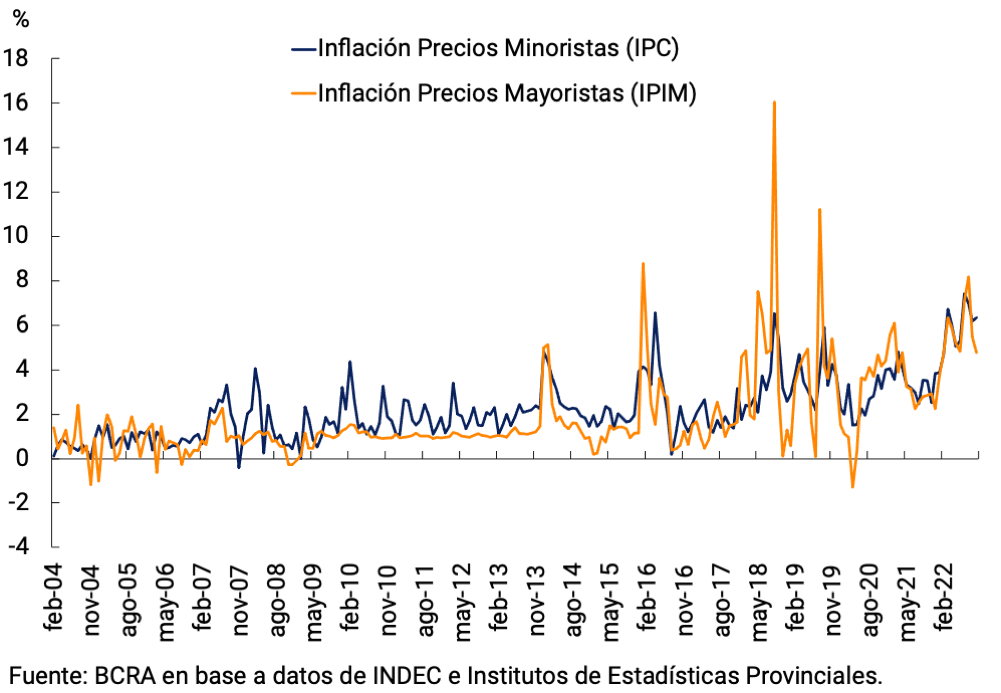
Both series show a trend. In addition, specific and limited periods are observed in which the role of anticipation changes between the variables. That is to say, from the simple observation of the temporal evolution of the variables it cannot be concluded that there is a systematic anticipation of one series with respect to the other, but rather that a simultaneous dynamic of the same is observed, on average, for the two periods examined.
Graph 2 | Temporal evolution CPI Inflation and IPIM Inflation 2016-2022
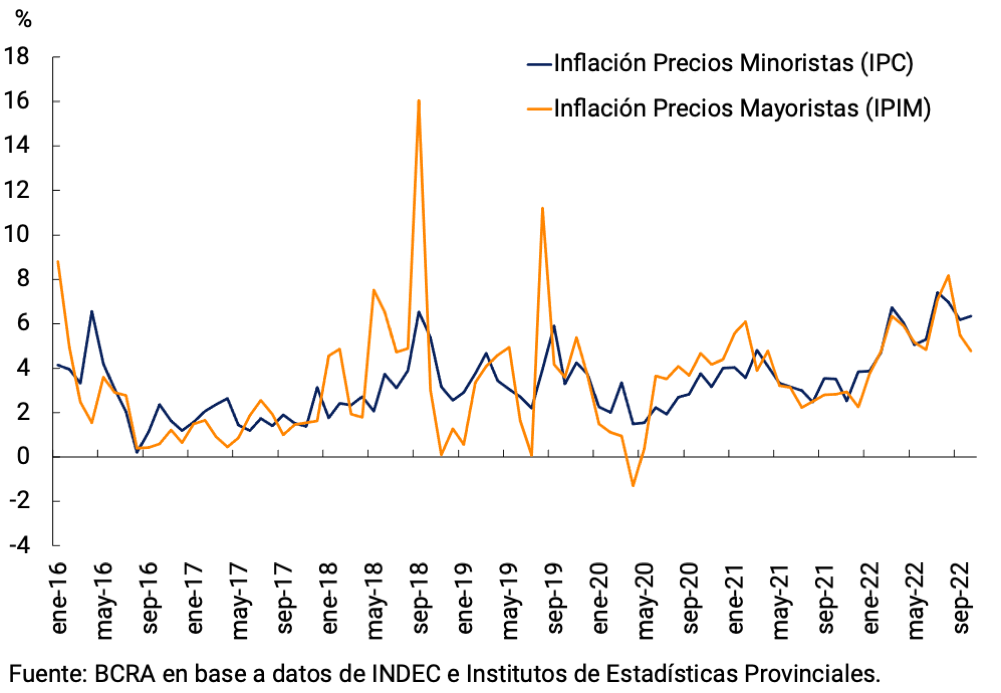
Long-term analysis and short-term dynamics
Based on the Johansen-Juselius methodology, a long-term relationship is found between the variables with a unit coefficient, both for the entire period and for the period 2016-202244. This methodology also allows us to evaluate whether any of the variables considered responds to deviations or imbalances in the long-term relationship between the two, which is known in the literature as “weak exogeneity” analysis. This concept of exogeneity has the advantage that it allows modeling a group of variables (the endogenous variables) without necessarily specifying how the second group (the exogenous variables) is determined 45,46.
The weak exogeneity analysis in the VEC model for CPI and IPIM in the period 2004-2022 (Table 1) shows that both variables respond to the imbalances of the long-term relationship, i.e., the two variables behave as endogenous. This is verified in Table 1 because: a) the two tests of significance of the adjustment coefficients are in absolute value greater than 1.96 and b) they present the opposite sign to the coefficient with which the variables enter the long-term relationship, which means that both variables correct the imbalances that are observed month by month. The implication is that, for the full sample, the behavior of the CPI and the IPIM should be modeled together, through a dynamic system of equations.
In the case of the 2016-2022 period (Table 1), the assessment of weak exogeneity shows a difference with the result obtained for the entire period, since the only variable that responds to the imbalances of the long-term relationship is the CPI (t-test greater than 1.96 in absolute value), i.e., in this sample period a conditional model of the CPI would be validated based on the IPIM.
Table 1 | Analysis of Weak Exogeneity period 2004-2022 and 2016-2022 Statistic t

“Temporal anticipation” analysis
Continuing with the evaluation of the link between the IPIM and the CPI, the analysis of cointegration is complemented with that of temporal anticipation through the evaluation of the absence of causality in the sense of Granger47.
The result of the temporal anticipation evaluation for the entire sample presented in Table 2 indicates that the two variables are temporally anticipated. The p-value allows us to reject the null hypothesis of “non-causality in the Granger sense” in both directions at the level of significance of 1%.
For the period 2016-2022, Table 2 shows that the evaluation of “non-causality in the Granger sense” yields results that are not different from the full sample, since the two p-values allow the rejection of the null hypothesis at 1% of significance.
Given this result of mutual temporal anticipation, it is worth noting the following. The weak exogeneity of the IPIM with respect to the CPI identified in the cointegration analysis for the period 2016-2022, does not validate the use of this variable as a predictor of the former for forecasting purposes, since the requirement of strong exogeneity of the IPIM to CPI48 is not met.
Table 2 | Evaluation of temporal anticipation period 2004-2022 and period 2016-2022

Conclusions
The empirical analysis of the hypothesis of predictive capacity or temporal anticipation of the IPIM with respect to the CPI requires, on the one hand, to evaluate the existence or not of a long-term relationship for the correct specification of the model when analyzing the temporal anticipation and, on the other hand, to take into account the concept of strong exogeneity when the purpose of the model is to forecast.
In this sense, two results stand out. First, as expected, there is clear evidence of a long-term relationship between the CPI and the IPIM for the entire period 2004-2022. In addition, the relationship between the two variables is dynamic throughout the period analyzed, since, from a simultaneous modeling for the entire sample, it is passed to a conditional CPI based on the IPIM for the period 2016-2022. Secondly, for the entire sample considered (and for the 2016-2022 sub-period) the IPIM and the CPI are anticipated in time. Thus, although for the 2016-2022 sub-period there is weak exogeneity of the IPIM with respect to the CPI, the absence of strong exogeneity prevents the use of the IPIM for CPI forecasting purposes in the conditional model.
References
Ahumada, H. (2006). A note on regressions with integrated variables, Economic Essays No. 45, BCRA.
Engle, R., Hendry, D.F., & Richard, J.F. (1983). Exogeneity, Econometrica, 51(2), 277-304.
Johansen, S. (1988). Statistical Analysis of Cointegration Vectors, Journal of Economic Dynamics and Control, vol.12, issue 2-3, 231-254.
Johansen, S. y Juselius, K. (1990). Maximum Likelihood Estimation and Inference on Cointegration-With Applications to the Demand for Money, Oxford Bulletin of Economics and Statistics, vol. 52, issue 2, 169-210.
Juselius, K. (2006). The Cointegrated VAR Model. Methodology and Applications. Oxford University Press.
Section 6 / Evolution of interest-bearing liabilities
Currently, the BCRA uses two instruments to regulate bank liquidity. First, you can use your own bills and notes, among which the Liquidity Bills (LELIQ) that are auctioned 3 times a week stand out. The BCRA may also, eventually, inject liquidity by repurchasing them in the secondary market. Secondly, it makes available to financial institutions the operation with passes, which allows them to place their liquid surpluses (passive passes) or demand liquidity (active passes).
These instruments allow financial institutions, fundamentally, to channel surplus liquidity. The BCRA can tighten or relax its monetary policy through changes in the policy interest rate and its consistency with the rest of the rate curve.
This set of remunerated instruments that are used to manage the liquidity of the economy represents, together with the Monetary Base, the main liabilities of the Central Bank’s balance sheet. Interest-bearing liabilities reached an average monthly balance of $9.2 trillion in November, representing 9.3% of GDP, while the Monetary Base in the same period stood at 4.5% of GDP.
Recent developments in interest-bearing liabilities
When evaluating the ratio to GDP from a historical perspective, it is found that the highest level of remunerated liabilities in recent years was reached at the beginning of 2018, representing at that time 11% of GDP (with the Monetary Base in the same period being 8% of GDP). It should be remembered that, at that time, the BCRA Bills (LEBAC) could be in the hands of local financial institutions, the public and private sectors, and within the latter also residents from abroad. Non-bank private sector holders held about 65% of total interest-bearing liabilities, of which 18 p.p. were in the hands of foreign investors.
During the second half of 2018, the BCRA implemented a plan to gradually reduce the stock of LEBACs and determined that the LELIQs, which had been in force since January of that year and could only be subscribed by financial institutions, would become the main monetary policy tool. In September 2018, the Minimum Cash Regime was modified, enabling financial institutions to integrate part of the requirement in pesos for deposits with LELIQ. This would be the first of a series of changes that would allow the partial integration of the requirement in pesos through these bills.
The COVID-19 pandemic was an unprecedented shock, which found the Argentine economy in an emergency situation, without access to credit markets and with very limited room for countercyclical policy. In this context, the Central Bank had to exceptionally assist the National Treasury to face the needs arising from the pandemic. To avoid imbalances in the money market, surplus liquidity was sterilized through monetary regulation instruments.
An additional element that also contributed to the increase in the balance of interest-bearing liabilities was the change in the reserve requirement scheme in mid-2020. At that time, the BCRA allowed all the reserve requirements corresponding to fixed-term deposits in pesos to be integrated into LELIQ, going from a non-interest-bearing reserve to a remunerated one. This initiative accompanied the policy of promoting the greater availability of savings instruments in pesos and the setting of minimum interest rates. Currently, the LELIQs used by financial institutions to integrate their requirement in pesos represent 0.6 p.p. of the product.
Graph 1 | Main liabilities of the BCRA as a percentage of GDP
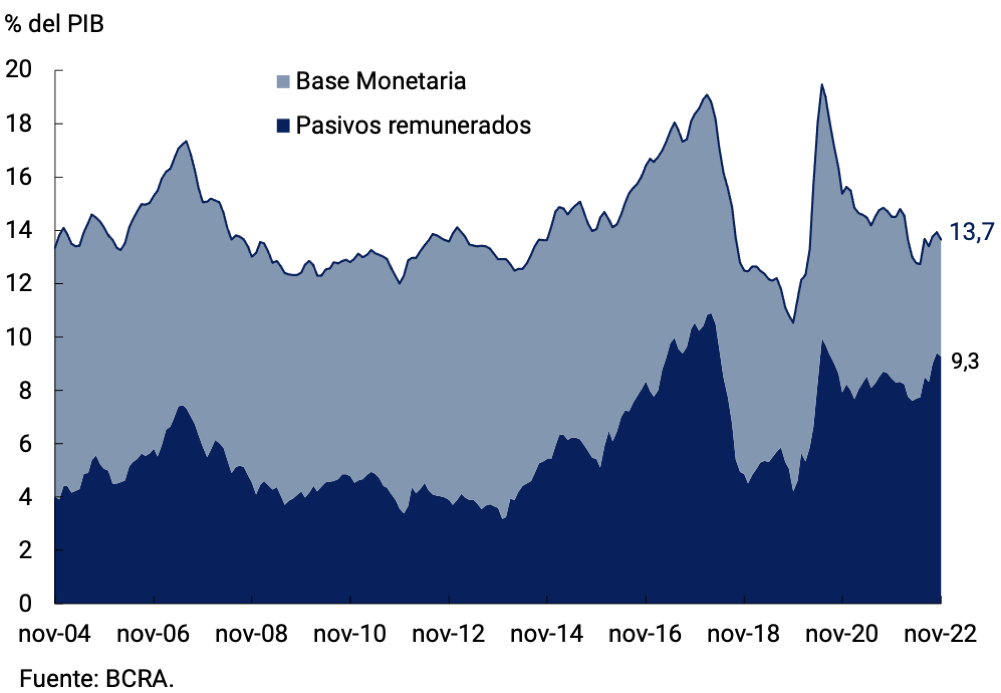
The financial support to the National Treasury during the pandemic and the consequent sterilization of surplus liquidity generated a nominal increase in the balance of the BCRA’s interest-bearing liabilities. The dynamics of interest-bearing liabilities accompanied the process of gradual normalization of the economy. Thus, the balance of BCRA instruments as a percentage of GDP rose until mid-2020, subsequently presenting a gradual reduction, to remain at levels close to 8% of GDP.
In mid-2022, in response to episodes of excessive financial volatility, the BCRA intervened in the secondary market for public securities in order to stabilize the prices of Treasury instruments. The BCRA also designed a liquidity window for public debt instruments in the portfolio of Mutual Funds (FCI). On the other hand, and with the same objective, it began to offer financial system entities a put option on National Government securities, awarded as of July 2022 and maturing before December 31, 2023. These operations led to an expansion of the system’s liquidity, which was ultimately channelled into monetary regulation instruments. Thus, between the end of the second quarter and the beginning of the third quarter, there was an increase in the balance of interest-bearing liabilities. It is worth mentioning that these operations would have a limited impact on the BCRA’s balance sheet, since the National Treasury securities were acquired under price and yield conditions that are more favorable than those of the remunerated liabilities issued to manage the amount of money.
On the other hand, in September 2022, favored by the boost of the “Export Increase Program”, the BCRA acquired a foreign exchange balance of US$7,000 million at a differential exchange rate (see Soybean dollar box). The flip side of these purchases was an expansion of the system’s liquidity, which was also sterilized with interest-bearing liabilities.
These two policies carried out by the BCRA during the second half of 2022, in a context where the demand for the Monetary Base grew at a lower rate, explained an increase in interest-bearing liabilities close to 2 p.p. of GDP, while generating an increase in its assets (International Reserves and Public Securities).
Thus, the evolution of interest-bearing liabilities in recent years is the counterpart of the policies implemented by the BCRA to: assist the National Treasury in the face of the COVID-19 pandemic, stabilize the sovereign debt market in the face of episodes of excessive financial volatility, strengthen its international reserves and promote better returns for savers, which contributes to reducing pressures in the foreign exchange market and strengthening the demand for assets denominated in pesos. Even with all these changes, the ratio of total monetary liabilities to GDP stands at a level of 13.7%, 5.3 p.p. below the maximum reached in 2018 and a record similar to that verified between 2004 and 2015.
Characteristics and relevance of interest-bearing liabilities
At present, the holdings of the BCRA’s remunerated liabilities are practically entirely in the hands of financial institutions62. Thus, unlike what has happened at other times in recent history, the monetary policy instruments of the Central Bank are in the hands of institutions regulated by the monetary authority itself, fulfilling exclusively their role of liquidity management.
These instruments today have a central role as a counterpart to a substantial portion of Argentines’ savings. Although the BCRA promotes the development of the capital market to channel these savings, until substantial progress is made in this regard, it must maintain mechanisms that allow financial institutions to remunerate savers with interest rates that allow the value of their savings to be preserved.
To analyse the sustainability of remunerated liabilities, the ratio with the Monetary Base is often used. As mentioned, within the BCRA’s balance sheet two preponderant concepts can be found within the liabilities: the WB and the Remunerated Liabilities. In simplified terms, the World Bank is the high-powered money that the central bank issues and banks multiply, via the secondary creation of money. On the other hand, interest-bearing liabilities are the main instruments that the monetary authority uses to sterilize monetary surpluses.
The comparison of two liabilities, in the case of a commercial bank, provides information on the structure of its funding and on its financial cost. But in the case of the Central Bank, this comparison is less relevant. Although there is a financial cost, the Central Bank does not issue its remunerated liabilities because it seeks financing; but it does so, for example, to balance the “market” of monetary base.
Dada la tasa de interés y las regulaciones fijadas por el BCRA, se determina autónomamente la demanda de base monetaria. Por el lado de la oferta, cuando el Banco Central usa una tasa de interés como principal instrumento de política y a su vez determina otros factores de creación monetaria, la colocación neta de pasivos remunerados es la forma en la que automáticamente se restablece el equilibrio monetario, ya que cualquier excedente en la oferta de dinero se vuelca hacia los pasivos remunerados.
The relevance of comparing interest-bearing liabilities with the Monetary Base is not clear. Using the Monetary Base as a deflator has the disadvantage that its evolution is affected by changes in reserve requirements. When the reserve coefficients rise, the value of the denominator rises, while the value of the numerator falls. Likewise, financial innovations can modify the composition of the demand for money, impacting the demand for the Monetary Base63. In fact, the monetary base is at historically low levels. This is so both because of the demand in pesos and because of the low requirement in pesos of the Minimum Cash Regime. The latter is associated with the possibility of integrating part of the requirement in pesos with LELIQ.
Outlook for interest-bearing liabilities
Interest-bearing liabilities are a policy instrument and as such reflect macroeconomic conditions and the needs for economic development and the strengthening of local financial and monetary markets.
A favorable path in which activity grows and inflation falls, that the demand for credit is reactivated supported by the perception of a more vigorous economy and that incomes are strengthened from the increase in the productivity of the economy will give rise to a greater demand for real monetary balances. The latter will also boost the demand for the Monetary Base, which would be supplied by the interest associated with the BCRA’s remunerated liabilities and, potentially, by a reduction in its stock.
Likewise, the macroeconomic policy scheme set out in the Extended Facilities Program (PFE) with the IMF stipulates a gradual reduction in the primary deficit. In this context, monetary assistance to the Treasury will follow a downward trajectory in terms of GDP, with zero expected by 2024. Less monetary funding from the National Treasury would reduce sterilization needs.
The continuity of this process of normalization of the economy, together with the strengthening and deepening of the public debt market, would allow the BCRA to gradually incorporate open market operations as the main instrument of monetary regulation, in line with the practices of most of the world’s central banks.
The transition is not linear, it is not without shocks, and its duration cannot be clearly estimated. But the conditions are in place to begin a gradual path towards less dependence on this instrument of monetary regulation.
Glossary
ADEFA: Association of Automotive Manufacturers of the Argentine Republic.
AFCP: Portland Cement Manufacturers Association.
AFIP: Federal Administration of Public Revenues.
AMBA: Buenos Aires Metropolitan Area.
ANSES: National Social Security Administration.
ASPO: Social, Preventive and Mandatory Isolation.
AUH: Universal Child Allowance for Social Protection.
BADLAR: Buenos Aires Deposits of Large Amount Rate (interest rate paid for fixed-term deposits of more than one million pesos in the 30 to 35-day bracket by the average of banking entities).
BCRA: Central Bank of the Argentine Republic.
BOAT: National Treasury Bond.
CABA: Autonomous City of Buenos Aires.
CAME: Argentine Confederation of Medium Enterprises.
CAMARCO: Argentine Chamber of Construction.
CAMMESA: Compañía Administradora del Mercado Mayorista Eléctrico Sociedad Anónima.
ECLAC: Economic Commission for Latin America and the Caribbean.
CER: Reference Stabilization Coefficient.
S Fuels and Energy.
DECNU: Decree of Necessity and Urgency.
DISPO: Social, Preventive, and Mandatory Distancing.
EIL: Survey of Labor Indicators.
EMAE: Monthly Estimator of Economic Activity.
EMBI+: Emerging Markets Bond Index Plus.
EPH: Permanent Household Survey.
EUR: Euros.
Fed: Federal Reserve of the United States.
FAITHFUL: Latin American Economic Research Foundation.
IMF: International Monetary Fund.
FSB: Financial Stability Board.
G20: Group of 20.
GBA: Greater Buenos Aires.
A.I.: Year-on-year.
IBIF: Gross Fixed Domestic Investment.
ILA: Leading Indicator of Economic Activity.
INDEC: National Institute of Statistics and Censuses.
National CPI: Consumer Price Index of national coverage released by INDEC.
CPI BA: Consumer Price Index of the Autonomous City of Buenos Aires.
IPIM: Internal Wholesale Price Index.
IPOM: Monetary Policy Report.
ISAC: Synthetic Construction Indicator.
VAT: Value Added Tax.
LELIQ: Letrax de Liquidez of the Central Bank of the Argentine Republic.
M2: Banknotes and coins + quasi-currencies in circulation + current accounts in $ and savings accounts in $.
MSMEs: Micro, small and medium-sized enterprises.
Mens: monthly/monthly.
MOA: Manufactures of Agricultural Origin.
MOI: Manufactures of Industrial Origin.
MTEySS: Ministry of Labour, Employment and Social Security.
N.A.: Annual nominal.
NEA: Northeast Argentina.
NGFS: Network for Greening the Financial System.
NOA: Northwest Argentina.
OECD: Organization for Economic Cooperation and Development.
P.B.: Basic points.
P.P.: Percentage points.
Q: Projected.
COUNTRY: Tax for an Inclusive and Supportive Argentina.
EAP: Economically Active Population.
PFE: Extended Facilities Program.
GDP: Gross Domestic Product.
PMI: Purchasing Managers’ Index. Index of surveys to purchasing managers.
PP: Primary products.
SMEs: Small and medium-sized enterprises.
REM: Survey of Market Expectations of the BCRA.
s.e.: Series without seasonality.
NFPS: National Non-Financial Public Sector.
TNA: Annual Nominal Rate.
Trim.: Quarterly / Quarter.
US$: US dollars.
UTDT: Torcuato Di Tella University.
UVA: Unit of Purchasing Value.
Var.: Variation.
WEO: World Economic Outlook prepared by the IMF.
References
1 The purpose of this indicator is to anticipate the turning points of the EMAE, from a recovery or expansion phase to a recession or vice versa, when certain requirements are met that have to do with the diffusion, duration and depth of economic cycles. In July 2022, the ILA-BCRA met these three criteria: it fell for the third consecutive month, the diffusion of growth of the components of the ILA was below the critical level (42.5% in the 4-month moving average) and the accumulated depth in the last 6 months changed sign and stood at –8.7%. For more methodological details of the ILA, see Section 3 / BCRA’s Leading Index of Economic Activity published in the IPOM corresponding to January 2017.
2 Gross fixed capital formation, which is composed of Construction and Durable Production Equipment (which includes Machinery and Equipment and Transport Equipment, of national and imported origin).
3 Data corresponding to the manufacturing IPI, own seasonalization.
4 The systems for Imports of the Argentine Republic (SIRA) and for Payments of Foreign Services (SIRASE) seek to unify import order procedures in a single window, provide predictability on payment dates and optimize the use of foreign currency.
5 A series of measures were recently announced to support the 11 provinces that suffered late frosts, mainly small producers with the aim of providing financing. The National Trust Fund for Agribusiness (FONDAGRO) will grant a line of credit at a zero rate for $1,000 million to be allocated to investments and working capital. It has a maximum of $900,000 per producer, and has a term of 30 months, with an 18-month grace period.
6 Estimates of the Rosario Stock Exchange.
7 Since the start of the new series in the second quarter of 2016.
8 Salaried workers with a retirement discount.
9 Salaried men and women with a retirement discount.
10 Among them are the National Program of Science, Technology and Social Innovation, the National Innovation Contest. The different financing funds such as the Argentine Technological Fund (FONTAR), the Fund for Scientific and Technological Research (FONCyT), the Argentine Sectorial Fund (FONARSEC). Research grants on strategic issues and in agreement with companies granted by CONICET, among others.
11 Data estimated based on the stock of debt as of III-22 that arises from the Survey of External Assets and Liabilities and the debt of October and November estimated from the difference between FOB imports and payments by the foreign exchange market.
12 This is the result of the BCRA’s accumulated annual net purchases in the foreign exchange market, accounting for the movements at the time of the agreement.
13 This is the result of the BCRA’s accumulated annual net purchases, accounting for movements at the time of the settlement of foreign currency.
14 A new instrument was created that allowed producers to make a demand deposit in financial institutions with variable daily remuneration depending on the evolution of the A3500 exchange rate, known as the link dollar, for up to 70% of the value of the sale of grains and allowed them to form freely available foreign assets for the remaining 30%. Likewise, the issuance of a Dollar Bill was approved, aimed at stimulating the entry of external funds for pre-financing of large exporters, to provide a yield of SOFR plus 0.9 to the foreign currency entered by this mechanism that are deposited in local accounts in foreign currency, extending the terms for the settlement of these funds up to 180 days. In addition, access to dollar-linked demand accounts was enabled for exporters who anticipate the settlement by more than thirty days with respect to the term determined for each sector.
15 Taking as an indication that people entered the country declaring that they were going to stay at “the home of relatives or friends”, it can be inferred that many of them stayed longer than usual in the country because in most of 2020 they could not enter as a result of the closure of borders.
16 To access the decree click here.
17 This section is based on the working document where this indicator is presented (for more information see the following link).
20 The 500 largest ports are sorted according to the cargo that passes through them. The medium port is the one that is in the median of that distribution.
21 For more information see the following link.
22 RESOG-2022-5248-E-AFIP-AFIP – Income Tax. Payment on account applicable to subjects listed in Article 73 of the Tax Law, with extraordinary income.
23 The rate on account of this tax on purchases taxed with the PAIS tax had been increased from 35% to 45%, as of Jul 14, 22. It should be noted that on Oct 13, 22, the scope of the PAIS tax was extended to new operations (importation of sumptuous goods), and new collections were established on account of income tax and personal property tax on transactions covered by said tax (for payments over US$300 per month, in addition to the 45% collection, an additional 25% on account of the Personal Assets Tax).
24 DCTO-2022-561-APN-PTE.
25 DECNU-2022-576-APN-PTE.
26 DECNU-2022-787-APN-PTE.
27 It should be noted that in relation to 2019 the tax structure underwent modifications, mainly from the creation of the PAIS Tax, due to changes in the rates of export duties and on the Personal Property Tax, as well as the revision of the tax reform promoted during 2017 that affected social security resources. All this also explains the higher real collection.
28 In September, $427,400 million were recorded from the extraordinary allocation of Special Drawing Rights (SDRs) that the IMF made in the context of the global crisis due to the COVID-19 pandemic.
29 Tax Information Exchange Agreements.
30 Contemplating the annual limit for the calculation of income from property income linked to the primary issuance of public securities equivalent to 0.3% of GDP for the purposes of the policy objectives contained in the program with the IMF.
31 Ley 27701 promulgada por DEPPA-2022-799-APN-PTE de fecha 30/11/2022.
32 Elasticity is defined as the sensitivity of variation that one variable has to changes experienced by another.
33 The rest of the NFPS income (non-tax, capital including extraordinary contribution, etc.) is not adjusted for the cycle.
34 The estimation of cyclical and trend components is a complex issue since they involve unobservable variables. There are several methodologies for estimating potential GDP. A common way to estimate it is through the use of filters. In this case, the Hodrick-Prescott was chosen. The estimate was made with a sample that included a 2-year projection to overcome the problem of peak instability, using the macroeconomic projections incorporated in the PPN-23. The Lambda used was 8,000, calibrated in such a way that during the second and third quarters of 2020 (critical period of the pandemic) potential GDP did not fall.
35 The agreement between the National Government and the Argentine Industrial Chamber of Apparel (CIAI) reached on September 22 with 60 leading brands was intended to return prices to the values of September 5 and keep them stable until December 1.
36 Under the agreement reached between the National Government and representatives of the pharmaceutical sector on July 19, 2022, the companies committed to update the price lists of medicines with monthly rates of up to 1 point below the variation of the CPI General level of the previous month (see the following link). For its application, prices as of June 30, 2022 were taken as a basis. On September 19, the agreement was extended under the same conditions until November 18, 2022. On December 15, 2022, a new agreement was announced by which a path of monthly increase of 3.8% is set for medicines that includes a trigger clause by which if in a given month inflation is greater than 5% per month, the following month it is authorized to set increases of up to 1 p.p. below the inflation of the previous month (see link).
37 The Fair Prices program launched on Nov. 11, 22 (Res. 823/22-Mecon) consists of a scheme of voluntary price agreements with companies that produce and market (wholesale and retail) articles of mass consumption. It establishes, on the one hand, the setting of prices for four months for a set of 1,823 items (mainly food and beverages, cleaning products and hygiene and personal care items), available in supermarkets and in the main chains of the country. For the rest of the products of the participating companies, monthly increases of up to 4% are allowed until February 2023. After its launch, the scope of the program was extended to other items such as fuels, with agreed increases of up to 4% until February 2023 (See link).
38 With data as of November 2022, Meat and derivatives represent approximately 9.1% of the total basket of goods and services that make up the CPI, 13.1% of the core CPI and 32.0% of the Food and non-alcoholic beverages division.
39 Beef prices tend to register relatively more limited increases during the second and third quarters and significant accelerations towards the end and/or beginning of each year.
40 The evolution of outerwear is approximated on the basis of the monthly variations corresponding to those of the grouping “Clothing and materials” (maximum available opening) which, in addition to Outerwear, includes Underwear and textile materials.
41 The estimate of the Tourism grouping (which includes Hotels, Tourism Transport and packages and excursions) was obtained by difference from the evolution of Seasonal and the other groups that make up that category. In the case of Fruits and Vegetables, the weights of these groupings can be estimated directly from the published data. In the case of outerwear, it is assumed that they have a relative weight of 50.3% within Seasonals in Dec-16, which arises from transferring to the structure of estimated weights of the INDEC CPI (Dec-16=100) the share of Outerwear over Apparel and Materials of the CPI CABA (Jul-11/Jun-12=100) in Dec-16.
42 Prepared by the BCRA based on data from INDEC, the Provincial Directorate of Statistics and Censuses of San Luis and the General Directorate of Statistics and Censuses of the City of Buenos Aires.
43 The Johansen-Juselius methodology can be considered as a synthesis: (i) of the Autoregressive Vector (VAR) methodology, but enriched with the incorporation of the term Equilibrium Correction (ECV) to distinguish short- and long-term effects, and (ii) of the approaches closer to economic theory, but through a reduced way of expressing dynamic simultaneous models. This type of analysis allows characterizing the temporal properties of the series, evaluating the existence of cointegration relationships and indicating the possible directions of the conditional models.
44 In the characterization of the temporal properties of the series, we found that for the entire period and for the 2016-2022 subperiod both Indices present a unitary root in their level, regardless of the deterministic components of constant and trend that were included in the tests and evaluated in their significance to be later incorporated in a timely manner in the long-term and short-term analyses.
45 Engle, Hendry and Richard (1983) define three concepts of exogeneity: weak, strong and super, depending on the purpose of the model, inference, forecasting and evaluation of policies and the parameters of interest.
46 While it is natural to construct an empirical model by previously selecting the variables to be treated as endogenous and exogenous, the concept of exogeneity is the tool used by applied econometrics to solve problems associated with the forms of specification and the selection of exogenous variables. The fulfillment of the weak exogeneity conditions allows valid statistical inferences (estimation and hypothesis testing) in an econometric model. Intuitively, the weak exogeneity of the variables located on the right side of a regression equation means that there is no loss of relevant information when conditioning the endogenous variables in these exogenous variables.
47 For a comprehensive discussion of how to correctly specify a model for the evaluation of non-causality in the Granger sense, see Ahumada (2006).
48 In this case, the additional requirement would be the non-anticipation of time or absence of causality in the Granger sense from the CPI to the IPIM.
49 Decree No. 576/2022.
50 Communication “A” 7600. A minimum rate of 120% of the monetary policy rate was set.
51 Communication “A” 7595.
52 Communication “A” 7571.
53 Decree No. 787/2022. Membership of the Program is voluntary, and only those subjects who have exported products from the soy complex in the last 18 months immediately prior to the entry into force of the decree can access.
54 It should be recalled that Communication “A” 7546 communicated that the BCRA would maintain an active presence in the domestic debt market, buying securities foreclosed as of July (with a residual term of at least 15 days) at a curve similar to the last one validated in the primary market plus a spread of 200 basis points (bp).
55 To calculate the ratios to GDP, the 3-month moving average of a monthly nominal GDP constructed using the EMAE as a high-frequency series was used.
56 Communication “A” 7536. A series of franchises were eliminated, preserving only those that favor productive credit to MSMEs and household consumption financing (Ahora12). In order to minimize the monetary effect, there was a change in the rates applied to minimum cash items. The latter came into force in October, while the allowance associated with ATM withdrawals will be computed up to and including December.
57 The means of payment are measured through the transactional private M2.
58 The rest of the depositors are made up of Financial Services Providers, Companies and Individuals with deposits of more than $10 million.
59 The private M3 includes the working capital held by the public and the deposits in pesos of the non-financial private sector (demand, time and others).
60 The regulation requires Group A institutions to comply with a quota of 7.5% of deposits, while smaller institutions must comply with a quota equivalent to 30% of that of large institutions.
61 For more detail, refer to the Monthly Monetary Reports (MMI) for the year 2022.
62 There is a tiny fraction of them that is in the hands of FCI.
63 The development of electronic means of payment reduces the use of working capital, which has a full impact on the demand for the Monetary Base with an increase in demand deposits in return. Given that only a fraction of demand deposits are accommodated, the growth in the demand for current account deposits of entities in the BCRA is less than proportional.
Share on


