The Central Bank of the Argentine Republic (BCRA) publishes the first Financial Inclusion Report, a biannual report aimed at communicating the state of financial inclusion in the country, the measures adopted in this area and, through specific metrics, monitoring the progress of the population’s financial inclusion. Following international experience, this paper analyzes the evolution of indicators that measure access, use and quality of financial services in the period between December 2015 and March 2019.
The Financial Inclusion Report (FIR) is part of the institutional efforts to contribute to the diagnosis, analysis and presentation of challenges of financial inclusion in Argentina. For its part, the BCRA, through its regulatory framework, has contributed to promoting the opening of new access points, facilitating the availability and opening of bank accounts, promoting greater use of electronic means of payment and favoring the use of electronic channels for carrying out operations remotely.
During the period analyzed, greater dynamism was observed in the dimensions of access and use, with advances in banking infrastructure, in transactions by electronic means and in savings instruments. The quality indicators also showed positive results in the financial education programs implemented by the Institution. However, challenges remain in covering deficits in physical access points in certain areas of the country, the deepening of the use of electronic means of payment, a greater penetration of credit instruments in the adult population and smaller companies, as well as achieving a greater degree of financial education among the population.
Highlights
Access Dimension | quantifies the service channels where users can have effective access to financial services.
-The physical infrastructure of the financial system increased in volume, registering an increase of 22% in the total number of access points (ADPs) to financial services in absolute terms (29,228) and 17% in relative terms to the adult population, from the beginning of 2016 to March 2019. ATMs have been the units that contributed the most to the expansion of total PDAs, registering a 29% growth.
-As of March 2019, the variation in this indicator meant the existence of 8.6 FLW per 10,000 adults nationwide.
-In addition to the PDAs of the financial system, in recent years the modality of withdrawing cash with debit card through point-of-sale terminals in stores and extra-bank collection networks has grown. As of March 2019, these withdrawal points represented at least 50% of the total number of ATMs and 2.5 points per 10,000 adults, thus improving the country’s access situation.
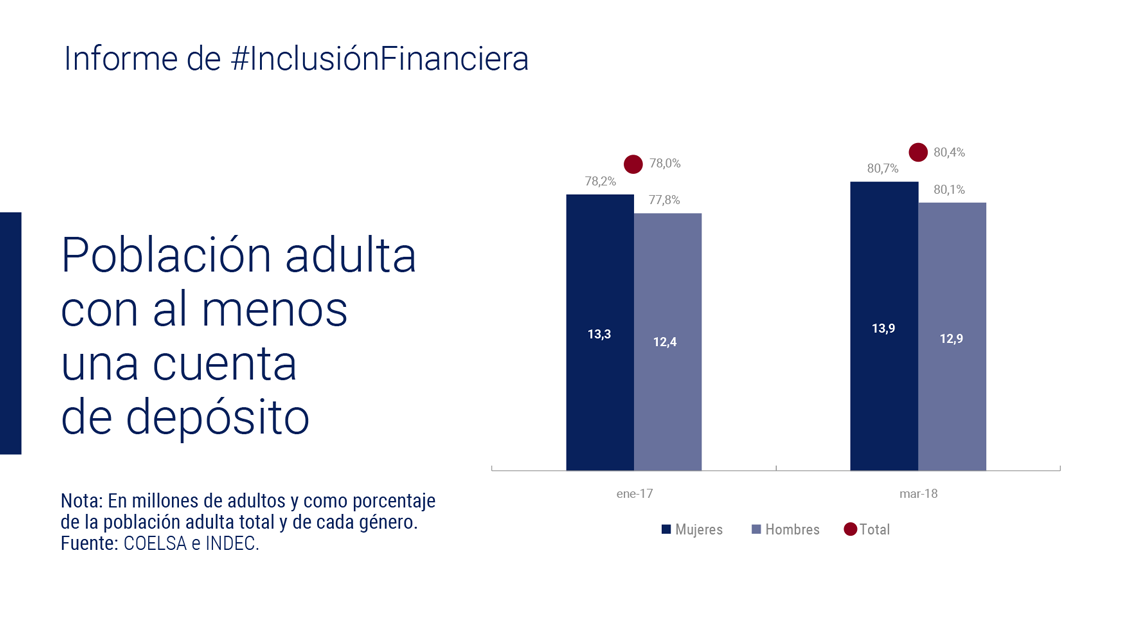
-Argentina registered 80% of adults with at least one deposit account – savings bank or checking account – in a regulated financial institution as of March 2018. This value can be considered high for an economy of our characteristics. In high-income countries, the penetration rate of a basic bank account is 95%, while in the jurisdictions classified by the World Bank as upper-middle-income, the group in which Argentina is categorized, this indicator is close to 73%.
Usage Dimension | It seeks to measure the degree of use of financial products and services.
-Access to credit in the financial system of the adult population reached 51% of adults as of March 2019, advancing four percentage points since December 2015. Throughout the period, credit card financing continued to be the most widespread financing instrument among the adult population (32% at Mar-19), while at the other extreme were mortgage loans (0.7% at Mar-19).
-Regarding credit assistance to productive units, as of August 2018, 40% of microenterprises (constituted as legal entities) had a line of credit with the financial system, while, considering a 12-month window, 52% of them took some financing. In the case of small and medium-sized “tranche 1” companies, 74% and 76% of them, respectively, had taken some type of financing between September 2017 and August 2018.
-Transactions by electronic means of payment made by individuals, that is, the sum of operations with debit cards, credit cards, transfers and prepaid cards, totaled 5.3 operations per adult (monthly average) during the first quarter of 2019. International comparison shows that there is room to expand the use of these instruments.
Quality dimension | It refers to the satisfaction of customers’ needs and their degree of understanding of financial products.
-The Global Financial Education Index summarizes the degree of financial knowledge, behaviors and attitudes of adults. For the year 2017, Argentina reached an average of 11.5 points out of a total of 21, reflecting a relatively low value at the international level.
-To face these challenges, the BCRA carries out different programs that seek, starting from school, to promote the development of financial skills for the development of daily life and to achieve adequate inclusion in terms of the correct use of financial products and services. As of March 2019, the Learning to Save (operational since 2016) and Financial Skills for Life (2017) programs have reached 18,070 secondary school students.
-The effectiveness of the financial system’s service channels, measured by the number of localities with at least three branches of different banks, has remained unchanged from December 2015 to March 2019. These localities accounted for 8% of the total and comprised 75% of the adult population.