Federico Sturzenegger, Governor of the BCRA, and Nicolás Dujovne, Minister of Economy, held a press conference at Kirchner Cultural Center (CCK) on June 7. In this framework, the following report presents the measures adopted to strengthen monetary policy with the aim of lowering inflation and explains how these measures will contribute to achieving the main objective, which is to promote price stability.
Strengthening of Inflation Targeting
The economic schedule the Argentine government announced on June 7, 2018 includes a series of measures that strengthen the monetary policy framework with the aim of lowering inflation.
The institutional strengthening of monetary policy revolves around three different axes: an enhanced operational and financial autonomy of the BCRA, the confirmation of the inflation targeting regime with a floating exchange rate, and the announcement of new inflation targets.
According to the schedule the BCRA is no longer entitled to give financial aid to the Treasury and the Treasury is to settle its debt (non-transferrable bills) with the BCRA for USD25 billion. These two measures will turn the Treasury into a source of monetary absorption.
The schedule proposes a reform to the Charter of the BCRA, which involves having strong reasons for removing its authorities and doing away with all direct or indirect financing to the Treasury. In addition, this reform will enable to enhance the BCRA’s accounting transparency and will introduce new mechanisms of accountability for its authorities.
Finally, the new inflation targets—in coordination with the new schedule of fiscal monitoring—are 17% for 2019, 13% for 2020, 9% for 2021, and 5% for 2022. This report presents the measures adopted and explains how they will contribute to achieving the main objective: price stability.
Inflation Targeting
Changes in the international arena, which favored the peso depreciation and the increase of global energy cost, prevent the compliance with the current inflation target. This requires redefining the inflation targets for the years to come, which will be 17% for 2019, 13% for 2020, 9% for 2021 and 5% for 2022. The BCRA considers these targets to be realistic, which compels it to adopt tough measures in terms of monetary policy. Given the uncertainties at the starting stage of this schedule, the BCRA is committed to keep the current contractive bias of monetary policy until a decrease of both inflation for the next months and inflation expectations for 2019 is clearly shown.
This new regime of decreasing inflation targets arises in very different circumstances from those in which the scheme was originally launched. The new targets improve the BCRA’s ability to achieve their compliance. The process of relative price correction is much more developed with respect to 2016, fiscal deficit is lower, and international reserves’ level is higher. In addition, there will not be any transfers from the BCRA to the Treasury and the BCRA will have more financial and institutional independence.
The BCRA is aware that disinflation exerts a serious effect upon the fiscal situation, given some expenses are adjusted by the past inflation, while income grows as the current inflation does. For that reason, these new inflation targets have been set in agreement with the fiscal authorities to assure the comprehensive consistency of the fiscal deficit schedule and a decrease in inflation.
The annual inflation targets mentioned in the first paragraph comprise y.o.y. inflation targets for each quarter. The BCRA will be more explicit when communicating its monetary policy. With the aim of influencing the inflation to come, the inflation target for the following twelve months will be published at every moment.The BCRA will seek to achieve a lower-to-22% inflation for twelve months as from July this year.
The BCRA is absolutely certain of the importance of lowering inflation to reach sustainable growth in our country. Experience shows that Argentina grows when inflation is reduced.
BCRA’s Financial Strengthening
According to the schedule the BCRA is no longer entitled to give financial aid to the Treasury and the Treasury is to settle its debt (non-transferrable bills) with the BCRA for USD25 billion. These two measures will turn the Treasury into a source of monetary absorption.
The BCRA’s balance sheet includes a stock of remunerated liabilities for 10.4% of the GDP. These liabilities arose as a result of the sterilization of fiscal deficit up to December 10, 2015, of the exchange clamp money surplus and of losses for sales of futures contracts in dollars prior to December 10, 2015, and the BCRA’s reserves purchase as from the same date.
BCRA’s Balance Sheet Items as of June 6, 2018 (as % of GDP)
Table1
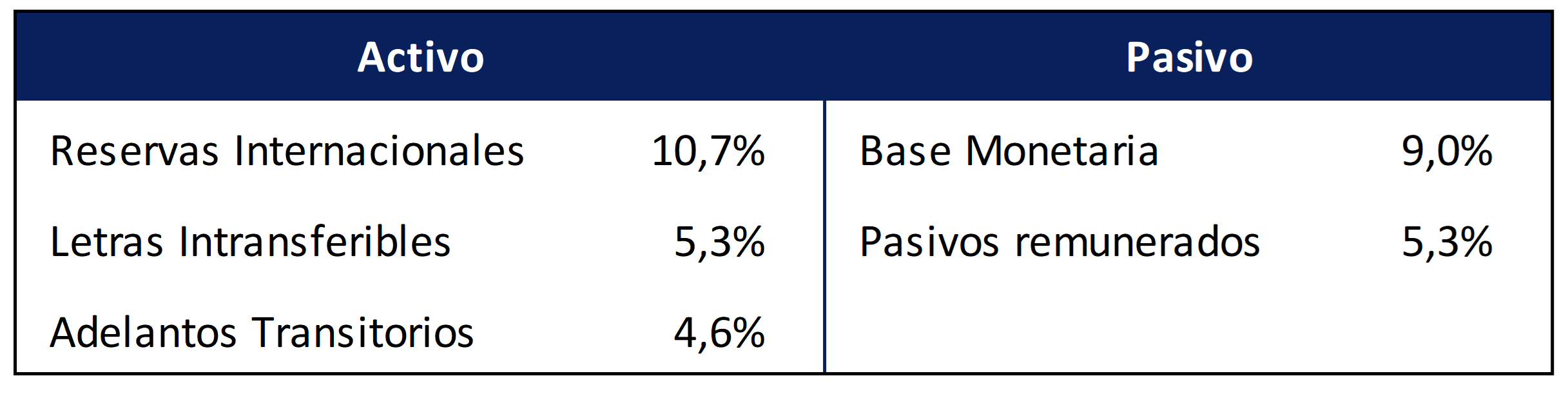
The new schedule is aimed at decreasing the BCRA’s remunerated liabilities through two mechanisms: the use of increasing money demand to purchase LEBAC bills, and the Treasury’s sale of medium and long-term liabilities to buy non-transferrable bills issued by the Treasury to the BCRA. This way, the consolidated debt stock of the Argentine state will be reduced and its deadlines’ profile will be extended. Likewise, these transactions will reduce the ratio of BCRA’s short-term stock of liabilities to international reserves.
From now on, this process will be implemented by reducing BCRA’s monetary financing to the Treasury to zero. On the other hand, the Treasury has undertaken to financially strengthen the Central Bank’s position by purchasing the non-transferrable bills it owes to the latter. The aim is to have the Treasury to buy non-transferrable bills from the BCRA for an amount in pesos equivalent to USD25 billion, which pace will depend on the market conditions.
By way of illustration, if the Treasury gets pesos in the market through debt issue, it will use such pesos in part to settle the Treasury’s debt with the BCRA (non-transferrable bills). Naturally such pesos will be withdrawn from the market. Therefore, the market will be in need of pesos and the only way to have them will be by selling LEBAC bills to the BCRA. This way, there will be fewer LEBAC bills in circulation and the same amount of money. Moreover, the BCRA’s short-term debt will turn into a Treasury’s longer-term debt.
This scheme, in which the BCRA does no longer transfer pesos to the Treasury and the Treasury, in turn, settles its debt with the BCRA, proves to be a radical change in Argentine monetary history. So far, the Treasury has usually been a monetary expansion source while, according to the new schedule, it will be a money absorption source, which will strengthen the BCRA’s balance sheet.
By the end of this process, its balance sheet will have the following structure:
BCRA’s Forecast Balance Sheet Items (as % of GDP)
BCRA’s Independence
The Executive Branch will submit a reform bill for the Charter of the BCRA to the National Congress, which core ideas will be more operational and financial independence, and more transparency in the institution’s submission of balance sheets. Likewise, the BCRA’s objective of price stability will become particularly important and its authorities will have to report on their objectives’ achievement.
In order to achieve the BCRA’s objectives, it is essential that institutions and the people in general rely on the monetary authority’s decisions in the medium and long-term. The BCRA’s institutional, functional and financial independence is highly important to contribute to achieve such credibility.1
There is worldwide consensus on the importance of central banks’ independence, which is considered one of the basic institutional characteristic features for good management. In fact, in the last few years, a significant number of countries changed their central banks’ regulations to strengthen their independence.2
Many studies show that the BCRA’s independence and, particularly, its impact on inflation and growth result in economic growth.
Institutional independence is a must in the face of a clear objective of monetary policy, reducing the risk of political pressure and of any potential conflict with the national government. A central bank’s ability to operate independently from the government, particularly within the monetary policy framework, is highly acceptable and desirable as well. For that reason, the reform bill for the Charter of the BCRA sets strict limits regarding the reasons why the monetary authority’s Governor, Deputy Governor and Members of the Board may be removed from their positions.
Regarding financial independence, the bill will do away with all direct or indirect financing from the BCRA to the Treasury. In addition, the BCRA will only transfer profits where it exhibits an adequate level of capitalization.
The BCRA’s greater independence will go hand in hand with a higher degree of transparency and with the duty of reporting its actions. For that purpose, new accounting standards will be adopted (see the pertinent part in this report) and BCRA’s authorities will be accountable to the National Congress and to the President of the Nation every time they divert from their objectives. This is the usual practice in countries with an inflation targeting regime.
Transparency of BCRA’s Financial Statements
Since the amendments of the Charter of the BCRA in 2012, the applicable regulations for the preparation of BCRA financial statements ceased to be tied to the same general principles established by the Superintendence of Financial and Foreign Exchange Institutions for the ensemble of banks (pursuant to Section 34, Law 24,144 as amended).
However, the BCRA intends to start a convergence process towards International Financial Reporting Standards (IFRS) for the preparation of its financial statements in line with the requirements to financial institutions and with the experience of other central banks in the region.
The transparency of the information published by the BCRA is essential to ensure a higher level of credibility and certainty regarding its financial position. Thus, the application of international standards improves transparency in the presentation of the BCRA’s assets and liabilities, granting more reliability and objectivity to its financial information. This allows both local users and the international community to have a better understanding of such information.
In this context, the potential effects of moving towards more transparent accounting standards regarding the main assets and liabilities have been analyzed. As a result, significant differences between such standards and the currently applied accounting framework have been spotted.
The greatest quantitative differences are found in assets linked to transactions with the national government which, according to current accounting policies, are recorded at nominal value. However, the value shown in financial statements are significantly reduced when applying the IFRS criteria. This happens because, according to the new accounting framework to be applied, these assets are to be recorded at the values that may be traded among independent parties. Where illiquid bonds are involved, specific valuation techniques shall be used, such as the discount of futures cash flow at current market rates for similar maturities.
The main impact would be exerted on non-transferrable bills received by the BCRA from the Treasury in exchange for international reserves granted to settle the latter’s debt with international organizations and public debt holders. Holdings to date amount to USD49 billion and would record a decrease in their valuation for about USD9.7 billion, comparable to ARS240 billion.
Temporary advances in pesos—which currently amount to ARS530.43 billion—granted to the national government pursuant to Section 20 of its Charter would also be affected due to similar adjustment. These advances would register an estimated valuation decrease of ARS60 billion.
On the whole, to date assets fall to the tune of ARS300 billion as a consequence of their lower valuation under international regulations.
The following chart shows the estimated impact of the valuation adjustments on the net worth for the period 2009-2016. As from 2011, net worth is negative as a result of the inclusion of new non-transferrable bills. Likewise, net worth is negative as from 2012 due to higher temporary advances since the amendments introduced to the Charter of the BCRA.
Net Worth of the BCRA
Chart1
The following chart shows estimations between the published net worth and the one estimated on the basis of valuation adjustments on the headings mentioned in dollars for the period 2009-2016.
Published Net Worth vs Revised Net Worth
Even though it will take several fiscal years to undergo the convergence process, the valuation criteria of the assets mentioned will be adjusted in the short-term in line with international regulations, thus reducing the differences explained above.
In symphony with international regulations, there will be changes in the way of recording certain transactions which do not affect the net worth. However, these changes have an impact on the presentation and structure of the accounts involved, changing, in turn, the total of assets as well as liabilities. In this sense, it is worth underscoring a change in the way of recording repo transactions and currency swaps. A reduction of ARS210 billion is estimated, both for assets and liabilities (according to data as of 05/31/2018).
To sum up, the following table shows the estimated adjustments with the highest impact on the Central Bank’s financial statement (in pesos) as of 05/31/2018:
Table3
(*) The figures of adjustments are preliminary estimates
It is worth mentioning that the figures in the charts previously shown have been calculated by using the current accounting methodology.
Appendix I. Inflation Targeting Regime
A monetary regime aimed at low inflation should have a nominal anchor. Both in Argentina and worldwide, the anchors used have typically involved monetary aggregates, the nominal exchange rate and inflation targets. Choosing one of them has significant implications for the performance of the economy.3
The BCRA ratifies its decision to adopt an inflation targeting framework with a floating exchange rate, a regime that has been used both in developed and emerging countries since the nineties. Such a regime has proven to be effective at a global level to anchor inflation expectations, thus keeping inflation low, reducing exchange rate pass-through to prices, and allowing the real exchange rate to float in order to stabilize growth. Emerging countries adopting this system have experienced greater drops in inflation with less volatility in GDP.4
The next sections compare in detail this regime with other alternatives.
Inflation Targets or Monetary Aggregates
Monetary aggregate are usually preferred because of the speed at which data on this variable are available, which in turn gives the chance of getting early signs of the monetary policy bias. These signs may rapidly affect inflation expectations and reduce the rate of price change, which enables the monetary authority to give account of any such bias almost immediately. Such advantages rely on a key assumption: there should be a strong relationship between the target variable (inflation) and the monetary aggregate used.
If the velocity of circulation of money shows considerable changes and the relationship is as weak as observed in practice, then the use of monetary aggregates will not work. Why? Because the instrument will not yield the desired target variable and, therefore, the monetary aggregate will not provide an appropriate reading of the monetary policy bias. A breakdown in the relationship between the change in monetary aggregates and inflation has not only been observed in the United States, but also in Germany, which followed this type of regime for a longer period. According to Bernanke and Mishkin (2007), another good example in this sense is the United Kingdom between 1979 and 1982 “when narrow and broad aggregates gave very different readings of the tightness of policy”.5
The same issue of instability in the relationship between the change in monetary aggregates and inflation has been found in emerging market countries, such as those in Latin America.6 In this sense, Mishkin and Savastano (2007) state that “monetary targeting as a strategy for emerging market countries [especially when analyzing Latin American countries] is not viable because of the likely instability of the relationship between monetary aggregates and inflation”.7
In the case of Argentina, it should be borne in mind that its economy has witnessed various changes in regime in the past few decades, which makes it more difficult to predict money demand and, therefore, the growth in aggregates required to implement the desired level of inflation. Moreover, the current structural growth in bank lending and an expectation that this situation will continue until the financial market of our country reaches standard levels make it even harder to achieve a stable relationship between the growth in aggregates and inflation.
For example, a 95% confidence interval for a forecast of 12-month growth in private M2 is about 10 percentage points. This clearly makes it difficult to use this aggregate in order to implement a selected inflation target. The same problem arises with other relevant aggregates.
Going over the history of our monetary policy, we could say that it was based on the control of monetary aggregates between 2005 and 2010, and on the control of the exchange rate (foreign exchange restrictions) between 2011 and 2015. The first 3 months of 2016 meant a temporary return to aggregates in order to withdraw the excess liquidity inherited from the former government. From April 2016, the interest rate has been used as an instrument of monetary policy.8 As seen in the following table, the last 2 years have witnessed the lowest level of volatility9 in the call interest rate between private banks. This lower volatility reduces uncertainty in banks’ and companies’ financial planning, and facilitates the development of the credit market.
Coefficient of variation of private banks’ call rate
Chart3
Flexible or Fixed Exchange Rate
Many stabilization plans in the nineties were based on fixed or managed exchange rates. Truly, a fixed exchange rate may turn out to be a useful tool for stabilization at an early stage. However, it is difficult to leave it aside once stabilization has actually been achieved. Along the nineties, a great deal of emerging countries continued following this type of regime, experiencing episodes of volatility in growth, in many cases along with currency crises. Consequently, most emerging countries replaced that regime with inflation targeting plus a floating exchange rate in the following decade, while retaining in many cases the possibility of intervening in the FX market under specific circumstances.
The economic literature has reached reasonable consensus on the conditions under which a fixed exchange rate regime might be advisable. Frankel (2011), for example, lists the characteristics a country should have to opt for a fixed rate against another country’s currency:
1. Small size.
2. Openness and existence of a major trading partner.
3. Symmetry of shocks with the country to which pegging is contemplated.
4. Labor mobility with that economy (so that workers may migrate in the event of unemployment).
5. Countercyclical remittances.
6. Countercyclical fiscal transfers (common within the United States, not at an international level).
7. Well-developed financial system.
8. Willingness to give up some monetary sovereignty (ability to conduct monetary policy autonomously).
As it can be seen, Argentina does not exhibit the recommended characteristics. In countries such as Argentina, a floating exchange rate system permits an appropriate response to external shocks. For example, in case of a decline in the terms of trade, the nominal exchange rate should depreciate to make the required adjustment of relative prices easier. Berg, Borensztein and Mauro (2002)10 find that, in a large sample of developing countries, those that have fixed exchange rate regimes and that face negative terms of trade shocks achieve real exchange rate depreciations after two years while suffering large GDP declines. In contrast, countries with floating rates display larger nominal and real depreciations immediately after the shock, and smaller output losses.
In turn, if the exchange rate is pegged to the dollar, Argentina’s multilateral real exchange rate might be affected by fluctuations in the currencies of our trading partners against the dollar. For example, the real—the currency of our main trading partner—has depreciated by about 18% so far this year. If the peso was pegged to the dollar, the former would significantly appreciate against the real, affecting the bilateral balance of trade.
A currency peg has other disadvantages apart from its monetary ineffectiveness to absorb shocks. This exchange rate policy makes it difficult for the BCRA to act as lender of last resort, and brings about loss of seigniorage (especially as a result of the dollarization of domestic transactions) as well as frailness vis-à-vis speculative attacks caused by reasons other than economic fundamentals (second-generation balance of payments crises).
Levy-Yeyati and Sturzenegger (2003)11 confirm this perspective in an empirical study on the impact of exchange rate regimes on growth. The novelty of this work lies in classifying regimes based on the actual behavior of the exchange rate. They conclude that there is a negative link between output volatility and exchange rate flexibility in non-industrial countries. Additionally, for developing countries, less flexible exchange rates are associated with lower growth. In turn, for industrial countries, the regime type has no statistically significant impact on growth.
Appendix II. Evolution of the BCRA’s Balance Sheet from December 10, 2015.
The BCRA’s balance sheet as of December 10, 2015 was extremely weak. It displayed negative net reserves, and the stock of remunerated liabilities — LEBAC bills and repos — reached 5.4% of GDP. That debt in LEBAC bills resulted from the sterilization of currency that had been issued for financing the Treasury. Between 2006 and 2015, the Treasury received USD64.5 billion worth of international reserves in exchange for non-transferrable illiquid bills which the BCRA could not place on the market.
Moreover, in the first months of 2016, the BCRA had to absorb the excess liquidity existing upon the change in government. Such excess liquidity is rooted in two basic factors: the payment of dollar futures that had been sold at prices that were inconsistent with the market during 2015, and the effect of foreign exchange restrictions, which forced depositors to make a greater demand for pesos. Both factors explained an excess liquidity of about 2 percentage points of GDP, which had to be sterilized, and the increase in the stock of LEBAC bills between mid-December 2015 and March 2016, which ended at 7.3% of GDP.
BCRA’s Balance Sheet Items as of Date of Change in Government (as % of GDP)
Table4
After correcting such imbalances in the monetary market, the new authorities of the BCRA started to accumulate international reserves in order to strengthen the institution’s deteriorated balance sheet. An increase of reserves is, basically, a macroprudential measure as they are a kind of “insurance” for the economy and strengthen the BCRA’s position in case of external fluctuations.12 As a result of this accumulation process, the BCRA acquired USD38.6 billion in net terms between December 10, 2015 and March 2018, with its total reserves reaching historical highs and substantially increased holdings in terms of the GDP.
International Reserves
Chart4
In 2016, the BCRA implemented an inflation targeting regime with a floating exchange rate, and the interest rate became the main monetary policy tool. Thus, once the monetary authority sets the benchmark interest rate, the amount of money in the economy is endogenously established taking into account the demand for liquidity at a given time. In case of excess liquidity, it is absorbed by the BCRA by way of reverse repos or the sale of any of its bills. By contrast, any shortfall is also addressed by the BCRA but this time by way of repos or the repurchase of its bills.
Within this framework, any pesos that have been issued to purchase foreign exchange reserves are sterilized through BCRA bills, depending on the demand for money, at the interest rate prevailing at the time they are placed. This process has resulted in a simultaneous increase in the BCRA’s assets and liabilities. Such a dynamic can be clearly observed in the following chart: the stock of remunerated liabilities of the BCRA increased in terms of GDP by 3.1 p.p. in these two years. However, its net liabilities actually evidence a drop of 2.4 p.p. in terms of GDP in the period bearing in mind the amount of reserves which have been acquired to strengthen its assets. To put it simply, the purchase of foreign exchange reserves sterilized through BCRA bills over these years has resulted in a reduction of the BCRA’s net liabilities.
Chart5
This rise in international reserves was one of the factors that allowed weathering the financial turmoil of the past few weeks that was originated in tighter financial conditions at a global level, coupled with domestic conditions. This process was certainly not free of difficulties, but the BCRA’s position in the face of those events was stronger thanks to such accumulation of foreign assets.
1 Regarding topics on the relationship among capital, central banks’ independence and monetary policy, we recommend reading “WORKING PAPER SERIES NO. 392: THE ROLE OF CENTRAL BANK CAPITAL REVISITED” issued by the European Central Bank in September 2004 and available at: https://www.ecb.europa.eu/pub/pdf/scpwps/ecbwp392.pdf?e7bba27cdd7b653529fc35400ff0a3c0
2 Ashraf, K. “Central Bank Legal Frameworks in the Aftermath of the Global Financial Crisis”, IMF Working Paper, WP/17/101.
3 Frankel, J. (2011). Monetary Policy in Emerging Markets, en Handbook of Monetary Economics, Benjamin Friedman y Michael Woodford (2011), vol. 3B, Chapter 25, p.p. 1456.
4 Goncalves, C.E. and J. Salles (2008). Inflation targeting in emerging economies: What do the data say?, Journal of Development Economics 85 (1–2), 312–318.
5 Bernanke, B. and F. Mishkin (2007). “Central Bank Behavior and the Strategy of Monetary Policy: Observations from Six Industrialized Countries”, in Monetary Policy Strategy, Frederic S. Mishkin, pp 195, The MIT Press, 2007.
6 Mishkin, F. (2006). Monetary Policy Strategy: How Did We Get Here?, NBER, wp 12515. Section 3: Central Banking in the late 1970s and the 1980s: The Failure of Monetary Targeting?
7 Mishkin F. and M. Savastano (2007). “Monetary Policy Strategies for Emerging Market Countries: Lessons from Latin America”, in Monetary Policy Strategy, Frederic S. Mishkin, pp 341, The MIT Press, 2007.
8 The period when the width of the BCRA’s repo corridor was extraordinarily increased is excluded.
9 Measured by the coefficient of variation: ratio of the standard deviation to the mean.
10 Berg, A., E. Borensztein and P. Mauro (2002). An Evaluation of Monetary Regime Options for Latin America. The North American Journal of Economies and Finance, Elsevier 13 (3), 213–235. December.
11 Levy-Yeyati, E. and F. Sturzenegger (2003). To Float or to Trail: Evidence on the Impact of Exchange Rate Regimes on Growth, American Economic Review 93 (4), 1173–1193.


