During the Annual Conference titled ”Argentina: The Same Challenges. What is the agenda to solve them?,” organized by the Latin American Economic Research Foundation (Fundación de Investigaciones Económicas Latinoamericanas, FIEL), Federico Sturzenegger, Governor of the BCRA, delivered a speech on growth and stability.
The full speech is as follows:
Thank you for inviting me to speak today. It is a pleasure to come back after a year to discuss with you about the progress in the struggle against inflation in Argentina and to talk about the progress of the economy in general. I would like to thank Fernando and Daniel—whom I consider to be among the best Argentine economists—for this invitation to discuss some of the aspects of monetary policy that have been extensively debated during the past year. I believe that it is a good time to do so today, when we are already looking at our 10% target for next year. That is why I’ve prepared a few words mainly addressed to my fellow economists, with whom we have a healthy and rich debate on monetary policy in our country.
The Benefits of Disinflation
On many occasions, even at this conference last year, I mentioned the almost unquantifiable benefits that the country will derive from converging to an inflation rate that is in line with that of the rest of the world, while maintaining a floating exchange rate. The benefits arise in terms of economic recovery in the short-term, structural growth, distributive equality, reduction of long-term interest rates, and restoration of lending, among many others. Earlier this week, Julio Velarde and Carlos Valdovinos (the governors of the central banks of Peru and Paraguay) told us the benefits of defeating inflation in their countries. They have had an annual inflation rate of about 3% for 10 years.
Last year, we were struggling to defend all these concepts. For example, the BCRA’s targets were seen as too ambitious by several economists. However, the annual inflation rate has fallen from 41% to 22.8% in the past twelve months. And just as we expected, as soon as inflation started to decrease, the economy started to reactivate, resuming a growth path after 5 years of stagnation. Yesterday, the data released by the National Institute of Statistics and Censuses (INDEC) showed that economic activity increased by 4.9% y.o.y. Today, we no longer hear so many voices foreshadowing what could happen to the economy if the BCRA persists in its anti-inflationary path (although some still do).
Nor do we hear so many voices anticipating the negative effect of a restrictive monetary policy on credit. It is the other way around, as we said. A drop in the inflation rate is a prerequisite for solid credit growth. Today, considering that total credit is growing at an annual real rate of 20%, this debate is becoming a thing of the past.
As you know, our operational tool for meeting the targets is the interest rate that lies in the middle of the 7-day repo corridor. You also know that we try to influence the structure of short-term rates through bids and transactions in the secondary market of LEBACs. I would like to emphasize the concept of “short term” in relation to those rates to encourage disinflation.
It is quite impossible to think that a company would decide to invest in expanding a factory, in building a wind farm or a logistics center, to be amortized in 5, 10, 20 years or more, based on the opportunity cost of buying LEBACs at 35 days, or even at 270 days. The relevant interest rate to evaluate an investment project is in fact the country risk rate, measured by the yield of a bond issued by the National Government for those terms, in pesos or dollars.
In this sense, the economic policies implemented by the current administration have made it possible to reduce both the interest rate in dollars to a 10-year low and the interest rate in pesos, the latter even more forcefully: until last year it was impossible to think of funding in Argentina in pesos for 10 years at a fixed rate.
The BCRA’s commitment to beating inflation is precisely one of the key elements contributing to reducing the cost of long-term financing. Moreover, the drop in inflation has beneficial effects on both the supply and demand sides. Demand expands precisely because the availability of credit improves, especially in countries where banks have surplus liquidity. Demand also increases because a lower inflation rate boosts consumers’ confidence, and, in turn, because inflation is a regressive tax, which falls hardest on the most vulnerable sectors. Therefore, inflation reduction means a highly progressive tax reduction.
But it is a positive supply shock at the same time. As inflation falls, credit rises, and more funding gives an extraordinary boost to productivity. It also improves the price system. And not only because it improves the competitive environment in the markets.1 A few years ago, I published a paper with my colleague José de Gregorio, where we explained how the credit market recovers the ability to better identify the most profitable projects when inflation falls, because it is harder for companies to hide their inefficiencies in that context.2 Pass-through also falls, which facilitates relative price corrections (between 2011 and 2015 the correlation between inflation and devaluation was 73%, but since December 2015 to date, this correlation has fallen to 18%).
On the other hand, decades of high inflation have led to a decoupling of the output gap and inflation dynamics. We also discussed this last year. This means, in practice, that inflation can accelerate without being accompanied by any positive effect on output (a statement surely shared by many of you here), but it also implies that it can be lowered with no negative effect on output (which, despite being a statement identical to the previous one, will surely not be shared by as many economists in this room).
Therefore, I insist that our colleagues should not criticize how ambitious the goals are, but precisely how unambitious they are. Economists are the ones who best understand that inflation is just a regressive tax, and it is necessary that they explain why reducing it is essential for our country to take off definitively. From the BCRA we call on you to help in conveying this message. Only better things lie ahead for our country with a faster decline in inflation.
Since July 2016, inflation in Argentina stands at an average of 1.6% per month, which means 21% annually. It is the lowest value in 7 years. I choose these long period of 14 months because the truth is that inflation has been quite even during that period. The exception was from February to April of this year, when, as we have also explained on several occasions, the easing of monetary policy, which ex post was greater than necessary, in the second half of last year caused the variables to deviate from our goals. Excluding these three months, which were also affected by changes in regulated prices, inflation averaged 1.45% per month, or 18.8% annually. These figures are considerably lower than those recorded in recent years.
This greater stability in inflation is the result of the actions of a monetary policy which, since March of this year, has adopted a more contractionary stance and which today has the most pronounced anti-inflationary bias of our administration, measured in terms of the ex-ante real interest rate.
I mention these figures because we are gradually pushing price developments towards more contained levels. Over the last four months, inflation has averaged 1.4% per month (just over 18% annualized). As I’ve said, we have the lowest inflation in 7 years, but the most important thing is deceleration, which will continue into the future. Regardless of the ups and downs that may occur along the way, all the current forecasts and measurements of inflation expectations agree on this. The Market Expectations Survey conducted by the BCRA is not the only document that evidence that analysts expect the disinflation process to consolidate in the coming months and years. The latest survey by the consulting firm Poliarquía shows that the percentage of Argentines who found prices stable over the last month is the highest since 2006. And the median expected inflation rate from the expectations survey carried out by Universidad Di Tella has been around 20% for four consecutive months. During the entire period we lived with the dollar clamp, it was not anywhere near that figure.
In this context, which is difficult, long and tortuous, I would like to talk about five key questions about the BCRA’s anti-inflationary policy that are often raised in the public debate. I would like to take this opportunity to address them, because I see a somewhat superficial approach, perhaps only taking place in the media, among some of my colleagues, and I think it is important to clarify these issues with a little more precision and rigor.
The five questions are: a) the BCRA is alone in the fight against inflation; b) monetary aggregates are growing too fast; c) wage dynamics are not in line with the targets; d) the stock of LEBACs is too large; and e) the low-level use of repos implies that the BCRA has abandoned them as a central instrument of monetary policy.
The BCRA Is Not Alone
Let’s analyze these statements one by one. When I hear that the BCRA is alone, I cannot help but recall the words of Mario Draghi at a BIS meeting. Although I have quoted them many times, it seems appropriate to do so again here:
“In the last half century central banks have come a long way in how they approach their macro-stabilization functions. As recently as the late 1970s, views still diverged across advanced economy central banks as to the efficacy of monetary policy in delivering price stability. Some, such as the Bundesbank and the Swiss National Bank, were already committed to using monetary measures to control inflation. But others, such as the Federal Reserve and various European central banks, remained more pessimistic in their outlook, believing that monetary policy was an inefficient means of taming inflation and that other policies should be better employed.
Illustrating this view, Fed Chairman William Miller remarked at his first FOMC meeting in March 1978 that “inflation is going to be left to the Federal Reserve and that’s going to be bad news. An effective program to reduce the inflation rate has to extend beyond monetary policy and needs to be complemented by programs designed to enhance competition and to correct structural problems.”
In this context of timidity about the effectiveness of policy, inflation expectations were allowed to de-anchor, opening the door to bouts of double-digit price rises. The outcome was a phase of so-called “stagflation,” where both inflation and unemployment rose in tandem.
The policy lesson that emerged from this period was that sustainable growth could not be separated from price stability, and that price stability in turn depended on a credible and committed monetary policy. From late 1979 onwards—with Volcker’s assumption of the Fed chairmanship—central banks converged towards this orientation and took ownership for fulfilling their inflation mandates. As their renewed commitment to control inflation became understood, inflation rates fell steeply in a context of improved anchoring of inflation expectations. Central banks abandoned the self-absolving notion that price stability depended on other non-monetary authorities.”3We should bear this in mind to understand that inflation was overcome in the world because of central banks’ commitment to reduce it. The instruments have proved to be adequate and their results, convincing. Let me remind you that Peru and Paraguay have had an annual inflation rate of 3% for more than 10 years. You don’t have to go too far to see that this is possible. You only have to cross Argentina’s border. To pretend that other players intervene in this dispute is to ignore the fact that inflation is a monetary phenomenon. Of course, the inflationary process has its complexities and its dynamics of convergence, but, as I hear when I go to the meetings of central bankers in Basel, no inflationary process can persist if there isn’t a central bank behind monetizing and validating it.
That is why the most important support a central bank can receive is a government that does not compromise its balance sheet, either by affecting its reserves or by demanding direct financing for the Treasury.
And the truth is that this government is making an enormous effort to consistently reduce monetary assistance to the National Treasury. Always within an overall framework of gradualism as a strategy for fiscal convergence, the BCRA’s financing of the Treasury went from 4.4% of GDP in 2015 to 2% in 2016, then to 1.5% in 2017 and will be 1.1% of GDP in 2018, with the certainty that this amount will continue to decline progressively in subsequent years.
Therefore, those who say that the BCRA is alone in this fight are not taking into account the extraordinary fiscal effort being made by the National Government to reduce the incidence of the inflation tax, which will represent a reduction of 3.3 points of GDP by 2018 compared with the amount financed by the BCRA in 2015.
I know that those who make these comments do so with the intention to help, to validate and encourage the BCRA’s fight against inflation. I appreciate this willingness to support us and to ask for even more cooperation. But the help they are asking for is somehow dangerous. As long as inflation is seen as if it were driven by factors other than monetary policy, it will be much more difficult for us to coordinate expectations. This is exactly what Draghi was explaining in the quote I’ve just mentioned.
This debate is related to another debate, which is the relationship between fiscal deficit and inflation. If a certain fiscal situation is unsustainable, it will be resolved either by resorting to the inflation tax and/or by defaulting. Thus, an unsustainable fiscal situation has an accelerating effect on inflation because it is expected that it will eventually imply recourse to the inflation tax, an expectation that is reflected by arbitrage in the immediate future. This was the basic intuition behind Sargent and Wallace’s (1981) model.4
But the most important thing here is the concept of “sustainability.” If the fiscal path is sustainable, there is no reason to think that fiscal deficit will necessarily fuel inflation, because it will find genuine ways to finance itself. The relationship between deficit and inflation then arises in an extreme situation of unsustainability. And in this respect, I believe that these are the best conditions in decades for public spending to find a sustainable path, because the government has explicitly outlined a path of fiscal convergence. The Treasury and Finance teams are, from my point of view, the best that Argentina has had in a long time, and also one of the most committed to this goal. And the President himself, who has already demonstrated his commitment to fiscal sustainability during his administration in the City of Buenos Aires. In my view, there is no reason to doubt the inter-temporal sustainability of the fiscal program, even being aware of the extraordinary increase in the size of the State that took place during the last administration.
I think what surprises many economists is that the government does not take dogmatic positions on the issue of public spending. The government is not dogmatically saying “everything the State does is right,” as the previous administration did, nor is it dogmatically saying “everything it does is wrong,” as many economists would like me to say. The government’s approach is citizen-centered and citizen-driven: what can I do to serve them better? How can I serve them without wasting resources? And that can mean either expanding the size of the State or shrinking it. This pragmatic approach in the City of Buenos Aires has meant a growth in the size of the State, while at the same time improving the quality of the public services provided. I think this is the right approach. It is an approach that takes us away from pure, simplistic and almost necessarily wrong dogmatism, and brings us into the world of reality, which is more complex but much more constructive.
Please do not take this the wrong way. Please do not think that I do not believe, or that the government does not believe, that fiscal convergence is necessary. I am just saying: firstly, the government’s approach is a service approach and not a dogma; and secondly, by ensuring the inter-temporal sustainability of expenditure, the relationship with inflation is drastically weakened.
Are Monetary Aggregates Doing Well or Badly?
I cannot begin this section without referring to the famous phrase of Gerald Bouey, then Governor of the Bank of Canada, who said in November 1982: “We have not abandoned the monetary aggregates, they have abandoned us,” when explaining why the Bank of Canada decided to stop setting its targets in terms of the monetary aggregate M1.
Central banks have long recognized that it is very difficult to predict movements in the demand for money: it moves mainly seasonally, between months, between weeks (and to give you an idea, at the BCRA we have a daily estimate of its seasonality). But it is also affected by the quality of cash, the denomination of banknotes, the profile of productive activity, credit movements and many other reasons.
As you can imagine, forecasting money demand becomes even more difficult in Argentina with the removal of the foreign exchange clamp and with credit and activity levels gaining momentum.
Let me give you an example. Everyone knows that the construction sector is showing really solid dynamism, above the average of the rest of the economy. Well, at the BCRA we have done some econometric calculations, regressing the circulation of banknotes held by the public against construction activity (controlling, of course, for general economic activity and other factors). The result was that the positive sign effect of this particular sector on aggregate banknote demand is highly significant, both from a statistical point of view and from an economic point of view.5 I think this somehow illustrates how difficult it is to draw conclusions about the evolution of the public’s demand for money, and how confusing it is to take the mere growth in aggregates as a measure of the anti-inflationary stance of monetary policy.
But whether money demand is easy or difficult to estimate, the truth is that it is unnecessary under the current monetary policy framework. Because in an inflation targeting regime with the interest rate as the main instrument, changes in the aggregates occur as a result of changes in the demand for money. A similar mechanism occurs with fixed exchange rate regimes, of which Argentina has had many. Among economists it is common to say that with a fixed exchange rate and free capital mobility, the amount of money becomes endogenous (a version of the monetary approach to the balance of payments). Thus, increases in monetary aggregates such as those Argentina experienced in 1992 and 1993—46% and 40%—accompanied by an inflation rate of 18% and 7%, respectively, or in 2003 and 2004, when aggregates grew by 59% and 35%, and inflation was 4% and 6% per year, respectively, did not strike economists as something worthy of note.
The analogy is clear. Saying there is no anti-inflation plan because monetary aggregates are growing at 30% seems as anachronistic as it would have been in 1993, when inflation was 7%.
I guess this little methodological slip is partly due to a lack of familiarity with inflation targeting regimes. And remember, this comes from someone who puts equilibrium in the money market at the core of inflation.
Monetary equilibrium can arise from a constant money supply (and then the interest rate adjusts), or from a constant interest rate (with the money supply infinitely elastic at that rate), and it is the quantities that adjust. This is exactly how the inflation targeting regime we are implementing works.
Over the past year, we have been observing and testing whether the system works with the degree of endogeneity I have mentioned. After going through several episodes of liquidity shocks (the most important ones were related to reserve purchases), one comes to the conclusion that the system is working correctly.
Let me illustrate this with the primary auctions of LEBAC bills. Banks have now changed how they comply with reserve requirements and how they manage liquidity in response to the existence of a single monthly maturity (designed to make these securities more liquid in their secondary market). Financial institutions tend to use the maturity of LEBACs to obtain some surplus liquidity for the rest of the month, in order to comply with reserve requirements and to meet the increasing demand for credit. This explains the large amounts of money issued on the specific days on which these securities mature.
Should the LEBAC auction change the demand for money in the economy? Not at all. Therefore, once banks have regularized their reserve requirements and become more certain about their cash position, this surplus liquidity should be absorbed again through repos and open market operations in the secondary market, leaving the initial amount of money unchanged.
Does this happen in practice? Let’s look at some examples. As a result of the primary auction in July, ARS65,000 million were issued in one day. By the end of July, with ARS 62,000 million absorbed through repos and open market operations, the monetary base was exactly the same as at the end of the previous month. Something similar happened in August, when around ARS100,000 million were issued in a primary auction, but ARS106,000 million returned in the following days through the various instruments of the BCRA, leaving the monetary base almost unchanged month-on-month.
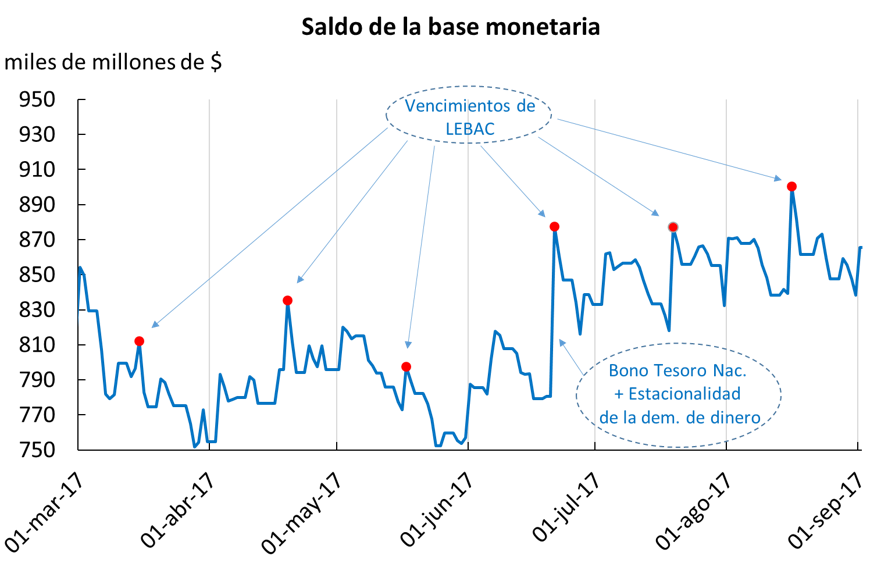
We could do the same with money issued for the reserve accumulation program. Pesos are issued to buy foreign currency, and you can see how, in the following days, this monetary surplus is absorbed by the BCRA. Taking into account the purchases of foreign currency since the objective of increasing international reserves was announced on April 6, the monetary base returns to its pre-purchase level, on average, within two days (1.64 days is the exact average).
As we see that the mechanism of endogenous money works smoothly, the most useful discussion of monetary policy is about the level of the interest rate, as in every country, and not about the level of aggregates. On Monday, Carlos Valdovinos (as I told you, the Governor of the Central Bank of Paraguay, which has had 3% inflation for 10 years) said, “Don’t ask me where the aggregates are; I don’t know the answer.”
My conclusion is that those who argue on the basis of aggregates are framing the discussion in terms of a monetary system that is not that of Argentina today. In a different context and with a different monetary policy, it may be an interesting discussion. I know that some economists, even those who have defended our actions, think it would be better that way, but the truth is that the Argentine operating framework today makes the discussion revolve around the level of the interest rate and not so much the aggregates.
Wage Agreements
The third thing I wanted to talk about today is wage dynamics. Obviously, an important part of the inflation targeting framework is to align the expectations of all agents in order to achieve a coordinated disinflation. If an agent does not believe disinflation will occur and adjusts prices in excess, without real productivity so justifying, they will subsequently find it difficult to sell their products when the BCRA has a sufficiently contractionary stance to drive the evolution of prices according to its objectives.
It is therefore important that wages are also in line with the ongoing process of disinflation. This means that they must have a significant “forward-looking” component in the negotiations, which in turn must also take into account the evolution of real wages in the previous collective bargaining. For example, if a trade union gets a 40% increase and inflation is 21% in the following months, it is in a different position compared to a trade union that begins the discussion with an initial increase of 15% or 20%.
We believe that this was perhaps the factor that led to one of the most visible successes of the targeting system in 2017, as wage negotiations resulted in nominal increases well below those of the previous year, but were then acknowledged by the monetary authority struggling to consolidate the disinflation process going forward. In turn, trigger clauses were helpful as they reassured workers that their wages were not going to fall in real terms. Thus, smaller increases in nominal wages in 2017 compared to, for example, 2016 have actually meant an increase in real wages. In this regard, it is interesting to quote a little-known phrase of General Perón, who in one of his speeches7 said that in 1954 he had met with leaders of Argentine trade unions, who unanimously told him: “We don’t want a wage increase. We want prices not to rise.” I believe that this anecdote illustrates how important it is for Argentines to have a BCRA that is truly committed to ensuring price stability.
What I would like to ask my colleagues here is to agree on how to assess the impact of wage agreements on the disinflation process. It is important to determine the impact of real wages during the wage agreement period. This means that it does not make much sense to look only at the nominal increase, not even the total for the whole year, but it is essential to look at the time of the year they take effect, how that salary evolved over the past year, which role increases play in relation to inflation expectations over the wage agreement period, and how the small print of trigger clauses is stated.
In other words, we should focus not on a specific wage increase but on how real wages have evolved over time. They are not the same thing.
Are There a Lot of LEBACs or a Few? Are They Expensive or Cheap?
The fourth issue concerns the stock of LEBACs. Here, the criticism is based on arguments that I think are clearly erroneous, such as those that analyze the level of interest in isolation, without even distinguishing between real or nominal rates, when obviously part of the interest of the BCRA bills is compensated by inflation. But from a technical point of view, I do not give these criticisms more weight. Given the level of inflation in Argentina, it is understood that a central part of the return of an instrument in pesos compensates precisely for the increase in the general price level. These numbers can be used on some TV show or in politics, but they should not be used by an economist.
In fact, LEBACs’ ex-post interest rate was negative in real terms for much of last year. Thus, the BCRA effectively reduced its LEBAC holdings, a very different story from the one that is often told.
The most important factor, however, is that much of LEBACs’ growth is due to an intensive reserve accumulation program that the BCRA has undertaken as part of its macroeconomic consolidation strategy.
In other words, the BCRA expands its balance sheet by increasing both its assets and liabilities when making sterilized purchases of international reserves. Understanding this is fundamental because only seeing one side of the balance sheet means missing part of the movie.
We then enter the discussion of whether, and to what extent, the BCRA should accumulate reserves. Reserves create an asset for the BCRA that is valued at the time it is needed most. The accumulation of foreign assets acts as a kind of “insurance” against international fluctuations and can be seen as a very useful macroprudential measure to consolidate the country’s macroeconomic stability.
A very good paper by Eduardo Levy-Yeyati and colleagues in 20138 concludes that the evidence shows that inflation-targeting central bankers (in Latin America) intervene not to fight against fundamentals but mainly to mitigate excess volatility: they buy dollars (and thus, accumulate international reserves) when the exchange rate is overvalued relative to its equilibrium level, and sell dollars (and thus, draw down international reserves) when it is undervalued. Since the intervention is motivated in this way, the quasi-fiscal costs of these operations are not significant. The report shows that once capital gains and losses are appropriately accounted for, sterilized intervention by inflation targeters from Latin America and the Caribbean over the past decade has entailed rather low costs or, in a some cases, profits for the monetary authority.
Let’s take a look at the LEBAC numbers. At the start, our administration required a considerable sterilization effort, since it was necessary to absorb the money issued in connection with the liabilities of the BCRA in the futures market and the excess of pesos in circulation (monetary overhang) because of the foreign exchange clamp. Both factors called for the absorption of approximately ARS125 billion in our first three months.
The stock of LEBACs and net repos as of March 1, 2016, after the absorption of this monetary surplus, amounted to 7.2% of GDP. Since then, we have purchased international reserves for USD24 billion, using pesos that had to be sterilized. Therefore, this increase in assets has been followed by an increase in the institution’s liabilities. The reserves acquired to date represent an amount close to 4.1% of GDP, while the BCRA’s stock of non-monetary liabilities amounts to 11.1%. As can be seen by considering both items, in fact, the net liabilities of the BCRA have since fallen to 7% of GDP, 0.2 p.p. less than the starting point in March 2016.
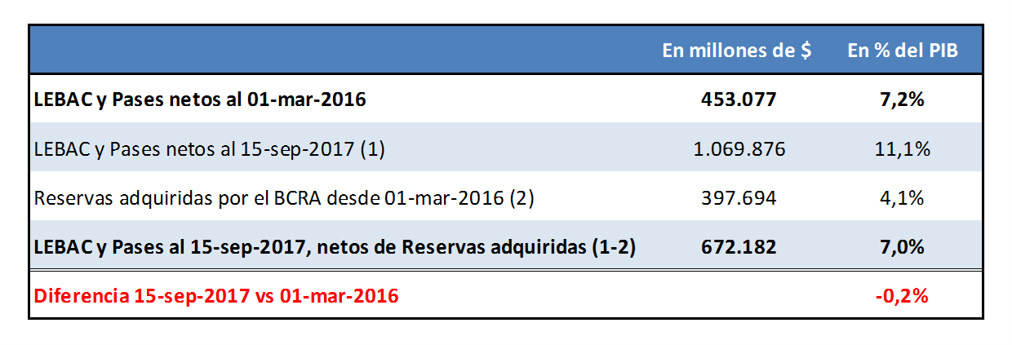
Such increases in the size of the balance sheet have been observed in central banks in almost all countries that have embarked on the sterilized increase of their international reserves. So, if you take a look at the balance sheets of the central banks of Peru, Mexico, South Africa or Brazil, to name a few, their dynamics are very similar.
The BCRA is likely to continue to accumulate reserves and expand its balance sheet. There is a debate, and I think it is a valid debate, about whether this growth in the balance sheet is appropriate or not. And it will be a debate we will continue to have once the BCRA reaches its reserves-to-GDP target ratio of 15%.
The Role of Repos
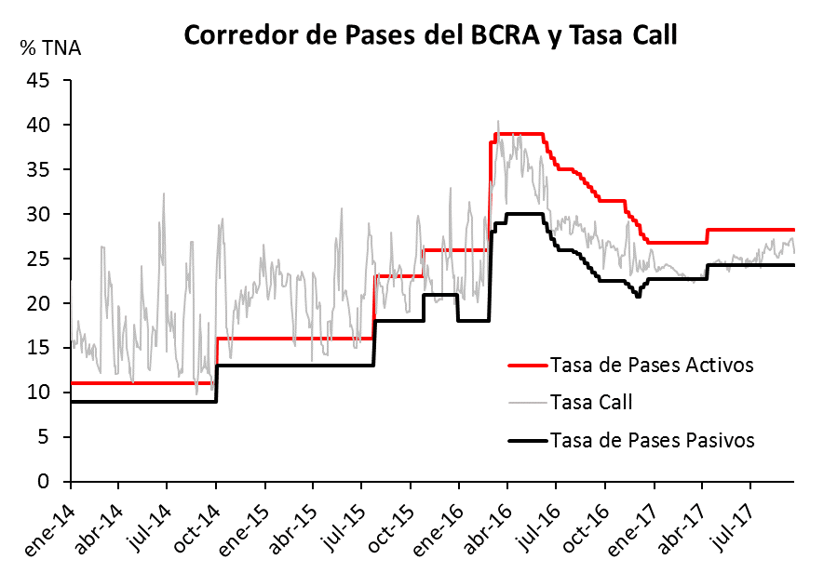
Before I conclude, I would like to make a small reference to the issue of repos. Recently, I have often seen analysts say that, as the volume of repos has declined in recent months, they are no longer an effective tool of monetary regulation. But this is not true.
Repos come into play when interest rates deviate from the middle of the repo corridor, since their role is precisely to induce interest rates to move within the range of the corridor set by the monetary authority. At the beginning of the year, the sum of several liquidity shocks and a more than necessary ex-post easing by the monetary authority, given the low inflation records in December and January, brought market rates down to the floor of the corridor. It is not surprising, therefore, that the BCRA accumulated a large amount of reverse repos during this period.
The contractionary cycle that followed managed to place market rates more in the middle of such corridor and even pushed them to the ceiling. Therefore, it is not at all surprising that the stock of reverse repos deflated by that time. Indeed, it was replaced by some repos in the days before the last auction.
The fact that market rates lie within the corridor just proves that it is more operational than ever.
I hope that today’s remarks will help to clarify some aspects of monetary policy in Argentina. It seemed appropriate to express the technical view of the BCRA regarding these issues, and hopefully these comments will serve to deepen the analytical treatment of this type of discussion.
Thank you.
1 Tommasi, M. (1994): “The Consequences of Price Instability on Search Markets: Toward Understanding the Effects of Inflation.” American Economic Review, American Economic Association, vol. 84(5), pp. 1385-96, December.
2 De Gregorio, J. and Sturzenegger, F. (1997): “Financial markets and inflation under imperfect information.” Journal of Development Economics, vol. 54(1), pp. 149-168.
3 Passage from a speech by Peter Praet, member of the Executive Board of the European Central Bank, at the LUISS School of European Political Economy, April 4, 2016, Rome.
4 Sargent, T. and Wallace, N. (1981): “Some Unpleasant Monetarist Arithmetic.” Federal Reserve Bank of Minneapolis Quarterly Review, vol. 5, pp. 1-17
5 See, for example, “An Association Between Cash Intensity and Construction Activity.” Article published on September 27, 2017, in the BCRA’s blog called Ideas de Peso
6 See the presentation of the Monetary Policy Report of April 2017
7 Presentation of Juan Domingo Perón to the General Confederation of Labor (Confederación General del Trabajo, CGT) during his third presidency (1973).
8 De la Torre, A.; Levy-Yeyati, E. and Pienknagura, S. (2013): “Latin America’s Deceleration and the Exchange Rate Buffer.” LAC Semiannual Report, October, World Bank.


