The Association of Argentine Banks (Asociación de Bancos Argentinos, ADEBA) provided the BCRA with updated information on the gross income tax levied on financial institutions in several provinces of Argentina.
The ADEBA report, dated July 3, 2025, details gross income tax application, together with the changes recorded in each province, taking into account the tax rate and tax base, among other parameters.
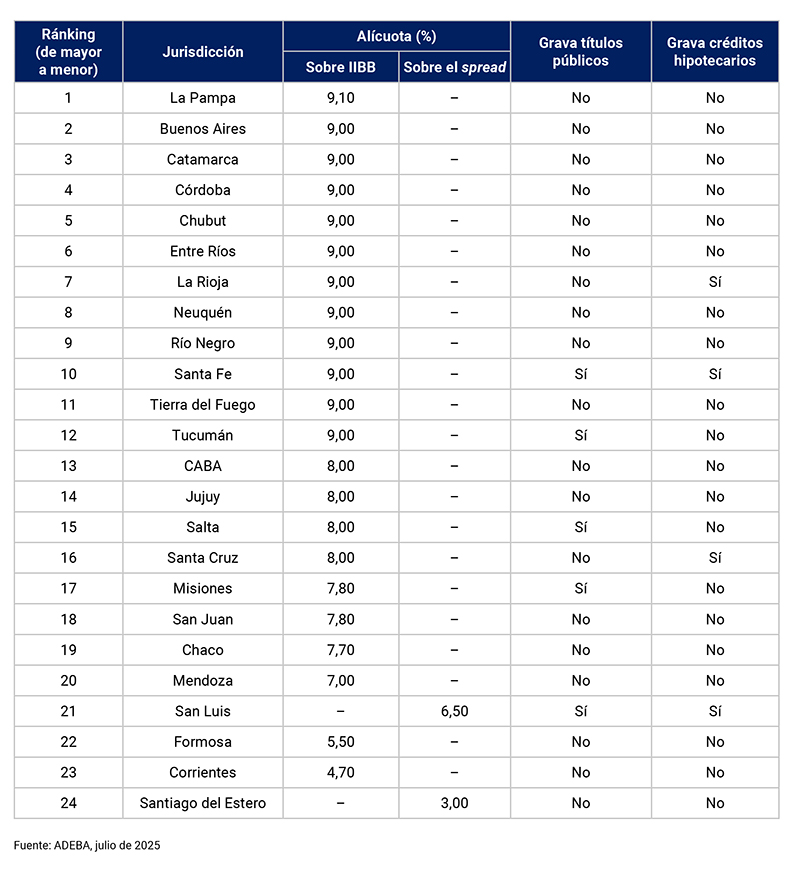
ADEBA highlights that, until 2003, the tax base in all provinces was calculated upon the difference between the total credit in income statement accounts and the interest and liability adjustment (spread), according to their enforceability in the relevant tax period. In 2004, the Autonomous City of Buenos Aires changed the tax base by taking the total credit in income statement accounts for calculation—without allowing any deduction. This change meant a significant increase in the gross income tax rate. Eventually, the other provinces adopted the same criteria.
According to this report, San Luis and Santiago del Estero are currently the only provinces that continue to use the spread as a basis for the tax base calculation.
In addition to this, ADEBA points out that in 2004 the tax rates applied were considerably lower. For example, the tax rate for the Autonomous City of Buenos Aires was 5% (currently 8%), for the Province of Buenos Aires, 6% (currently 9%), for Córdoba, 3.5% (currently 9%), and for Mendoza, 4% (currently 7%).
The ADEBA report also specifies which provinces include government securities and mortgage loans in their gross income tax base. The inclusion of these items in the gross income tax base levied by the provinces also increases the cost of public credit and mortgage loans to individuals, thereby hindering the development of Argentina’s economy.


