MONETARY AND BANKING CONFERENCE 2022
Challenges of the new global context for macroeconomic stability and growth
SPEAKERS
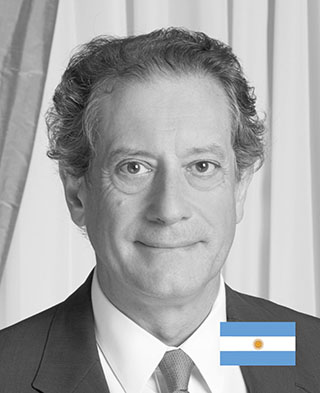
Miguel Ángel Pesce
Miguel Ángel Pesce has served as president of the Central Bank of the Argentine Republic since December 2019. He has a degree in Economics, graduated from the Faculty of Economic Sciences of the University of Buenos Aires (1981-1987).
Pesce was president of the Bank of the Province of Tierra del Fuego (between 2015 and 2019), director at YPF S.A. (2019) and vice president of the Central Bank of the Argentine Republic (BCRA), between 2004 and 2015. He was also president of the Trust Fund for the Reconstruction of Companies, representative of the Ministry of Economy and Production at the BCRA (between 2003 and 2004) and Minister of Economy, of the Federal Intervention, in Santiago del Estero, in 2004. In that same year he was general syndic of the Nation. In the City of Buenos Aires, he was Secretary of Treasury and Finance (between 2001 and 2003) and Undersecretary of Financial Management and Administration (from 1998 to 2001). In the Chamber of Deputies of the Nation, he was an advisor in the Finance and Budget and Finance Commissions (1984-1989).
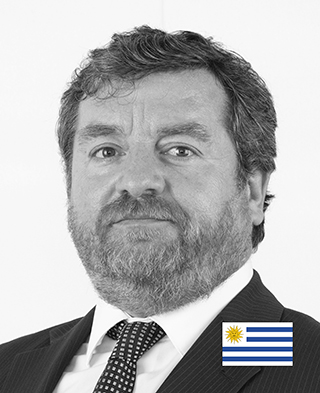
Mario Cimoli
Mario Cimoli has been former acting executive secretary of the Economic Commission for Latin America and the Caribbean (ECLAC) since October 2022. Previously, he was the Deputy Executive Secretary of ECLAC, being responsible for supervising and coordinating multidisciplinary and interdivisional working groups, substantive institutional documents and advising ECLAC member governments on development issues. He also served as director of the Productive and Business Development Division since 2010.
Mr. Cimoli holds a Ph.D. from the University of Sussex in the United Kingdom and is a Senior Lecturer in Political Economy at Ca’ Foscari University in Venice, Italy. Prior to joining the United Nations, he had an extensive career as a visiting professor and researcher at various academic institutions, including the universities of Udine, Pisa, and Pavia in Italy, the Metropolitan Autonomous University of Mexico (UAM), and the National University of General Sarmiento in Argentina.
His extensive publication record reflects a substantial contribution in theories and policies for development, particularly in the fields of micro and macroeconomic policies, with a focus on development pathways, economic growth, and the interconnections between industrial policy, technological development, and innovation.
His most recent publications include: Industrial Policies, Patterns of Learning and Development: An Evolutionary Perspective (2020); Choosing sides in the trilemma: international financial cycles and structural change in developing economies (2020); and A technology gap interpretation of growth paths in Asia and Latin America (2019). These complement his seminal works: Learning, Technological Capabilities and Structural Dynamics (2011); Innovation and Economic Development: The Impact of Information and Communication Technologies in Latin America (2010); Industrial Policy and Development, The Political Economy of Capabilities Accumulation (with Dosi, G. and J. E. Stiglitz, 2009); and Institutions and policies in developing economies (with Dosi, G., R. R. Nelson, and J. E. Stiglitz, 2009).
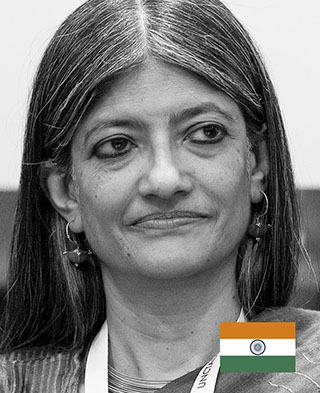
Jayati Ghosh
Jayati Ghosh taught economics at Jawaharlal Nehru University, India, for nearly 35 years, and is currently a professor of economics at the University of Massachusetts Amherst, USA. He is a member of the World Health Organization’s Health Economics Council, the United Nations Advisory Board on Economic and Social Affairs, and the Secretary-General’s High-Level Advisory Board for Effective Multilateralism of the United Nations.
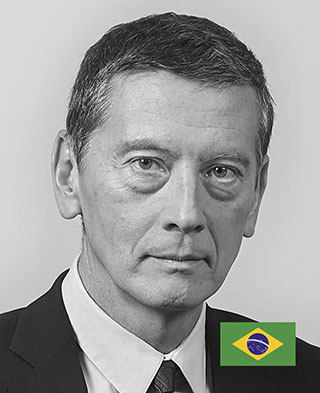
Luiz Awazu Pereira da Silva
Luiz Awazu Pereira da Silva has been Deputy Director General of the BIS since October 2015. Prior to joining the BIS, Mr. Pereira da Silva, a Brazilian national, had served as Vice President of the Central Bank of Brazil since 2010. And before that, he held various positions at the World Bank in Washington D.C., Tokyo, and Southern Africa. He also held the position of Chief Economist at Brazil’s Ministry of Budget and Planning and Brazil’s Deputy Minister of Finance in charge of international affairs.
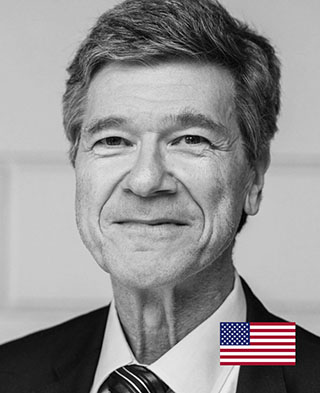
Jeffrey D. Sachs
Jeffrey D. Sachs is a university professor and director of the Center for Sustainable Development at Columbia University, USA, where he directed the Earth Institute from 2002 to 2016. He is president of the United Nations Sustainable Development Solutions Network, chair of the Lancet COVID 19 Commission, co-chair of the Council of Engineers for the Energy Transition, commissioner of the United Nations Broadband Commission for Development, academician of the Pontifical Academy of Social Sciences in the Vatican, and Honorary Distinguished Professor “Tan Sri Jeffrey Cheah” at Sunway University. He advised three United Nations Secretary-Generals and is currently Special Advisor on the Sustainable Development Goals to United Nations Secretary-General António Guterres.
He was a professor for more than 20 years at Harvard University, USA, where he obtained his bachelor’s, master’s and doctorate degrees in Economics. Sachs has received 40 honorary doctorates, and his recent awards include the Tang Prize in Sustainable Development in 2022, the Legion of Honor by decree of the President of the Republic of France, and the Order of the Cross of the President of Estonia. His most recent book is The Ages of Globalization: Geography, Technology, and Institutions, published in 2020.
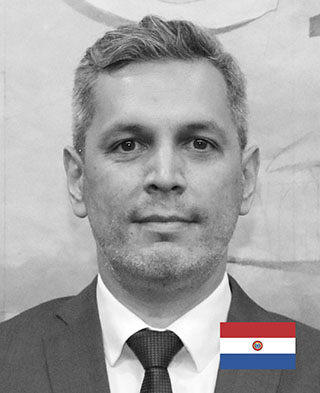
Humberto Colmán Castillo
Humberto Colmán Castillo is a Member of the Board of Directors of the Central Bank of Paraguay. Postgraduate in Applied Macroeconomics from the Pontificia Universidad Católica de Chile and Economist from the National University of Asunción. He took courses on economic growth and finance at Harvard University and Columbia University in the United States. He is Professor of Macroeconomics at the Universidad Católica Nuestra Señora de la Asunción, Paraguay. He was Deputy Minister of Economy of the Ministry of Finance and since August 2020 he has been a full member of the Board of Directors of the Central Bank of Paraguay.
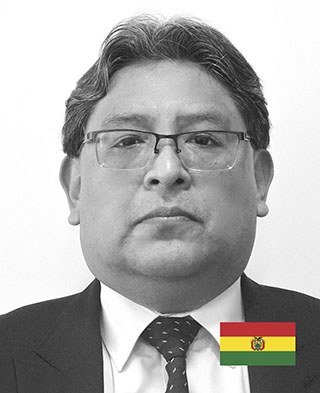
Roger Edwin Rojas Ulo
Roger Edwin Rojas Ulo is interim president of the Central Bank of Bolivia.
Ph.D. in Development Sciences (Ph.D.) from the Universidad Mayor de San Andrés (UMSA) in Bolivia with a master’s degree in Economics and Public Policy from the Torcuato Di Tella Institute in Argentina. He has a degree in Economics from UMSA and completed professional refresher courses in the USA, Brazil and Korea.
He was advisor and senior advisor to the Board of Directors of the International Monetary Fund (2017-2020), director of the Productive Development Bank (2016 and 2017), deputy minister of the Treasury and Public Credit of the Ministry of Economy and Public Finance (2008-2015), director general of Public Credit (2006-2008) and economic researcher (2001-2006) at the Ministry of Finance. He was also an external consultant in different international organizations and a research professor of Postgraduate Studies in Development Sciences CIDES-UMSA.
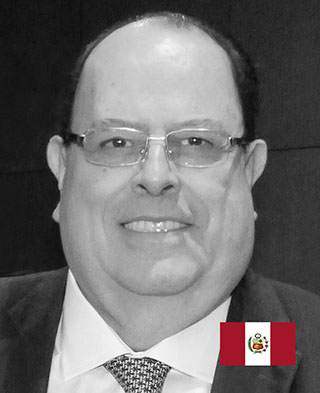
Julio Velarde
Julio Velarde has been governor of the Central Reserve Bank of Peru (BCRP) since October 2006. In this role, he has received several awards such as Central Banker of the Americas in 2022, Central Banker of the Year for the Americas in 2020 and Global Central Banker of the Year in 2015 by The Banker & The Financial Times, among other notable honors.
Governor Velarde previously served as director of the BCRP during 1990-1992 and 2001-2003 and as chair of the Advisory Council for the Americas of the BIS (2018-2020); he also served as Chair of the G24 on International and Monetary Affairs (2018-2019) and as Chairman of the Board of Directors of the Center for Latin American Monetary Studies (2007-2009). He has served as executive president of the Latin American Reserve Fund (2004-2006) and was dean of the Faculty of Economics at the Universidad del Pacífico in Peru (2001-2003).
Governor Velarde holds a master’s degree in Economics from Brown University, USA, where he also completed doctoral studies, and a bachelor’s degree in Economics from the Universidad del Pacífico in Peru.