$2 Bill
Design
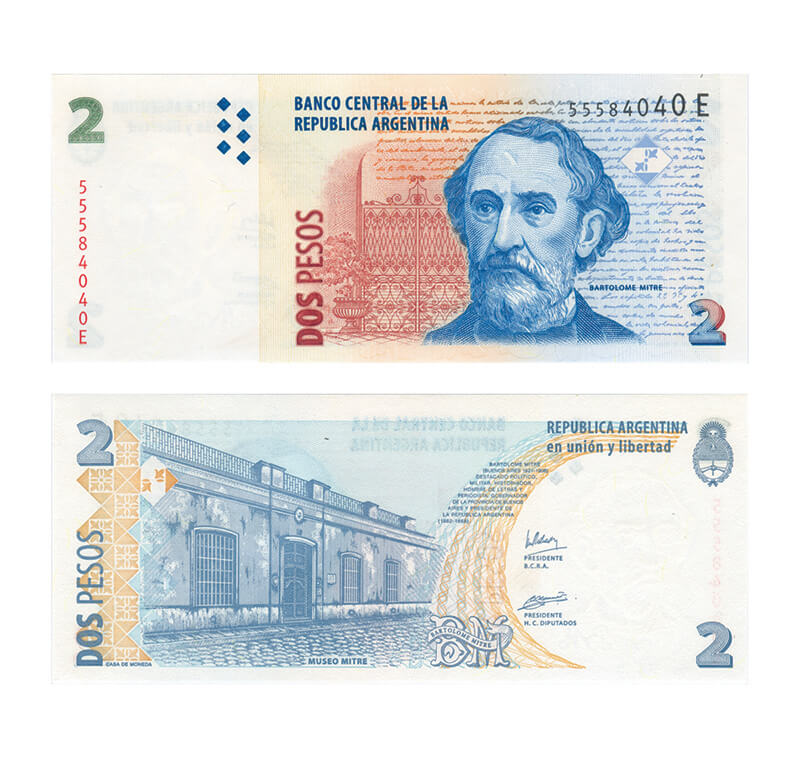
The bill’s design illustrates the life of General Bartolomé Mitre (1821-1906).
Bartolomé Mitre
From a young age, he participated in the country’s political and military conflicts, both before and after the enactment of the National Constitution (1853). He played a decisive role in the agreement of the union pact that enshrined the reform of the Magna Carta.
He was appointed Governor of the Province of Buenos Aires, and in 1862, he was elected President of the Republic. He initiated a government action that laid the basic guidelines for the organization and pacification of the country.
After completing his term, he carried out diplomatic efforts with Brazil. Away from political action, he took refuge in intense intellectual work (in 1858 he had published History of Belgrano and the Argentine Independence). He undertook the elaboration of History of San Martín and the South American Emancipation. He carried out other historical studies, engaged in poetry and the translation of classics. He intervened in the crisis of 1880 and in the revolution of 1890. From the pages of the newspaper “La Nación”, founded in 1870, he made his influence felt on national events.
Obverse
The main motifs are printed in intaglio, and the backgrounds in offset. In the main imprint, the portrait of the hero can be seen, and in the backgrounds, the replica of a handwritten text corresponding to the “History of Belgrano and of the Argentine Independence”, as well as the reproduction of the front gate of his house.
Reverse
The entire design is printed in offset.
You can see the house of Bartolomé Mitre, current seat of the homonymous Museum, an exponent of the architectural structure of the 19th-century residence. In 1869, it was donated to General Mitre by popular subscription, and in 1906, the State acquired it to turn it into a Museum. The site was declared a National Historic Monument in 1942. In addition, a biographical synthesis of the hero in microprint, the initials of his name, and the typical tiles of the time can be observed.